
A second passport can mean citizenship in another country or an additional passport book issued to an eligible U.S. citizen. These are different outcomes: one follows the acquisition of another nationality, while the other supports specific travel needs without changing citizenship.
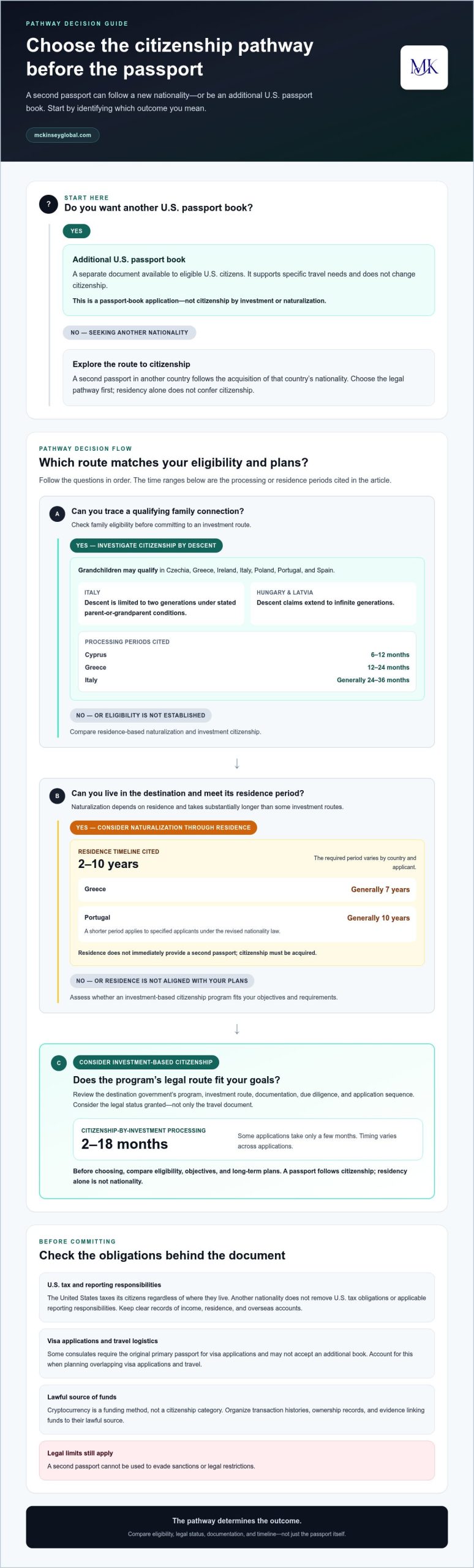
For investors, the central decision is which route aligns with their eligibility, objectives, and long-term plans. Citizenship by investment processing ranges from two to 18 months, while naturalization through residence can take substantially longer. A second passport is therefore an outcome to assess alongside the legal pathway, not a standalone application category.
This guide explains how investment applications work and what to consider about costs, validity, and processing time. It also compares investment with ancestry and residence-based routes to help you decide which second passport pathway to explore.
Key Takeaways
- Distinguish an additional U.S. passport book from citizenship in another country before choosing an application route.
- Compare investment, ancestry, and residence-based pathways against your eligibility, objectives, and expected timeline.
- Citizenship-by-investment processing can range from two to 18 months; understand the application stages and factors that can affect timing.
- Review passport validity and visa endorsements carefully, since a visa remains in the passport book where it was issued.
Citizenship by investment
Compare citizenship by investment with citizenship by descent and naturalization before choosing a route. A second passport may follow the acquisition of another nationality, but an additional U.S. passport book is a separate document available to eligible citizens.
-
Evaluate Investment-Based Citizenship
Assess the destination government’s program, investment route, documentation, due diligence, and application sequence. Citizenship-by-investment processing ranges from two to 18 months, though some applications take only a few months. Consider the legal status granted, not just the travel document: a second passport follows citizenship, while residency does not itself confer nationality. Review how the program’s requirements align with your objectives and future plans.
-
Review Dual Citizenship and U.S. Reporting
Consider tax and travel obligations before acquiring another nationality. The United States taxes its citizens regardless of where they live, so foreign citizenship does not remove U.S. tax obligations. A second passport also cannot be used to evade sanctions or legal restrictions. Some consulates require an applicant’s original primary passport for visa applications and will not accept an additional book, which can affect travel plans.
Dual citizenship does not exempt U.S. citizens from applicable reporting responsibilities. Keep clear records of income, residence, and overseas accounts, and consider how each country’s rules apply to your circumstances.
-
Assess Residency Pathways for Americans
Compare residence-based naturalization with investment citizenship by reviewing the residence period and whether you can live in the destination. Naturalization timelines range from two to 10 years of residence. Greece generally has a seven-year pathway, while Portugal generally requires 10 years under its revised nationality law, with a shorter period for specified applicants. Residency remains distinct from citizenship and does not immediately provide a second passport.
- Trace family eligibility before committing to an investment route. Czechia, Greece, Ireland, Italy, Poland, Portugal, and Spain offer citizenship by descent to grandchildren. Italy limits descent to two generations under stated parent-or-grandparent conditions, while Hungary and Latvia extend descent claims to infinite generations. Processing periods differ: Cyprus takes approximately 6 to 12 months, Greece 12 to 24 months, and Italy generally 24 to 36 months.
- Treat cryptocurrency as a funding method that requires careful documentation, not as a citizenship category. Before applying, organize transaction histories, ownership records, and evidence connecting funds to their lawful source. Clear records help explain how funds were acquired and transferred. This preparation matters whether you pursue a second passport through investment or another qualifying route.
Submitting applications in the United States or abroad
For an additional U.S. passport book, prepare your valid existing passport, supporting letter, two identical photos, and applicable form. Applying for a second passport book is different from acquiring citizenship abroad, so first identify which process fits your goal. Travel access and visa requirements depend on the citizenship and destination involved.
-
Gather Required Application Documents
Assemble a complete application file before submitting it. Include your valid existing passport, two identical passport photos, and a supporting letter explaining the ongoing need for another passport book. An employer’s letter should describe frequent travel needs; self-employed applicants should use company letterhead. Keep your statement to one page and explain how visa applications overlap with travel.
-
Select the Correct Application Form
Use Form DS-82 if you can submit your current valid passport and meet renewal requirements. If you cannot submit it, or do not qualify for renewal, apply in person using Form DS-11. A passport issued before you turned 16 may make you ineligible for DS-82. A passport issued more than 15 years ago is another example of a renewal barrier.
Read the form instructions carefully and identify your request as an additional passport, not a replacement. In the application’s “other information” section, state that you are applying for a second passport and do not want your current passport cancelled. This makes your intended document status clear.
- Pay the applicable passport book fee and account for the submission method. The U.S. An applicant using Form DS-11 in person must also pay a $35 acceptance fee; the application does not carry a $35 execution fee. Keep payment details with the application documentation.
-
Review Fees and Expedited Processing
Plan your application around travel dates, and distinguish the passport book fee from any acceptance fee. Expedited processing is a timing option, not a substitute for eligibility or complete documentation. Review the applicable application instructions for service and delivery arrangements, and allow time for document handling and processing.
- Submit through the method required by your form. DS-11 applicants apply in person, while eligible DS-82 applicants may submit their application with the existing passport. If applying abroad, follow the U.S. passport application process through the relevant U.S. consular channel. Keep copies of your application and supporting letter.
- Assess travel access separately from the application. Visa-free entry varies by nationality and destination; an additional U.S. passport book does not create different citizenship rights. Check each destination’s entry conditions, and remember that some consulates require the original primary passport for visa applications. If your objective is residence rather than another passport, UAE residency solutions are a separate pathway.
Second passport validity and endorsement
A U.S. citizen may use an additional U.S. passport for travel to or from the United States, but it does not create another nationality. A second U.S. passport is typically valid for four years, compared with ten years for a standard U.S. passport.
- Record the issue and expiry dates of both passport books as soon as they are issued. The additional book typically expires after four years, so schedule a renewal review about three and a half years after issuance. Track the primary book’s ten-year validity period separately.
- Match each visa to the passport book in which it was issued. A visa remains valid only in that specific book and does not transfer to another passport. For example, if a foreign visa is in your primary passport, presenting only the additional book does not transfer the visa to it.
- Before each trip, identify which passport contains the required visa and which book you will present. If a consulate requires your original primary passport for a visa application, the additional book may not meet that requirement. Plan the application around any travel already scheduled with the original document.
- Check the destination’s passport-validity requirements before departure. U.S. travelers should confirm whether the passport book they plan to present at the border meets the destination’s six-month validity rule. Check the book you will actually carry, rather than assuming the other passport’s later expiry protects your itinerary.
- Keep both books secure and distinguish them in your travel records. Note each passport number, expiry date, visa location, and relevant entry stamps to help you select the correct book for a later trip. When one book is submitted to a consulate, the other may support travel planning, but it cannot replace a visa attached to the submitted book.
- Reassess your travel plans whenever a passport is submitted abroad, renewed, or nearing expiry. An additional U.S. passport’s four-year validity can mean a different replacement schedule from the primary book’s ten-year cycle. Update reservations and visa application records when a passport number changes so your documents refer to the correct book.
- Use a consistent document sequence at each border: carry the passport containing the relevant visa, present that same book for the related journey, and keep the other secure. A second passport cannot be used to evade sanctions or legal restrictions. Separate books offer an administrative option for frequent travel, not an exemption from another nation’s entry rules.
How a second passport differs from a replacement passport
Identify whether you need an additional travel document or a replacement for a book you already held. For U.S. citizens, eligibility for an additional passport book depends on holding a valid U.S. passport book.
- Start by checking the status of your current U.S. passport. If it remains valid and you need another book for frequent travel, you may qualify for an additional passport. If you do not hold a valid passport book, the additional-book route does not meet the eligibility requirement.
- Define the purpose of your application before gathering documents. An additional book addresses the need for two usable passport books; a replacement addresses the loss or end of use of an existing document. These are different requests, so describe your situation accurately on the official application.
- Check passport numbers before planning travel. An additional U.S. passport book has a different number from the holder’s other book. Keep both numbers distinct in airline reservations, visa records, and travel files; a reservation using one number may not match the book you present later.
- Check where your existing visas and entry records appear. A visa is valid only in the passport book where it was issued and does not transfer to another book. If you apply for an additional document while a visa remains in your original passport, plan to carry the book containing that visa.
- Match the requested outcome to your travel circumstances. Frequent travel with overlapping visa applications can explain why two books are useful; replacing a document does not create a second nationality. A passport issued by another country requires citizenship there, not simply a replacement request or a second U.S. book.
- Review the information on each official document after issuance. Confirm that the name and passport number match the travel records associated with that book. If a visa application, ticket, or booking uses the other number, correct the record before departure rather than assuming the books are interchangeable.
- Keep a clear record of which document you are seeking and why. For example, a U.S. citizen with a valid passport and frequent international travel may seek an additional book; someone without a valid passport book needs to pursue the appropriate passport application instead. Distinguishing these situations helps align eligibility, documentation, and intended use.
Investment program costs and processing times
Compare total commitment and processing stages, not headline figures alone. Citizenship-by-investment processing times range from two to 18 months, while some applications take only a few months.
- Separate the investment commitment from application-related expenses when comparing programs. A qualifying contribution or investment is only one part of the financial plan; due diligence, government processing, and document preparation can also affect total costs. List each category separately, then compare programs using consistent cost assumptions.
- Check what each investment route requires you to hold. A contribution and an investment asset have different financial profiles: one may be a direct payment, while another may involve maintaining an eligible asset. Confirm the route’s holding conditions and include them in your liquidity and exit planning.
- Build your timeline around the full application sequence, not just the final decision. Citizenship-by-investment processing spans two to 18 months, and some cases can take a few months. Document preparation, due diligence, government review, and completing the qualifying investment all shape the overall schedule.
- Prepare international source-of-funds documentation before submission. Organize records showing how funds were earned, transferred, and held, and make sure names and transaction details align across documents. For cryptocurrency proceeds, keep transaction histories and records connecting digital assets to lawful funds.
- Compare programs against your actual objective. If you need citizenship, assess a citizenship-by-investment route; if residence is your priority, compare residency programs and their requirements separately. Greece Residency by Investment, for example, is a residency route, not an immediate citizenship grant.
- Request a complete cost breakdown after identifying the route and applicant circumstances. The price depends on the case and is provided after a quote request; relevant factors include the chosen program, applicant composition, investment structure, and required application steps. Do not treat a headline contribution as the full budget.
- Set a decision deadline only after accounting for document readiness, review stages, and investment completion. A short processing estimate does not remove due diligence or mean every case follows the same schedule. Align any planned move, business transaction, or travel with the program’s sequence rather than relying on a single headline timeline.
For a structured review of program fit, discuss your citizenship or residency options in light of your investment objectives and timing.
McKinsey Citizenship and Residency Solutions: Antigua and Barbuda Citizenship by Investment
McKinsey Citizenship and Residency Solutions helps investors assess citizenship and residency pathways, including Antigua and Barbuda Citizenship by Investment. Turn to the firm after comparing investment with residence-based routes, when you want structured guidance on program selection, application preparation, and procedural requirements.
Citizenship-by-investment pathways to consider include Antigua and Barbuda, St. Kitts and Nevis, and Dominica. Greece Residency by Investment is a separate option for investors whose objective is residence rather than immediate citizenship. The right route depends on your eligibility, mobility priorities, investment objectives, and preferred long-term status. Compare these factors first to make the next steps more focused.
To discuss available pathways, contact McKinsey Citizenship and Residency Solutions or visit mckinseyglobal.com.
Make Your Next Move With a Clear Objective
Before pursuing a second passport, define the outcome you need most: broader travel options, a place to reside, or a structured route to another citizenship. Weigh that objective against your family’s plans, willingness to meet program requirements, investment priorities, and long-term international commitments. A clear priority helps distinguish a citizenship pathway from a residency option and focus on the application decisions that matter to your circumstances.
McKinsey Citizenship and Residency Solutions can guide applicants considering Antigua and Barbuda Citizenship by Investment, St. Kitts and Nevis Citizenship, or Greece Residency by Investment. Each represents a distinct pathway, so the next step is to assess which aligns with your intended status and future plans. Bring your priorities and questions to the discussion; a focused review can help you proceed with greater clarity.
Contact McKinsey Citizenship and Residency Solutions to discuss your options and take the next step with confidence.
Frequently Asked Questions
What does “second passport” mean?
It can mean either an additional passport book or a passport issued after acquiring citizenship in another country. These are different legal situations: an additional U.S. passport book belongs to a U.S. citizen, while a foreign passport represents another citizenship. Before applying, identify whether you need another travel document or are seeking nationality through ancestry, investment, or naturalization, since each route has different eligibility criteria.
Can I apply for a second passport if my first one is expired?
An expired U.S. passport does not meet the requirement for an additional passport book, which is available only to someone who already holds a valid U.S. passport book. Consider whether you need a new U.S. passport instead, and choose the application route that fits your circumstances. If you mean a passport from another country, eligibility depends on that country’s citizenship rules, such as descent or naturalization.
Does a second passport cost more?
A U.S. Applicants using Form DS-11 in person also pay a $35 acceptance fee; the application does not carry a $35 execution fee. These amounts concern a U.S. passport book, not citizenship by investment in another country. For foreign citizenship programs, total expenses depend on the selected route, government charges, due diligence, and applicant documentation.
What does a second passport mean?
The phrase describes a travel document held alongside another passport, but it does not always mean the holder has dual citizenship. For example, an eligible U.S. citizen may hold two valid U.S. passport books for specific travel needs. By contrast, a person who becomes a citizen of another nation may hold that nation’s passport. Check the issuing country and the citizenship the document represents.
Can a U.S. citizen legally hold a second passport?
Yes, U.S. citizens may hold two valid U.S. passport books at the same time under certain circumstances. The additional book is issued at the discretion of the U.S. Department of State and requires an ongoing, compelling need involving frequent travel and overlapping visa applications. It cannot be used to evade sanctions or legal restrictions, and it does not change the holder’s U.S. citizenship.
How can U.S. citizens obtain a second passport through ancestry or citizenship by descent?
Begin by tracing your family line and identifying the ancestor through whom you may qualify. Then review the destination country’s generational limits and documentation rules. Czechia, Greece, Ireland, Italy, Poland, Portugal, and Spain offer descent claims to grandchildren; Hungary and Latvia extend claims across infinite generations. Italy limits descent eligibility to two generations under specified parent-or-grandparent conditions. Gather civil records connecting each generation.
Which countries offer citizenship by investment and what are the costs?
Citizenship-by-investment options include Antigua and Barbuda, Dominica, St. Lucia, St. Kitts and Nevis, and Türkiye. Program costs vary by jurisdiction and route, and a headline investment does not represent the full financial commitment. Assess government charges, due diligence, documentation, and any qualifying investment structure together. Keep citizenship programs distinct from residency options, which grant a different legal status.
How long does it take to get a second passport through naturalization or investment?
Investment-based citizenship processing ranges from two to 18 months, while residence-based naturalization timelines range from two to 10 years of residence. The naturalization period depends on the destination’s rules and the applicant’s eligibility; the investment route involves program review, due diligence, and completing the qualifying investment. Compare the full pathway and its requirements, rather than treating processing time alone as the decision criterion.