Could an investment visa lead to EU citizenship? It can start a pathway, but it does not grant citizenship directly: no EU country currently offers citizenship solely in exchange for investment. The investment visa path to EU citizenship instead begins with qualifying residence, followed by meeting the destination country’s separate naturalization requirements.
That distinction matters when comparing European options. An investment that qualifies for residence may not shorten the citizenship timeline, and requirements for physical presence, integration, and qualifying investments differ by country and can change. The right pathway depends on eligibility as well as how you and your family intend to live.
This article explains the legal sequence from investment residence to a possible citizenship application and the criteria to consider when assessing jurisdictions such as Portugal and Greece. McKinsey Citizenship and Residency Solutions is an independent advisory firm, not affiliated with McKinsey & Company, and supports investment migration planning. You’ll learn how to compare residence conditions, naturalization requirements, and compliance obligations, then identify a practical next step aligned with your long-term objectives.
Key Takeaways
- An investment visa can provide a route to residence, but citizenship depends on a separate national naturalization process.
- Understand the investment visa path to EU citizenship by separating investment eligibility, residence compliance, and later nationality requirements.
- Compare Portugal and Greece by investment category, residence conditions, physical presence, and naturalization rules, not by investment threshold alone.
- Assess how your residence intentions, family objectives, investment liquidity, and ability to meet ongoing obligations affect jurisdiction fit.
- Prepare for a disciplined application process by organizing your goals and supporting documents, then assessing suitable pathways and next steps.
Investment Visa to EU Citizenship: What the Pathway Actually Means
In brief: Investment residence is permission to live in a country after meeting the requirements of a qualifying investment route. Permanent residence, where available, is a more durable residence status, but it is not nationality. National citizenship is membership of a particular country under its laws. EU citizenship follows from being a national of an EU member state. It is not granted through a separate EU investment visa.
This distinction is central to any investment visa path to EU citizenship. An investor may qualify for a residence permit through an investment route, sometimes called a Golden Visa. The permit grants residence rights under the issuing country’s rules; it does not provide an EU passport or automatically convert into permanent residence or citizenship. The Golden Visa programs overview provides background on the term, while each country’s current laws determine the specific rights and requirements.
Does an investment visa grant EU citizenship directly?
No. Residence permission and nationality are distinct legal statuses. An investment route may allow an applicant to reside in a participating country, subject to the program’s requirements, but EU citizenship follows only if that country later grants the individual its nationality. EU citizenship is attached to member-state nationality, not to the investment or residence permit itself.
An approved residence application is therefore not a promise of permanent residence, naturalization, or an EU passport. Distinguish what the initial permit provides from what a later citizenship application would require. Approval at one stage does not determine the outcome of another.
How can residence lead to a citizenship application?
Naturalization is a separate legal process assessed under the relevant country’s rules. Depending on the jurisdiction, an applicant may need to establish qualifying lawful residence, meet language or integration standards, and satisfy other statutory conditions. The applicable residence period and how time is counted can vary, so verify the current rules for the country and the applicant’s circumstances.
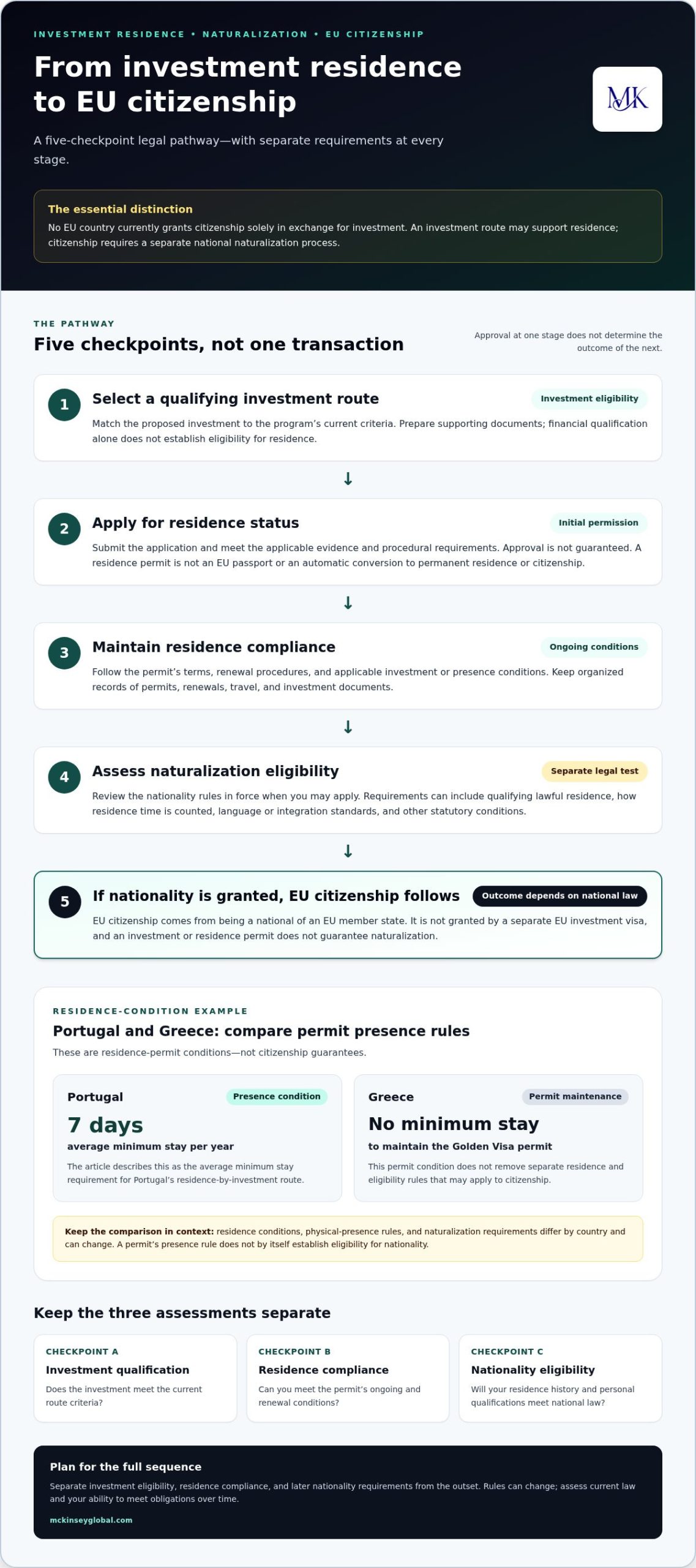
The broad sequence has several distinct checkpoints:
- Select a qualifying route: Identify an investment category that meets the program’s current criteria.
- Obtain residence status: Submit an application and meet the applicable evidentiary and procedural requirements. Approval is not guaranteed.
- Maintain compliance: Continue to satisfy the permit’s conditions, including any applicable investment, renewal, or residence obligations.
- Assess naturalization eligibility: At a later stage, determine whether your residence history and personal qualifications meet the country’s nationality rules.
For planning, keep investment qualification, residence compliance, and eventual nationality eligibility separate. A route with manageable residence conditions may still require a substantial commitment to the country to support naturalization. Rules can change, so assess current law and your ability to meet obligations over time. Do not treat an investment as a guaranteed citizenship outcome.
How Investment Residence Can Become a Naturalization Pathway
An investment visa path to EU citizenship involves a sequence of legal assessments, not a single transaction. The investment may support an initial residence application, but the residence permit, renewal conditions, and any later citizenship application each have distinct requirements. Plan for all three stages from the outset.
- Set the objective. Decide whether your priority is residence flexibility, establishing a home, including family members, or eventual eligibility to apply for citizenship. The amount of time you intend to spend in the country can influence which route is practical.
- Assess the investment route. Match the proposed investment to current program criteria and prepare the supporting documents required for the application. Financial qualification alone does not establish eligibility for residence.
- Apply for and maintain residence. After approval, follow the permit’s terms, renewal procedures, and any continuing investment or presence conditions. Keep organized records of permits, renewals, travel, and investment documents.
- Reassess naturalization eligibility. At the relevant point, review the nationality law then in force, including how qualifying residence is counted and whether language, integration, or other conditions apply. Meeting the initial investment criteria does not prove eligibility for naturalization.
What conditions may apply after residence approval?
Residence conditions vary by program, so do not infer them from the label “Golden Visa.” For example, Portugal’s residence-by-investment route has an average minimum stay requirement of seven days per year, while Greece’s Golden Visa has no minimum stay requirement for maintaining that permit. These program conditions do not bypass the separate residence and eligibility rules that may apply to citizenship.
For each renewal, keep clear records of required filings, investment status, travel dates, and communications relating to the permit. Language and integration requirements, where applicable, belong to the relevant country’s naturalization rules. Do not assume they apply identically across jurisdictions. Confirm current requirements before relying on them in a long-term plan.
Why can citizenship rules change during a long-term plan?
Immigration and nationality laws can change while a person holds residence or prepares a future naturalization application. Portugal illustrates why the legal position needs to be checked during planning: under rules verified as of October 2026, the general naturalization residence period for most foreign nationals became ten years on May 19, 2026; it is seven years for nationals of Portuguese-speaking countries in the CPLP and EU member-state nationals. How these rules apply to an individual, including how residence is counted, requires legal assessment.
Use current law as the basis for decisions, while recognizing that future requirements are not assured. An advisory review can help align objectives, jurisdiction choice, and application preparation. McKinsey Citizenship and Residency Solutions provides investment residency planning to help structure a comparison without promising approval or eventual citizenship.
Comparing European Investment Routes Without Confusing Residence and Citizenship
A useful comparison looks beyond the qualifying investment to the residence rights it supports, the conditions for keeping that status, and the separate rules for later naturalization. Portugal and Greece show why investment residence should not be treated as a single, uniform route to an EU passport.
| Comparison point | Portugal Golden Visa | Greece Golden Visa |
|---|---|---|
| Qualifying investment examples | Options include a minimum €500,000 investment in a regulated fund, qualifying business investment and job creation from €500,000, and donation routes starting at €200,000 or €250,000. Real estate is no longer a qualifying option. | Options include real estate, with thresholds of €800,000 in designated high-demand areas, €400,000 in many other areas, and €250,000 for qualifying conversions or restoration projects. A qualifying startup investment route also starts at €250,000. |
| Presence to maintain investment residence | An average of seven days per year. | No minimum stay requirement for the Golden Visa permit. |
| Possible naturalization assessment | As of October 2026, the general qualifying residence period is ten years for most foreign nationals, and seven years for nationals of CPLP countries and EU member states. | May be eligible to apply after living in Greece for at least seven years, subject to applicable naturalization requirements. |
These figures describe different stages. The investment category and presence expectation relate to residence, while naturalization depends on national law and the applicant’s circumstances. Portugal’s nationality period and Greece’s requirement to live in the country make it important to distinguish permit-maintenance rules from the residence conditions relevant to citizenship. For more country-specific context, the Greece residency by investment guide covers the Greek route in greater detail.
Which criteria matter when comparing investment residence?
Start with your objectives: whether family members need to be included, how much time you expect to spend in the country, how the investment is structured, and what long-term mobility means for your household. Then compare renewal duties, qualifying investment conditions, presence expectations, and the practical requirements of a later naturalization application. Headline claims can obscure important differences. A like-for-like assessment is more useful than ranking programs without current, comparable evidence.
Schengen travel access is distinct from citizenship. A residence permit from a Schengen member state generally allows visa-free travel within the Schengen Area for up to 90 days in any 180-day period. It does not grant EU nationality or the broader rights attached to citizenship. Cyprus, for example, is an EU member but is not yet a full member of the Schengen Area, which shows that the two frameworks are not interchangeable.
How does investment residence differ from citizenship by investment?
Investment residence grants a residence status under a country’s immigration rules. Citizenship by investment refers to a route to nationality under the relevant country’s law. Caribbean citizenship programs, including those in the firm’s portfolio, do not themselves confer EU citizenship. For broader context on investment-route structures, see the donation versus real estate strategy guide. An investment visa path to EU citizenship may open a route, but it cannot guarantee naturalization.
How to Assess Eligibility, Investment Fit, and Long-Term Compliance
A sound assessment begins with the life you intend to build, not simply the investment category that appears most attractive. The investment visa path to EU citizenship involves separate questions of program eligibility, residence compliance, and eventual naturalization. A strong fit at the first stage does not settle the later ones.
What should an investor clarify before selecting a route?
Before comparing programs, define your intended time in Europe, family priorities, preferred legal status, and capacity to meet obligations over an extended period. Then assess whether the investment structure suits your financial plans and whether you can prepare and maintain the required documents. Investment appetite is not the same as program eligibility, and neither replaces the naturalization criteria.
- Objectives: Identify whether your priority is residence, family relocation, mobility, or the possibility of applying for citizenship later.
- Family needs: Consider which family members may need to be included and how their plans affect residence and documentation requirements.
- Residence intent: Compare the time you expect to spend in the country with the permit’s presence conditions and any separate residence rules relevant to naturalization.
- Investment fit: Review the investment’s structure, expected holding period, and liquidity in light of your financial circumstances.
- Compliance capacity: Determine whether you can meet ongoing filings, renewal steps, recordkeeping, and any applicable presence or integration requirements.
Application preparation may involve due diligence and source-of-funds documentation. Organize records explaining the origin and movement of funds, along with the identity, investment, and residence materials required by the applicable process. Clear, consistent documentation makes it easier to address questions during preparation and review, but it does not guarantee approval.
How should investors manage rule changes and compliance?
Keep dated, organized records of applications, permits, renewals, investments, travel, and supporting documents. This creates a reliable timeline if you later need to demonstrate residence history or show that program conditions were maintained. Revisit the requirements at each permit renewal and before any naturalization application, since the rules and your circumstances may have changed.
Keep three concepts separate in your planning: immigration status determines permission to reside, nationality law governs access to citizenship, and tax residence is assessed under applicable tax rules. One status does not automatically determine the others. For personal tax consequences, seek advice suited to your circumstances from a qualified tax professional. This section is not individualized tax advice.
Before committing, verify current laws, qualifying investment thresholds, processing expectations, residence conditions, and program eligibility for the relevant jurisdiction. McKinsey Citizenship and Residency Solutions is an independent advisory firm, not affiliated with McKinsey & Company. Its structured support helps organize jurisdiction comparisons and application planning, without guaranteeing eligibility, approval, or citizenship. Assess your investment residency options with a focus on fit, documentation, and long-term compliance.
Plan an Investment Visa to EU Citizenship Strategy With Clear Next Steps
A workable plan separates the outcome you want now from the possibility you may pursue later. Residence may address a near-term relocation or mobility objective, while citizenship depends on a later assessment under the destination country’s nationality law. Treat the investment visa path to EU citizenship as a long-term strategy with decision points, not as a guaranteed passport outcome.
Use this sequence to turn broad goals into a practical plan:
- Document your objectives. State whether you seek residence, a future naturalization opportunity, family relocation, or a combination. Record timing constraints and how much time you could realistically spend in Europe.
- Compare jurisdictions against those objectives. Assess current qualifying investment categories, residence conditions, family inclusion, renewal obligations, and the naturalization framework. Keep immediate residence benefits distinct from possible future citizenship.
- Assess personal eligibility and investment fit. Consider each applicant’s circumstances, the proposed investment structure, and the documents needed to support the application. A route that looks attractive on paper may not fit your residence plans or compliance capacity.
- Prepare for application management. Organize identity and family records, investment information, and supporting documents. Build a timeline for application steps, permit renewals, and future reviews of applicable rules.
What information helps structure an initial assessment?
A useful assessment begins with each applicant’s citizenship, family composition, residence preferences, investment objectives, and relevant timing constraints. It should also establish your willingness to meet ongoing conditions, including any applicable presence expectations. This information helps distinguish a near-term goal of obtaining residence from a longer-term intention to seek citizenship, which is governed by separate requirements.
Be clear about which considerations are priorities and which are flexible. For example, a family’s preferred residence pattern may affect how a route is evaluated, while investment eligibility and naturalization standards remain separate legal questions. An initial comparison can organize these factors without treating any one of them as a guarantee of approval or nationality.
How can professional advisory support reduce planning uncertainty?
Independent advisory support can organize jurisdiction comparisons, clarify application stages, and coordinate preparation around the requirements of the selected route. McKinsey Citizenship and Residency Solutions advises on investment migration pathways, including investment-based residence options in Portugal and Greece. The firm’s role is advisory and application-focused.
Rules, qualifying investments, and residence conditions can change, so revisit your plan as applications progress and circumstances evolve. Advisory guidance can support structured decision-making and procedural coordination, but it cannot guarantee eligibility, approval, permanent residence, or eventual citizenship.
For a tailored discussion of your objectives, family requirements, and potential jurisdictions, Discuss your investment migration strategy.
Make Your Next Decision With a Clear Plan
Turn a broad ambition into a decision framework: identify what you need from residence now, what citizenship might mean for your family later, and which obligations you can realistically sustain. A careful investment visa path to EU citizenship strategy accounts for changing national rules without treating future naturalization as assured.
McKinsey Citizenship and Residency Solutions is an independent advisory firm, not affiliated with McKinsey & Company. Its investment migration planning spans Europe and other regions, including Portugal Golden Visa and Greece Residency by Investment advisory. This perspective can help organize jurisdiction comparisons and application planning around your objectives, while keeping residence options distinct from citizenship outcomes.
Bring your priorities, family considerations, residence preferences, and investment objectives into a focused discussion. Discuss your investment migration strategy and identify a practical next step. With a clear framework and careful preparation, you can move forward with greater confidence.
Frequently Asked Questions
Can an investment visa give an investor EU citizenship immediately?
No. An investment visa or residence permit does not provide immediate EU citizenship. The investment visa path to EU citizenship starts with residence under a national program; a later citizenship application must be assessed separately under that country’s nationality laws. Holding a residence permit does not by itself give you an EU passport. Treat any claim that an investment guarantees citizenship as a reason to examine the applicable law and the distinct stages involved.
Is EU citizenship granted by the European Union or by an individual member state?
Citizenship is granted by an individual EU member state under its national law. A person who becomes a citizen of an EU country also acquires EU citizenship, with rights arising from that status. There is no separate EU citizenship application based on investment. Identify the specific country whose nationality you may eventually seek, then review its naturalization rules rather than relying on a general claim about “European citizenship.”
How long can it take to move from investment residence to citizenship?
There is no single EU-wide timeline. As of October 2026, Portugal’s general naturalization residence period is ten years for most foreign nationals, and seven years for nationals of CPLP countries and EU member states. In Greece, an individual may be eligible to apply after living there for at least seven years. These are not automatic approval dates: qualifying residence, other legal criteria, and application processing also affect timing.
Can an investor keep tax residence in another country while holding European residence?
Potentially, but an immigration permit does not by itself determine where you are tax resident. Tax residence is assessed under relevant domestic rules and, where applicable, tax agreements; personal circumstances can matter. For example, maintaining a home or spending substantial time in another country may be relevant, but the result depends on the jurisdictions involved. Before changing residence patterns or investments, obtain tax advice tailored to your circumstances.
Does a residence permit in one EU country allow someone to work throughout the EU?
No, not automatically. A residence permit generally concerns residence and any work authorization in the issuing country; it does not create unrestricted employment rights across every EU member state. Short-term travel rights are also different from permission to take a job or provide services elsewhere. Before accepting work across borders, identify the destination country’s applicable authorization rules and consider whether your permit’s conditions restrict your planned activity.
Can family members be included in an investment residence application?
Often, yes. Many investment residence programs allow an applicant to include a spouse and dependent children, but eligible family categories and evidence requirements differ by country and program. Identify each proposed applicant early, clarify dependency status where relevant, and prepare relationship and identity records consistently. Do not assume every relative qualifies under the same definition or that inclusion in a residence application establishes future citizenship eligibility.
What happens if an investment or residence rule changes before naturalization?
The effect depends on the wording and implementation of the new law, including any transitional provisions, and on the stage your application has reached. A rule change may affect new applicants differently from current permit holders, but continued protection should not be assumed. Keep dated copies of applications, permits, investment records, and official notices, then reassess requirements at renewal and before naturalization under the rules then in force.