What if European residency were more than a travel convenience, and instead supported your family’s long-term plans? For investors weighing geopolitical uncertainty or the limits of the 90/180-day rule, the schengen area residency benefits can include short-stay travel to other Schengen countries and the right to live in the country that issued the permit, subject to its conditions. A residence permit is not citizenship, and travel elsewhere in the Schengen Area remains subject to the 90/180-day limit.
It is reasonable to seek greater mobility and stability while also wanting clarity on what residency does and does not provide. A permit does not grant the right to live or work throughout the Schengen Area. Its value lies in combining short-stay travel with a lawful base in one country and, if eligibility requirements are met, a potential longer-term path to permanent residency or citizenship.
This 2026 guide explains how residency may support mobility, family planning, and lifestyle objectives, alongside regulatory changes investors should consider. It compares Greece and Portugal residency pathways, covers Latvia as another option, and shows how to assess whether a European residence permit fits your plans.
Key Takeaways
- Assess schengen area residency benefits as part of a broader mobility and risk-management strategy, not solely as a travel convenience.
- Understand how the 90/180-day limit, the Entry/Exit System, and ETIAS affect travel planning in 2026.
- Compare Greece, Portugal, and Latvia pathways against your investment objectives, family priorities, and the rules currently in force.
- Distinguish the rights attached to a permit in its issuing country from short-stay travel rights elsewhere in the Schengen Area.
- Check program rules and application requirements carefully as investment migration pathways evolve.
Schengen Area Residency Benefits and Strategic Mobility in 2026
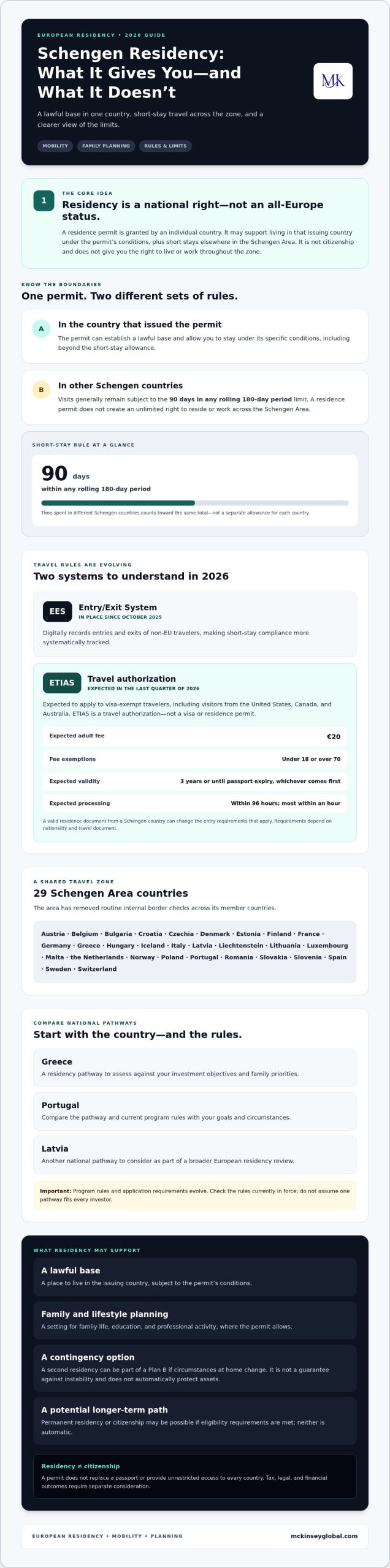
For global investors, European residency can provide more than a base for extended visits. It is a legal status granted by an individual country, and the rights it provides depend on the specific permit. A valid residence permit generally allows short stays in other Schengen countries, subject to the 90/180-day rule. It does not grant the right to live or work throughout the zone. The Schengen Area comprises 29 countries that have removed routine internal border checks, creating one of the world’s largest shared travel zones.
The Evolution of Global Mobility
Mobility planning has shifted from arranging holidays to establishing a lawful base. For business owners and families with interests across borders, residency in Europe can support longer stays in the issuing country and provide a setting for education, professional activity, and family life, subject to permit conditions. This is distinct from citizenship: residency does not replace a passport or provide unrestricted access to every country.
The Schengen Area’s 29 members are Austria, Belgium, Bulgaria, Croatia, Czechia, Denmark, Estonia, Finland, France, Germany, Greece, Hungary, Iceland, Italy, Latvia, Liechtenstein, Lithuania, Luxembourg, Malta, the Netherlands, Norway, Poland, Portugal, Romania, Slovakia, Slovenia, Spain, Sweden, and Switzerland. Greece and Portugal are options for investors considering European residency, while Latvia offers another national pathway. The right fit depends on an applicant’s objectives and the applicable program rules.
Residency as a Contingency Plan
For high-net-worth individuals, “sovereign risk mitigation” means reducing reliance on a single country’s political, economic, and legal environment. A second residency can form part of a Plan B: a lawful alternative base for a family if conditions at home change, and another option for organizing personal and professional interests. It is not a guarantee against instability, nor does residency automatically protect assets. Those outcomes depend on separate legal, tax, and financial considerations.
A passport remains central to international travel, but its access is tied to the issuing country’s arrangements and can be restrictive for people subject to short-stay limits. Residency adds a different kind of flexibility: it can establish residence rights in a host country while preserving other options. The schengen area residency benefits therefore include practical mobility and a potential foundation for longer-term family planning, not blanket freedom to settle anywhere in Europe.
In 2026, Schengen residency can combine lawful residence in one European country, short-stay travel across the zone, and a considered contingency for family and professional plans.
Decoding the 2026 Mobility Landscape: ETIAS and the 90/180 Rule
For non-EU nationals visiting the Schengen Area without a residence permit, the short-stay limit is 90 days in any rolling 180-day period across the zone. It is not a separate allowance for each country: time spent in France, Italy, or another Schengen state counts toward the same total. Since October 2025, the Entry/Exit System (EES) has digitally recorded non-EU travelers’ entries and exits, making compliance with the limit more systematically tracked.
A residence permit changes the position in its issuing country: holders may stay there under the conditions of their permit, beyond the short-stay allowance. It does not create an unlimited right to reside in other Schengen states; visits elsewhere generally remain subject to the 90/180-day rule. Nor does residency by itself authorize employment across the zone. These distinctions matter for entrepreneurs planning regular meetings in financial centers such as Paris, Frankfurt, or Amsterdam.
Navigating ETIAS and Entry Requirements
As of September 2026, ETIAS is expected to launch in the last quarter of the year. It will apply to visa-exempt travelers, including visitors from the United States, Canada, and Australia. The online authorization is expected to cost €20 for adults, with applicants under 18 or over 70 exempt from the fee. Once approved, it is valid for three years or until the passport expires, whichever comes first. Processing is expected within 96 hours, with most applications processed within an hour.
ETIAS is a travel authorization, not a residence permit or visa. A valid residence document from a Schengen country can change the entry requirements that apply to its holder. Check the rules for your nationality and travel document rather than assume ETIAS is required or irrelevant. The European Commission’s overview of the Schengen Area provides official context on the system. A long-term permit does not remove border formalities or permit conditions.
Operational Freedom for Entrepreneurs
Residency can make business travel more predictable by establishing a lawful base in the host country, while short visits to other Schengen destinations remain governed by the applicable rules. Before planning frequent cross-border activity, confirm the permitted stay, work rights, and entry documentation for each destination. This is especially important when coordinating family residence, corporate commitments, and travel outside Europe.
The Schengen Area, the European Union, and the Eurozone are not interchangeable: Schengen concerns internal border controls, the EU is a political and economic union, and the Eurozone comprises countries using the euro. Their memberships differ. Investors assessing the schengen area residency benefits should consider the specific rights of the permit and destination, alongside their wider global residency and citizenship strategy.
Assessing Lifestyle Benefits: Education, Healthcare, and Security
For families, the value of European residency is measured not only in travel access but also in the practicalities of everyday life. A residence permit can establish a lawful base in its issuing country, where families can assess local schools, healthcare, and longer-term opportunities. These advantages are not uniform across the Schengen Area: eligibility depends on national rules, the permit category, and individual circumstances.
Educational Advantage and Family Legacy
Residency may help families plan a child’s education in the host country, including access to local schools and, where eligibility criteria are met, domestic tuition arrangements. Neither admission nor a lower fee rate is automatic. Universities and education authorities may consider residence duration, nationality, program, and other requirements. Compare those conditions before choosing a pathway, especially if your plans depend on a particular school or degree program.
Studying locally can also help children develop language skills, build professional networks, and understand the regional labor market. A residence permit alone does not grant unrestricted work rights across Europe, so career options depend on the country’s rules and, where relevant, a future change in status. For families thinking across generations, second citizenship planning is separate from residency, with its own eligibility and naturalization requirements.
Healthcare Infrastructure and Wellness
European countries have public and private healthcare providers, but a Schengen residence permit does not create automatic access to every country’s healthcare system. Entitlement, registration, insurance obligations, and costs depend on the host country and the individual’s circumstances. Before relocating, verify how a permit holder and accompanying family members can access primary care, specialist treatment, and emergency services.
That preparation means checking where care is available, what coverage applies, and how to maintain continuity for existing medical needs. The same diligence applies to travel requirements. The official ETIAS website is a reference for the authorization system, but ETIAS does not determine residence or healthcare entitlements.
Security, Quality of Life, and Long-Term Status
A dependable daily environment can matter as much as formal mobility rights. Families may weigh public services, personal safety, schooling, and access to care alongside a country’s lifestyle and business conditions. Residency can contribute to a considered Plan B, but it is not a guarantee of personal or asset security. Legal, tax, and financial planning remain distinct.
Longer-term status may be possible, but permanent residency and citizenship are separate processes, governed by each country’s residence, integration, and other eligibility rules. As one example, the citizenship pathway for most new Portugal applicants was extended to 10 years of legal residence in May 2026. The schengen area residency benefits are best assessed against a family’s realistic timeline, not an assumption of automatic settlement or citizenship.
Comparative Analysis: Greece, Portugal, and Latvia Pathways
Choosing a residency route requires more than comparing investment structures. Assess the destination, permitted activities, physical-presence expectations, renewal conditions, and any longer-term residence or citizenship objectives. Rules can change, so confirm current requirements before committing capital. The schengen area residency benefits may support regional travel, but each permit is governed by the country that issues it.
Greece: The Mediterranean Gateway
Greece’s residency-by-investment program includes several qualifying routes. For real estate, the 2026 thresholds are €800,000 in Attica, Thessaloniki, and specified islands with more than 3,100 residents; €400,000 in other regions; and €250,000 for converting a commercial property to residential use or restoring a listed building. The first two routes require a single property of at least 120 square metres. Qualifying alternatives include a €250,000 investment in a company listed on Elevate Greece or a minimum €400,000 investment in specified Greek bonds or real estate company securities.
Property acquired through the program cannot be used for short-term holiday rentals. Greece may suit families seeking a Mediterranean base, but assess investment eligibility separately from lifestyle preferences. Processing times depend on individual circumstances. Confirm current administrative expectations rather than relying on a generic estimate. Review the Greece residency by investment pathway for program context.
Portugal: The Fund-Based Strategy
Portugal no longer accepts direct real estate investment as a qualifying Golden Visa route. In 2026, one available option is a €500,000 investment in a qualifying non-real-estate fund. Other routes include scientific research, arts and cultural heritage, and qualifying company or job creation. Review fund eligibility, investment terms, and applicant suitability before choosing this route. Portugal remains relevant to investors seeking a European base and a diversified investment structure. Details are available in this guide to the Portugal Golden Visa strategy.
Do not assume a five-year citizenship path: as of May 2026, the period of legal residence required for most new applicants is 10 years. The physical-presence conditions for maintaining a permit and qualifying for citizenship are distinct. Verify both under current rules.
Latvia: A Northern European Option
Latvia may appeal to applicants seeking a Northern European base. Since September 15, 2026, its real estate and bank-deposit routes have been closed to new applicants. Current options include a €50,000 qualifying business investment or €150,000 through an alternative investment fund. The business route permit is valid for two years. Review the Latvia investment residency program and verify renewal and presence requirements before proceeding.
Across all three jurisdictions, do not equate holding a permit with satisfying residence requirements for permanent status or citizenship. Compare each route against your intended time in-country, family needs, and investment profile. Then assess Greece residency options as part of that comparison.
Securing Your Future: The McKinsey Strategic Advisory Process
Investment migration involves more than selecting a destination and preparing forms. Applicants must align family objectives, source-of-funds documentation, investment eligibility, and residence conditions with the rules of the country issuing the permit. Requirements can change, and an error or omission may create delays or jeopardize an application. Careful due diligence helps identify issues before capital is committed.
For families assessing the schengen area residency benefits, the central question is whether a specific permit supports their actual plans. Distinguish travel access from the right to reside in the host country, and understand the conditions attached to renewal and any future application for permanent status or citizenship.
End-to-End Application Management
McKinsey Citizenship and Residency Solutions is an independent boutique advisory firm specializing in investment migration, including Greece, Portugal, and Latvia pathways. Its end-to-end application support can help coordinate pathway assessment, document preparation, application submission, and follow-up. Each case remains subject to the relevant authorities’ requirements and decision-making.
Residency cards also carry ongoing responsibilities. Permit holders should track expiry dates, renewal criteria, investment conditions, and any physical-presence rules that apply to their status. These obligations are determined by the issuing jurisdiction. Confirm them with the relevant authority and seek appropriate professional guidance where needed. A change in circumstances may prompt a review of available options, but moving between programs requires a fresh eligibility assessment, not an assumed transfer of status.
Expert Guidance for Complex Cases
Professional advisory can provide structure where regulations, family circumstances, and investment decisions intersect. A disciplined review should test objectives against current program criteria, identify documentation gaps, and explain relevant risks without implying a guaranteed outcome. Confidential handling and procedural integrity matter in high-stakes planning, particularly where applications include sensitive personal, financial, and family records.
Before proceeding, clarify the scope of support, the documents you must provide, key deadlines, and which compliance duties remain your responsibility after approval. McKinsey Citizenship and Residency Solutions focuses on investment migration pathways, including Greece Residency by Investment, the Portugal Golden Visa, and Latvia Residency. To explore how these options may fit your circumstances, review the firm’s residency by investment options as a starting point for a considered assessment.
Build a Residency Strategy Around Your Long-Term Goals
The schengen area residency benefits can extend beyond regional travel, but a permit’s value depends on its specific conditions and how they support your family’s plans. Keep three principles in view: residency in one country does not mean unrestricted residence across the zone; investment routes and presence requirements differ by jurisdiction; and future permanent residence or citizenship requires meeting separate eligibility criteria.
Sound planning starts by comparing those conditions with your priorities for mobility, family life, investment, and long-term stability. McKinsey Citizenship and Residency Solutions is an independent boutique advisory firm specializing in investment migration pathways, including European and Caribbean options. Its advisory work focuses on assessing program requirements and responsibilities as part of application planning.
If you are considering a European residency pathway, start with a structured review of your objectives and the relevant program rules. Consult with a McKinsey Strategic Advisor on your Schengen Residency Portfolio to discuss which options may fit your circumstances.
Frequently Asked Questions
What are the primary travel benefits of Schengen residency in 2026?
A valid residence permit from a Schengen country can support short-stay travel to other Schengen countries, subject to the 90/180-day rule and applicable entry requirements. It also allows the holder to reside in the country that issued the permit under its conditions. These schengen area residency benefits do not amount to unrestricted settlement across all member states, and the permit does not replace a passport.
Does Schengen residency allow me to work in any member state?
No. A residence permit generally gives rights in the country that issued it, and the specific permit determines whether and how its holder may work there. It does not automatically authorize employment in other Schengen countries. Before accepting work or conducting business activity across borders, check the destination country’s rules and whether a separate authorization is required. Short-stay travel rights and employment rights are distinct.
How does the 90/180-day rule apply to residency permit holders?
The 90/180-day limit generally applies to short stays in Schengen countries other than the one that issued the residence permit. Permit holders may reside in their host country under the permit’s conditions, even beyond 90 days, but visits elsewhere are generally limited to 90 days in any rolling 180-day period. Time spent across those other Schengen countries counts toward the shared limit, so track travel dates carefully.
What is the fastest pathway to Schengen residency for investors?
There is no single pathway that can reliably be called the fastest for every investor. Processing depends on the country, route, completeness of the application, due diligence, and administrative handling. Greece, Portugal, and Latvia have different qualifying investment structures and requirements, which may also change. Compare current eligibility, documentation, residence conditions, and processing expectations before committing funds. Treat any promised timeline cautiously unless confirmed by the relevant authorities.
Can my family members be included in the residency application?
Family inclusion may be possible, but eligible relatives, documentation, and application procedures depend on the country and specific residency route. Confirm which family members qualify, whether they apply together or separately, and what evidence of relationship or dependency is required. Also review the rights and renewal conditions that apply to each family member. Do not assume that a main applicant’s approval automatically grants identical status to relatives.
What happens to my residency status if I do not spend time in the country?
The consequences depend on the issuing country, permit category, and the conditions for renewal or maintaining status. Limited physical presence may affect renewal eligibility or a later application for permanent residency or citizenship, even if the residence card remains valid for a period. Review the current rules before spending extended time abroad, keep evidence of required residence, and seek clarification from the relevant authority where the conditions are unclear.
How does ETIAS affect residents of Schengen countries?
ETIAS is a pre-travel authorization for visa-exempt travelers, not a residence permit. As of September 2026, its launch is expected in the last quarter of the year. Whether a particular traveler needs ETIAS depends on nationality and travel documentation. Do not assume that holding a residence card means the requirement applies or is waived in every circumstance. Check current official guidance before travel and carry valid travel documents.
Is there a difference between EU residency and Schengen residency?
Yes. The European Union and the Schengen Area are distinct arrangements, with different membership and purposes. EU membership does not mean every country participates in Schengen, and some Schengen countries are not EU members. A residence permit is issued under the laws of a particular country; it does not create a general “Schengen residency” status or grant identical residence and work rights throughout the EU or Schengen Area.