
A second citizenship does not automatically require you to give up your first. A U.S. citizen may naturalize in another country without risking U.S. citizenship, but the other country’s rules determine whether it permits dual nationality and what conditions apply.
Treating this as more than a passport decision is sensible: eligibility, obligations, and long-term plans all matter. This guide explains what dual citizenship means, who may qualify through ancestry, residence, or investment, and how changing country requirements can affect an application.
You’ll also learn what citizenship consulting and application support can involve, from assessing a potential route to preparing documents and navigating the required process. The goal is to help you understand the rules and practical steps before deciding how to proceed.
Key Takeaways
- Compare ancestry, residence, and investment routes against your eligibility and long-term priorities before choosing a path.
- Review the citizenship rules of both countries involved, including whether each permits you to retain your existing nationality.
- Assess passport access alongside the conditions attached to citizenship; travel benefits are only one part of the decision.
- Organize your application around the selected program’s criteria, required documents, and procedural steps, and account for rule changes as you plan.
1. What Is Dual Citizenship?
Dual citizenship means holding nationality in two countries at the same time. A U.S. citizen may naturalize elsewhere without losing U.S. citizenship, and more than 60 countries allow U.S. passport holders to hold dual citizenship, subject to their rules. A second citizenship can provide a legal status that lasts for life, though each country defines its own obligations.
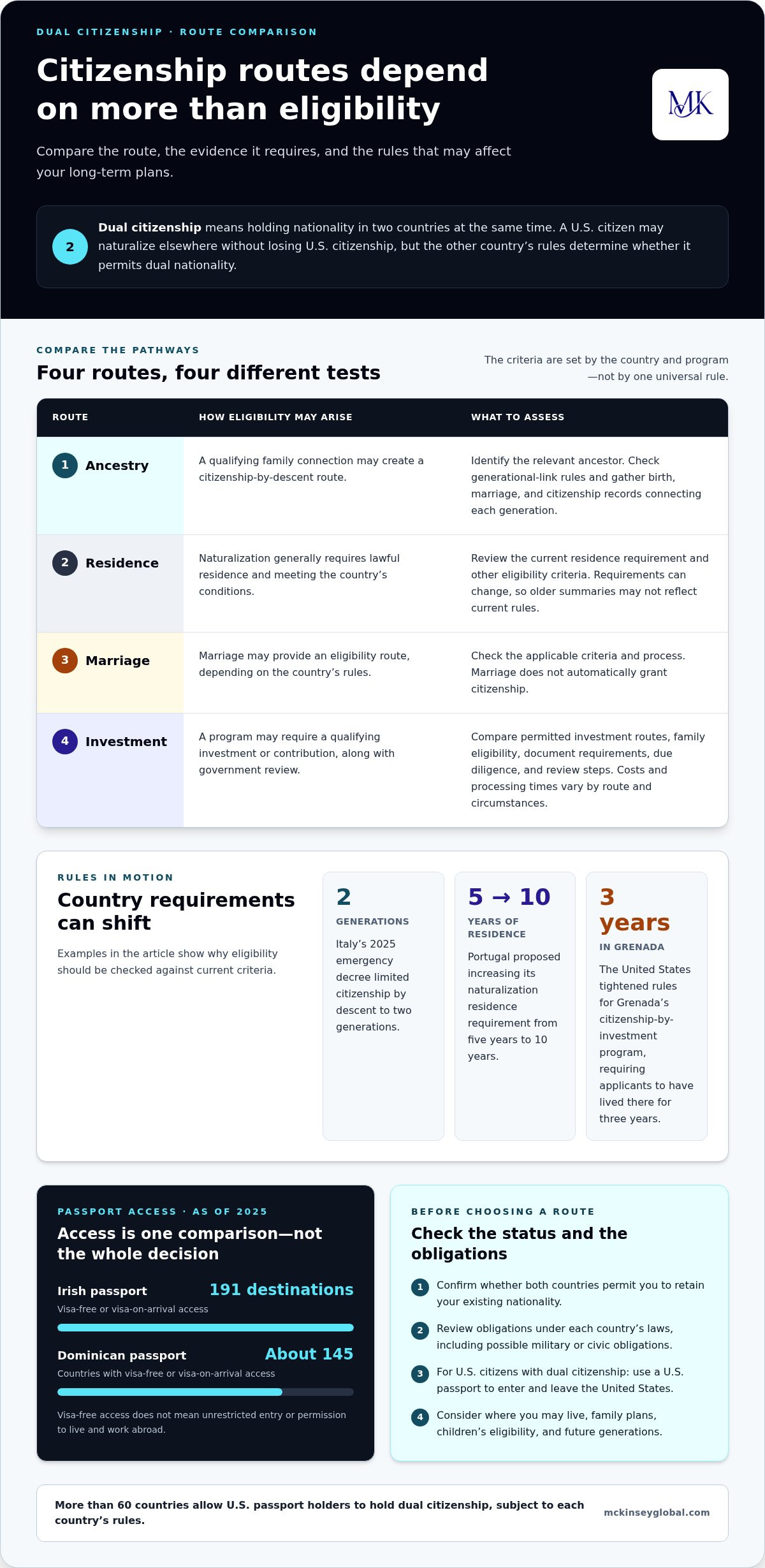
People may qualify for citizenship through ancestry, residence, marriage, or investment. Ancestry routes depend on documented family links; naturalization generally requires lawful residence and meeting the country’s conditions. Marriage may create an eligibility route, but it does not automatically grant citizenship. Investment programs set their own criteria, which may include a qualifying investment or contribution and government review.
To assess eligibility for citizenship by descent, identify the relevant ancestor and review the country’s rules on generational links and documentation. Gather birth, marriage, and citizenship records connecting each generation, then compare them with the official eligibility criteria.
Citizenship by investment is an option for applicants who meet a government’s investment and due-diligence requirements. Dominica is one country with a citizenship-by-investment program. Compare each program’s permitted investment routes, family eligibility, documentation, and review process, as the government sets the required steps. Costs depend on the selected route, government charges, and individual circumstances. Processing times also vary according to document readiness, checks, and government review, so thorough preparation can help keep the application organized.
Assess citizenship as a long-term decision, not just an application. Consider where you expect to live, whether you can retain your current nationality, and whether either country imposes military or civic obligations. For families, education plans, children’s eligibility, and future generations may also matter. The right route is one whose requirements and continuing responsibilities fit your circumstances, not simply one that offers passport access.
2. Dual citizenship for citizens of other countries
Dual citizenship means holding citizenship in two countries at the same time. “Second citizenship” is a broader term for an additional nationality; it does not establish whether both countries recognize dual status. For a U.S. citizen, eligibility depends on the other country’s citizenship policies. Some countries allow new citizens to retain their original nationality, while others require renunciation.
More than 60 countries allow United States passport holders to hold dual citizenship, subject to the requirements of the citizenship they seek. The rules are country-specific, so there is no single list of conditions that applies to every applicant. A U.S. citizen should determine whether the destination country recognizes dual citizenship with the United States and whether their current nationality permits acquiring another.
U.S. citizens with dual citizenship owe allegiance to both the United States and the other country. They must use a U.S. passport to enter and leave the United States, and they do not have to choose one nationality over the other. These rights do not remove obligations under either country’s laws. Living abroad also does not automatically change citizenship status.
Start by identifying the route: ancestry, naturalization, marriage, or an investment program. Review the destination country’s eligibility criteria and document requirements, then consider the laws of every country where you hold citizenship. A citizen of another country seeking U.S. citizenship should ask their embassy or consulate whether they can retain their original nationality. Qualifying for U.S. citizenship involves meeting immigration and residency requirements.
Practical risks include conflicting rules, documentation requirements, and travel procedures. Before applying, ask the relevant embassy or consulate about recognition and eligibility, and assess how both countries treat your status. For example, a foreign national applying to become a U.S. citizen should understand their home country’s rules before submitting a naturalization application. These steps help clarify the legal implications for family plans, children, and long-term freedom of movement.
3. Are countries tightening their requirements?
Citizenship rules are changing in different directions, so passport access is only one planning factor. Citizenship rules can change, and countries may take different approaches to dual citizenship. Italy’s 2025 emergency decree limited citizenship by descent to two generations, while Portugal proposed increasing its naturalization residence requirement from five years to 10 years.
Investment and residence routes can change. The United States tightened rules for Grenada’s citizenship-by-investment program, requiring applicants to have lived in Grenada for three years. This illustrates why you should assess eligibility against current criteria rather than rely on older summaries. Your route, residence history, family links, and documents can all affect whether you qualify.
Passport mobility offers a practical comparison, but visa-free access does not mean unrestricted entry or permission to live and work abroad. As of 2025, an Irish passport provided visa-free or visa-on-arrival access to 191 destinations. A Dominican passport provided that access to about 145 countries. Entry conditions still depend on the destination, the traveler’s purpose, and applicable border rules.
Plan an additional passport around how you expect to use it. Identify frequent destinations, travel permits, family needs, and possible residence plans, then compare travel access with the obligations attached to each nationality. Another passport may offer an additional travel option during disruption, but it does not replace visas, border rules, or compliance with entry requirements. Learn more about how second passports unlock visa-free travel and why destination-specific entry conditions still matter.
For U.S. citizens, the passport rule is clear: use a U.S. passport to enter and leave the United States, even if you hold another nationality. Keep both passports valid and make sure personal details match across travel documents. An additional citizenship may support long-term mobility and stability, but its practical value depends on your destinations, residence plans, and circumstances.
4. Citizenship consulting and application support
Citizenship consulting can turn a nationality goal into a structured application plan. First identify the route: ancestry, residence, marriage, or investment. Each has distinct eligibility criteria, evidence requirements, and government procedures. A clear assessment connects your circumstances with the relevant program before you assemble documents.
For an ancestry claim, map your family line and collect records linking each generation to the relevant country. Compare names, dates, and places across birth, marriage, and citizenship documents. For naturalization, organize residence records and evidence that addresses the destination government’s stated conditions. For an investment application, match the selected route to its rules and supporting-document requirements.
Application support can include preparing a document checklist, tracking outstanding records, and reviewing files for consistency before submission. For example, identify a spelling difference between a birth certificate and passport, then address it through the process required by the relevant authority. Organizing files clearly also helps applicants respond accurately to government requests for further information.
Treat due diligence as a central stage, not a final formality. Provide complete, truthful information and understand which government reviews the application. A professional assessment can also help distinguish citizenship from residence: a residence permit does not itself grant nationality. Consider how the status you seek relates to travel, family plans, healthcare access, and any political or civic responsibilities.
Rules change, and eligibility depends on the country and route. Confirm current requirements through official government sources or a legal professional, especially when more than one nationality is involved. Before proceeding, prepare a concise file of family records, residence history, identity documents, and questions about obligations. To explore citizenship and residency options, take the next step with a route-focused discussion.
McKinsey Citizenship and Residency Solutions: Antigua and Barbuda Citizenship by Investment
McKinsey Citizenship and Residency Solutions helps investors assess whether an investment-based citizenship route fits their objectives and circumstances. Its Antigua and Barbuda Citizenship by Investment program is a relevant option for those considering that route. The firm also offers St. Kitts and Nevis Citizenship and Dominica pathways. For those considering residence rather than immediate citizenship, Greece Residency by Investment is a separate option.
Before proceeding, clarify your priorities, review the program’s eligibility criteria, and consider how a new status fits your family and mobility plans. Application support can help you understand the process and organize the steps, while the relevant government sets the requirements and makes the decision. The right route depends on your goals and the program conditions.
To discuss which pathway may suit your circumstances, contact McKinsey Citizenship and Residency Solutions.
Make Your Mobility Strategy Deliberate
A second citizenship is most useful when it supports a clear plan, rather than serving as an abstract safeguard. Before taking action, decide which outcomes matter most: more travel flexibility, a future residence option, or a pathway that accommodates family priorities. Then consider how each potential nationality fits your existing commitments and long-term plans.
McKinsey Citizenship and Residency Solutions can guide you through its Antigua and Barbuda Citizenship by Investment and St. Kitts and Nevis Citizenship pathways, as well as Greece Residency by Investment for those considering residence. The right option depends on your objectives and the relevant program’s requirements. A careful assessment can help clarify which factors matter most.
If you are ready to explore your options, contact McKinsey Citizenship and Residency Solutions to discuss a suitable next step. A considered plan can turn a complex decision into a clear course of action.
Frequently Asked Questions
What Is Dual Citizenship?
Dual citizenship means holding nationality in two countries, with each country’s laws defining the rights and duties attached to that status. For example, a U.S. citizen who also becomes a citizen elsewhere remains subject to obligations in both countries. Keep records of each nationality and use the passport required by the country you enter or leave.
Are countries tightening their requirements?
Some countries have tightened particular citizenship routes, while others have broadened recognition of dual nationality. Germany’s rules changed in 2024, and Italy’s 2025 decree narrowed citizenship by descent. These shifts can affect different applicants in different ways. Before preparing a file, identify the exact route and review its current government criteria, especially if eligibility depends on ancestry or residence.
Are there any countries to watch?
Germany, Italy, Portugal, and Grenada merit attention because their citizenship policies or program conditions have changed or have been proposed for change. Track the specific route relevant to you rather than relying on a country’s general reputation. For example, an applicant pursuing citizenship by descent should monitor ancestry rules, while an investor should follow the program’s eligibility and residence conditions.
How Do I Secure Second Citizenship If I Don’t Have Ancestral Ties to the Country?
Without an ancestry route, consider naturalization through residence, eligibility through marriage, or citizenship by investment where available. Each has distinct criteria, such as residence history, family documentation, or compliance with investment-program requirements. Start by choosing a country that aligns with your plans, then identify its official application route and gather the required evidence.
How about the downsides?
Holding another nationality can add administrative and legal obligations, and the two countries’ rules may differ. Travel applications may ask for a record of countries visited over the past five or even ten years. Some visa applications also require you to submit a passport to an embassy or consulate for two to three weeks, temporarily limiting its availability for other travel.
Is it worth applying now even if I don’t need it?
Consider applying when you have a clear objective, a viable route, and time to manage the documentation and obligations. A future travel, residence, or family plan can help define that purpose. Compare the status you seek with your existing citizenship, practical needs, and long-term responsibilities. Starting without a defined need can create administrative work without a corresponding benefit.