
A passport’s access to destinations without a traditional visa depends on its nationality and each destination’s entry rules. A United Kingdom passport grants access to 191 countries without a traditional visa, though permitted stays and entry conditions vary. For travelers, visa free access is only one part of planning an international journey.
It is understandable to focus on how many countries a passport can access, but its practical value also depends on whether each destination requires advance authorization or offers a visa on arrival. A second passport may expand the destinations you can visit visa free, but you still need to understand the entry rules for every trip.
This article explains how entry options differ, how permitted stays affect travel plans, and how to check current requirements. Use it to assess what a second passport may offer and how destination-specific conditions could shape your next journey.
Key Takeaways
- Compare destination access by the specific passport you plan to use, not by a general passport ranking.
- Distinguish entry without a visa from a visa on arrival or advance travel authorization before planning a trip.
- Check current entry conditions for your route, passport type, and travel purpose before departure.
- Review permitted stay limits separately for each destination, as they can shape the length and structure of your itinerary.
Which Countries Can I Travel to Visa-Free?
The answer depends on your passport nationality, passport type, and destination. According to the European Commission, the Schengen area is composed of 29 countries: 25 EU Member States and 4 non-EU countries, Iceland, Norway, Switzerland and Liechtenstein. A passport may permit visa-free travel to one country but require authorization elsewhere.
For Turkish ordinary passport holders, a Pegasus list compiled for ordinary passport types as from December 2017 names Albania and Japan for 90 days, Georgia for 1 year, and Qatar and Thailand for 30 days. Visa-free travel still requires meeting the destination’s entry requirements. Since the list dates from December 2017, treat it as an illustration, not a current guarantee. Check the destination’s official entry rules before relying on a listed visa-free stay.
Passport category affects eligibility for the U.S. Visa Waiver Program. Passports issued as British Subject, British Dependent Territories Citizen, British Overseas Citizen, British National (Overseas) Citizen, or British Protected Person do not qualify. A U.K. passport stating Right of Abode or indefinite leave to remain in the United Kingdom also does not qualify.
Validity requirements vary. For most passport holders using the U.S. Visa Waiver Program, the requirement that a passport remain valid for six months beyond the stay is waived. Brunei passport holders must have passports valid for at least six months from their departure date from the United States. Check passport type, validity, and destination rules with the relevant government or embassy. Security screening and travel records may also affect admission.
Visa-free entry permits only activities allowed under the destination’s visitor rules. The U.S. Visa Waiver Program does not allow study for credit, employment, work as foreign press or other information media, or permanent residence.
Visa-free versus visa on arrival and visa required
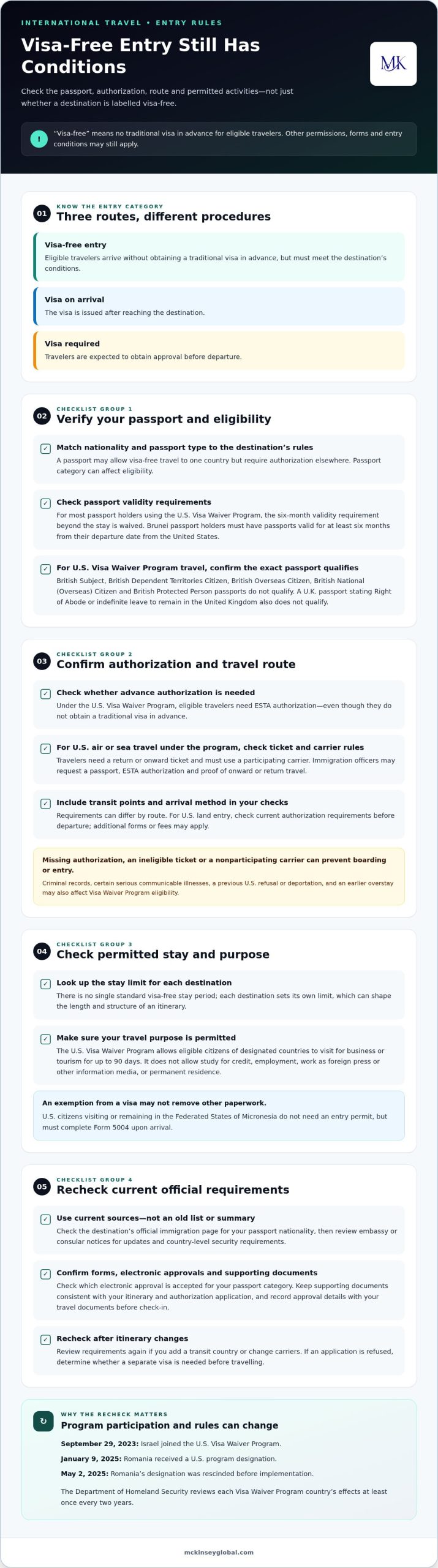
Visa-free entry lets eligible travelers arrive without obtaining a traditional visa in advance, subject to the destination’s conditions. In practice, it applies only to travelers who meet those conditions. A visa on arrival is issued after reaching the destination, while a visa-required destination expects travelers to obtain approval before departure. Each option has its own procedures.
The U.S. Visa Waiver Program shows how entry without a traditional visa can still require advance steps. Citizens of designated countries may visit the United States for business or tourism for up to 90 days, according to U.S. Customs and Border Protection. Travelers need ESTA authorization, and eligibility depends on both the traveler and the country’s designation.
Security measures also shape participation. Congress and the Secretary of Homeland Security introduced program security enhancements in 2015. In 2022, the Secretary announced information-sharing requirements for current and aspiring participating countries. These measures make security cooperation part of the framework for visa free travel to the United States.
For air or sea travel to the United States under the program, travelers need a return or onward ticket and must use a participating carrier. Immigration officers may request a passport, ESTA authorization, and proof of onward or return travel. These documents help establish identity and whether the traveler meets the relevant entry conditions.
Missing authorization, an ineligible ticket, or a nonparticipating carrier can prevent boarding or entry. Criminal records, certain serious communicable illnesses, a previous U.S. refusal or deportation, and an earlier overstay may also affect eligibility for the program.
Country designation can change. Romania received a U.S. program designation on January 9, 2025, but it was rescinded on May 2, 2025, before implementation. For longer-term plans beyond visitor entry, United Arab Emirates residency solutions are a separate option.
Entry-rule changes and verification
Entry permissions can change. Countries may revise authorization, program participation, or document checks. Israel joined the U.S. Visa Waiver Program on September 29, 2023. Program participation can change over time. These changes show why passport holders should use current destination rules, not old summaries. Check the official government immigration page for your passport nationality before booking.
The United States also reviews program designations. The Department of Homeland Security reviews each VWP country’s effects at least once every two years. VWP travelers need authorization under ESTA. For U.S. land entry, travelers should check current authorization requirements before departure. Entry requirements may include additional forms or fees, so travelers should check the current rules for their route.
Some destinations require forms even when travelers need no visa. U.S. citizens visiting or remaining in the Federated States of Micronesia do not need an entry permit. They must complete Form 5004 upon arrival. This distinction matters: a visa exemption may not remove other immigration documentation. Confirm whether arrival forms, electronic approvals, or other permissions apply to your route.
Before departure, compare your passport nationality, transit points, travel purpose, and arrival method. Review the permitted stay and entry conditions on the destination’s current official page. Check embassy or consular notices for diplomatic updates and country-level security requirements. Keep supporting documents consistent with your itinerary and authorization application. Confirm which electronic approval is accepted for your passport category, and record its details with your travel documents before check-in. Recheck requirements after itinerary changes, particularly if you add a transit country or change carriers. If an application is refused, determine whether you need a separate visa before travelling.
Permitted lengths of stay
Visa-free access does not establish one standard stay period; each destination sets its own limit and permitted purposes. US passport holders can stay in Japan for a maximum of 90 days, according to the Ministry of Foreign Affairs of Japan. That ceiling defines the authorized visit, not a general allowance for every destination or passport. At the border, officials assess the traveler’s passport and stated purpose against the destination’s entry conditions.
For the United States, the Visa Waiver Program permits citizens of designated countries to travel for business or tourism for stays of up to 90 days without a visa, according to U.S. Customs and Border Protection. The purpose matters: this route is for business or tourism, not every activity. Travelers should align their plans and supporting documents with the category under which they enter.
Other examples show how widely limits can differ. US passport holders may stay in Barbados and Canada for up to 6 months, while the limit in New Zealand is 3 months. US citizens may stay in Georgia without a visa for up to 1 year. UK citizens may stay in the Schengen Area for up to 90 days in any 180-day period. Each figure applies to the stated passport and destination.
Before travelling, find the maximum permitted stay, how that period is measured, and whether the rule differs by entry route. Compare your planned arrival and departure dates with the destination’s official immigration information. Check whether visa-free entry also requires electronic authorization, a visitor permit, or another document. Use any specific limit stated on a consulate or government page to plan your stay, and do not assume a border officer can extend it.
For plans that require a longer-term residence framework rather than repeated visitor stays, explore United Arab Emirates residency solutions as a separate planning option.
McKinsey Citizenship and Residency Solutions: Antigua and Barbuda Citizenship by Investment
McKinsey Citizenship and Residency Solutions advises investors assessing citizenship and residency by investment options when a second passport forms part of their international plans. Its citizenship offerings include Antigua and Barbuda, St. Kitts and Nevis, and Dominica, alongside Greece Residency by Investment.
For travel planning, St. Kitts and Nevis nationals have visa-free access to over 100 countries and territories. The practical value depends on the destinations you intend to visit, permitted stays, and entry rules for the passport issued. Citizenship does not replace the need to review current requirements for each journey.
If you are considering a second citizenship, McKinsey Citizenship and Residency Solutions can guide you through the relevant program and application considerations. Contact McKinsey Citizenship and Residency Solutions to discuss your plans, or visit mckinseyglobal.com.
Make Your Next Move With a Clear Travel Strategy
Let your long-term priorities guide the next decision. A second passport may support broader travel options, while residency may better suit plans to establish a base abroad. The right route depends on the destinations that matter to you, your intended travel patterns, and the role citizenship or residency would play in your wider plans.
Treat visa-free access as one factor, not the only measure of a program’s value. Assess how a potential status aligns with your objectives, then review the entry rules and stay limits for the places you expect to visit. A structured comparison can help separate immediate travel needs from longer-term priorities and identify questions to resolve before proceeding.
McKinsey Citizenship and Residency Solutions can discuss relevant citizenship and residency pathways in light of your objectives. For a measured conversation about your next steps, contact McKinsey Citizenship and Residency Solutions. A clear plan can help you move forward with greater focus.
Frequently Asked Questions
Why Do Certain Countries Have Visa Restrictions?
Countries use visa restrictions to manage border entry, immigration, security screening, and temporary visits. Requirements may also reflect reciprocal arrangements between governments or a destination’s assessment of travel documents and information-sharing practices. For travelers, access can therefore vary by passport nationality, travel purpose, and destination. Rules for tourism may differ from those for work or study.
What does visa-free travel mean?
Visa-free travel means a traveler can enter a destination without obtaining a traditional visa in advance, provided they meet its entry conditions. It does not necessarily mean arriving without preparation: an electronic authorization, arrival form, or visitor permit may still be required. Check the rules for your passport and travel purpose, as authorization may be required even when entry is visa free.
Which countries can U.S. citizens visit visa-free?
U.S. citizens can visit destinations including Andorra, Singapore, the Philippines, and Peru without a traditional visa, subject to each country’s entry conditions. Published stay limits include 90 days in Andorra, 30 days in Singapore, 30 days in the Philippines, and up to 183 days in Peru. Treat each destination separately: permitted activities, documents, and entry procedures can differ.
How long can U.S. citizens stay in visa-free countries?
Permitted stays differ by destination and may be counted under different rules. For example, U.S. citizens may stay in Peru for up to 183 days, while Singapore allows a maximum of 30 days. Before setting an itinerary, compare the destination’s limit with your intended departure date and confirm whether the allowance applies to the entire visit or a defined period.
What passport validity and blank-page requirements apply to visa-free travel?
Passport validity and blank-page requirements depend on the destination and travel arrangement. Under the U.S. Visa Waiver Program, the six-month passport-validity rule is waived for most passport holders, while Brunei passport holders must have six months’ validity from their departure date from the United States. VWP travelers also need an electronic passport with a chip. Check the destination’s official requirements for passport validity and blank pages.
Do visa-free travelers need an electronic travel authorization or pre-registration?
Sometimes. The U.S. Visa Waiver Program requires ESTA authorization, and U.S. citizens will need ETIAS approval before traveling to the Schengen Area starting in 2026. These systems are separate from a traditional visa, but they still require advance action. Confirm whether authorization applies to your passport, route, and travel date; requirements can differ for air, sea, and land entry.