
The lowest entry threshold does not automatically make a citizenship program the best fit. Among the options compared here, Dominica has the lowest stated minimum investment requirement, making it the leading candidate for the cheapest citizenship by investment in this comparison.
A low starting point matters, but so do application stages, physical presence requirements, and the legal framework governing each program. This comparison explains how minimum contribution thresholds differ across lower-cost programs, outlines the application process, and identifies where residence obligations apply. It also considers the legislation behind selected programs, a factor that can be overlooked when attention centres on entry cost alone. Together, these details help distinguish a headline minimum from a program that fits your mobility priorities, family circumstances, and procedural requirements.
Key Takeaways
- Compare stated minimum contributions across programs, then weigh how each route’s requirements fit your circumstances.
- Dominica has no residence requirements, while stated processing timelines differ between programs.
- Review the legislation governing a program, since its legal framework is an important part of the comparison.
- Use the decision guide to weigh contribution thresholds, application steps, physical presence and legal structure together.
Application process and physical presence requirements
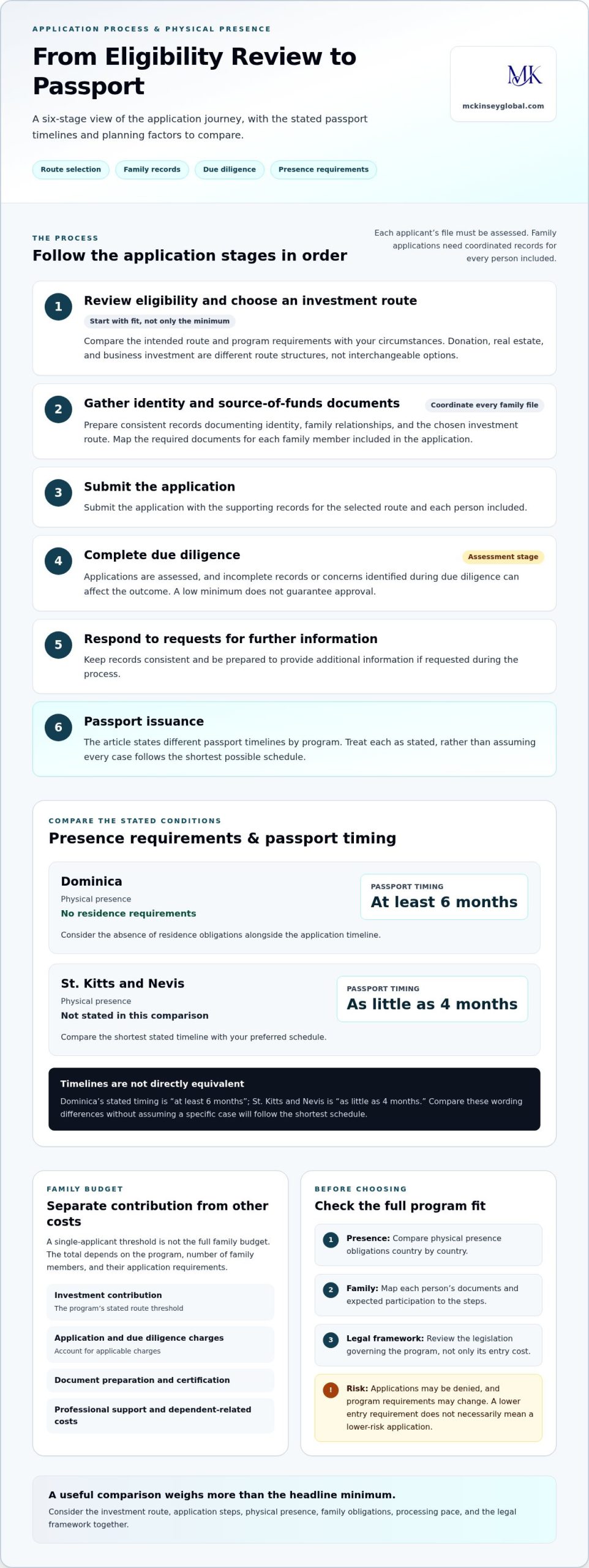
Compare the route from the initial eligibility review to passport issuance, not just the headline contribution. A practical sequence is to select an investment route, gather identity and source-of-funds documents, submit the application, complete due diligence, and respond to requests for further information. Each applicant’s file must be assessed, so family applications require coordinated records for every person included.
Physical presence can distinguish one program from another. Dominica’s Citizenship by Investment Program has no residence requirements. Applicants can obtain a Dominica passport in at least 6 months. St. Kitts and Nevis applicants can obtain passports in as little as 4 months. These are different timelines, so compare them as stated rather than assuming every case follows the shortest possible schedule.
| Program | Physical presence | Passport timing | Planning consideration |
|---|---|---|---|
| Dominica | No residence requirements | At least 6 months | Consider the absence of residence obligations alongside the application timeline. |
| St. Kitts and Nevis | Not stated here | As little as 4 months | Compare the shortest stated timeline with your preferred schedule. |
To estimate an all-in family budget, separate the investment contribution from other potential expenses. Account for applicable application and due diligence charges, document preparation and certification, professional support, and costs associated with adding dependents. The total depends on the program, the number of family members, and the requirements for their applications. A single-applicant threshold therefore does not represent a family’s full budget.
Before choosing, map each family member’s documents and expected participation against the program’s steps. Select the option whose presence requirements, processing pace, and total family obligations best match your priorities.
What Are the Cheapest Citizenship by Investment Programs in 2026?
For a 2026 comparison, the Caribbean programs differ in contribution thresholds, investment pathways, and legal frameworks. Dominica has the lowest stated minimum among the four compared here.
Caribbean Citizenship Programs
Dominica has the lowest stated minimum; the other three thresholds are higher. US citizens should consider program eligibility and personal tax consequences separately, since the investment minimum alone does not determine an individual’s tax position.
Caribbean Program Comparisons
The minimum contribution helps rank these programs by entry threshold, but it does not capture every application requirement. For example, Dominica has no residence requirements, while physical presence rules and application steps should be compared country by country. The figures above provide a starting point, not a complete family budget or a measure of which citizenship best suits an applicant’s priorities.
Compare each program against your intended investment, application process, and presence needs. This puts the threshold in context without treating all four Caribbean options as equivalent.
Donation, Real Estate, and Business Routes
Dominica, Antigua and Barbuda, St. Lucia, and St. Kitts and Nevis are the Caribbean programs compared here. Each country sets its own eligible investment routes, so donation, real estate, and business investment are not interchangeable. Compare the route’s structure and obligations alongside the minimum threshold. The lowest figure alone does not identify the right investment category for your circumstances.
Risks of Cheap Programs
A low minimum does not guarantee approval or prevent program requirements from changing. Applications may be denied, and incomplete records or concerns identified during due diligence can affect the outcome. Compare program rules as well as thresholds, and prepare a consistent file documenting identity, family relationships, and the investment route. A lower entry requirement does not necessarily mean a lower-risk application.
Citizenship-by-investment minimum contribution thresholds
Comparing the programs in ascending order shows where each country sits by entry contribution. These figures describe minimum investment requirements, not overall suitability or a complete family budget.
| Country | Minimum investment requirement | Position in this comparison |
|---|---|---|
| Dominica | USD 200,000 | Lowest stated minimum |
| Antigua and Barbuda | Second-lowest stated minimum | |
| St. Lucia | USD 240,000 | Middle of the five thresholds |
| St. Kitts and Nevis | USD 250,000 | Highest Caribbean minimum listed |
| Türkiye | Highest stated minimum in this comparison |
Dominica has the lowest threshold among these five, followed by Antigua and Barbuda. St. Lucia and St. Kitts and Nevis have higher stated minimums, while Türkiye’s threshold is substantially higher than each Caribbean figure listed. This ranking answers a narrow question: which stated entry investment is lowest? It does not establish which program is preferable for a particular applicant.
Use the figures as a first comparison, then assess each country’s investment route and application requirements. For example, an applicant comparing Dominica with Antigua and Barbuda should look beyond the difference between their minimums. They should also consider the application process, physical presence rules, and legal framework, all of which can shape how a program fits their circumstances.
For a practical shortlist, record each country’s minimum alongside the route you intend to pursue and the family members to include. Then compare these details with the program’s application steps and presence obligations. A contribution threshold is a clear starting point, but a sound decision requires comparing the full program structure rather than choosing solely by the lowest figure.
Citizenship-by-investment legislation
A contribution threshold describes the financial entry point; legislation establishes each citizenship-by-investment program’s legal framework. Comparing the governing acts helps distinguish programs with different statutory foundations and shows why the lowest threshold alone cannot describe the full route.
Dominica’s program is regulated by its Citizenship Act and CBI Regulations. St. Kitts and Nevis’s program is regulated by the Citizenship Act, Cap. 1.05, and launched in 1984. St. Lucia’s program is established under Citizenship by Investment Act No. 14 of 2015. These identifiers provide a practical starting point for understanding the formal basis of each program.
Other examples show why country-specific legislation belongs in a cost comparison. Grenada’s program is administered under the Grenada Citizenship by Investment Act, 2013. Türkiye’s program is regulated by Turkish Citizenship Law No. 5901. The Ministry of Justice of the Republic of Türkiye states that meeting the stated conditions does not give an applicant an absolute right to acquire Turkish citizenship.
For a useful comparison, record the governing law beside each country’s minimum investment, then consider what the law means for your application. Separate the program’s statutory foundation from its contribution threshold, and note whether the material describes a program as regulated, established, or administered under an act. Those legal relations are not interchangeable. For example, St. Lucia’s program is established under its 2015 act, while Grenada’s is administered under its 2013 act.
Before selecting a route, identify the governing legislation and the decision-making discretion described for that country. Türkiye’s stated conditions do not create an absolute right, a distinction that matters when assessing the legal dimension alongside investment requirements. Discuss citizenship options in light of their legal frameworks as you refine your comparison.
McKinsey Citizenship and Residency Solutions: Antigua and Barbuda Citizenship by Investment
McKinsey Citizenship and Residency Solutions can guide you as you compare Antigua and Barbuda Citizenship by Investment with other available routes. Turn to the firm after assessing contribution thresholds, presence requirements, application steps, and legislation, when you want guidance on its citizenship options.
Alongside Antigua and Barbuda, the firm offers St. Kitts and Nevis Citizenship and Dominica. For a different pathway, Greece Residency by Investment is also available. The right focus depends on whether your priority is citizenship or residency and which program’s requirements fit your circumstances.
A structured discussion can help you move from a broad comparison to a more focused assessment of these options. Contact McKinsey Citizenship and Residency Solutions or visit mckinseyglobal.com to discuss your next steps.
Turn Your Shortlist Into a Clear Next Step
The most useful next step is to turn your shortlist into a decision framework that reflects your priorities. Decide whether citizenship or residency is central to your plans, which family members to include, and how much weight to give mobility, presence obligations, and each route’s legal structure. This makes a comparison of the cheapest citizenship by investment options more relevant than a ranking based on contributions alone.
McKinsey Citizenship and Residency Solutions can help you consider the available pathways in light of your priorities. A focused discussion can clarify which questions matter as you move from general research to evaluating a route for your plans. This allows you to take an informed next step without treating the lowest entry threshold as the only deciding factor.
Contact McKinsey Citizenship and Residency Solutions to discuss your options and take the next step with greater clarity.
Frequently Asked Questions
What happened to Caribbean citizenship by investment prices after July 2024?
There is no single Caribbean-wide price that captures every program after July 2024; thresholds depend on the country and investment route. To assess a change, compare the same route before and after that date, and distinguish its required contribution from government charges and other application expenses. This avoids treating a regional headline as the cost applicable to every applicant or family.
What is the cheapest citizenship by investment program in 2026?
Among the programs compared, Dominica has the lowest stated minimum investment requirement at USD 200,000. That makes it the lowest-threshold option in this comparison, not necessarily the lowest total-cost choice for every applicant. A practical shortlist should also account for the selected investment route, applicant composition, and additional charges, then assess whether the program’s requirements align with your objectives.
What are the minimum investment and government fees for each citizenship by investment program?
The stated minimums are Dominica, USD 200,000; Antigua and Barbuda, USD 230,000; St. Lucia, USD 240,000; St. Kitts and Nevis, USD 250,000; and Türkiye, USD 400,000. Treat each figure as an investment threshold, not a total. Government charges are separate budget items, and the relevant amount depends on the country, chosen route, and applicants included.
Which citizenship by investment programs have the lowest total cost for a single applicant?
Dominica has the lowest stated minimum contribution among the five programs compared, but that alone does not establish the lowest total cost for a single applicant. Compare the full expense structure for the same investment route, including government charges and application-related costs. For a consistent comparison, use one applicant, one route, and the same expense categories for every country.
How much does citizenship by investment cost for a family of four?
A family-of-four total depends on the country, investment route, and charges applicable to each family member. Start with the program’s required investment, then add relevant government and application expenses for the principal applicant and dependents. Do not assume that multiplying a single-applicant threshold by four gives the family total. First determine how the program treats dependents and shared investment requirements.
What are the eligibility requirements for the cheapest citizenship by investment programs?
Eligibility is assessed under each program’s rules, so prepare a complete, consistent file for review. Core documents include identity records, information supporting the lawful source of investment funds, and proof of family relationships for any dependents. Also consider due diligence and the program’s permitted investment route. Meeting a contribution threshold alone does not establish that an application satisfies every requirement.