A Golden visa provides a residence route linked to an eligible investment or another qualifying category. It is distinct from citizenship, and the rights attached to a permit depend on the country and programme.
Investment thresholds are only one part of the decision. A useful comparison also considers eligible routes, residence conditions, required documents, and whether the goal is residence or eventual citizenship. This guide explains how a Golden visa works and what to assess when comparing options.
Portugal’s programme shows why its history matters. Launched in 2012 to attract international capital after the sovereign debt crisis, it later changed substantially: Portugal announced plans to end the programme in February 2023 and removed real estate as a qualifying route that year. Understanding that evolution helps frame what a Golden visa can offer, and why current qualifying routes matter.
Key Takeaways
- Compare qualifying investment routes by country and investment type; the headline threshold alone does not show the full eligibility picture.
- Distinguish a residence permit from citizenship, and assess each country’s residency conditions before considering a later status.
- Prepare for document requirements to vary by route, from identity photographs to evidence supporting an investment or project.
- Portugal’s programme has evolved over time, so understanding its policy changes helps clarify which investment routes remain relevant.
Minimum investment thresholds
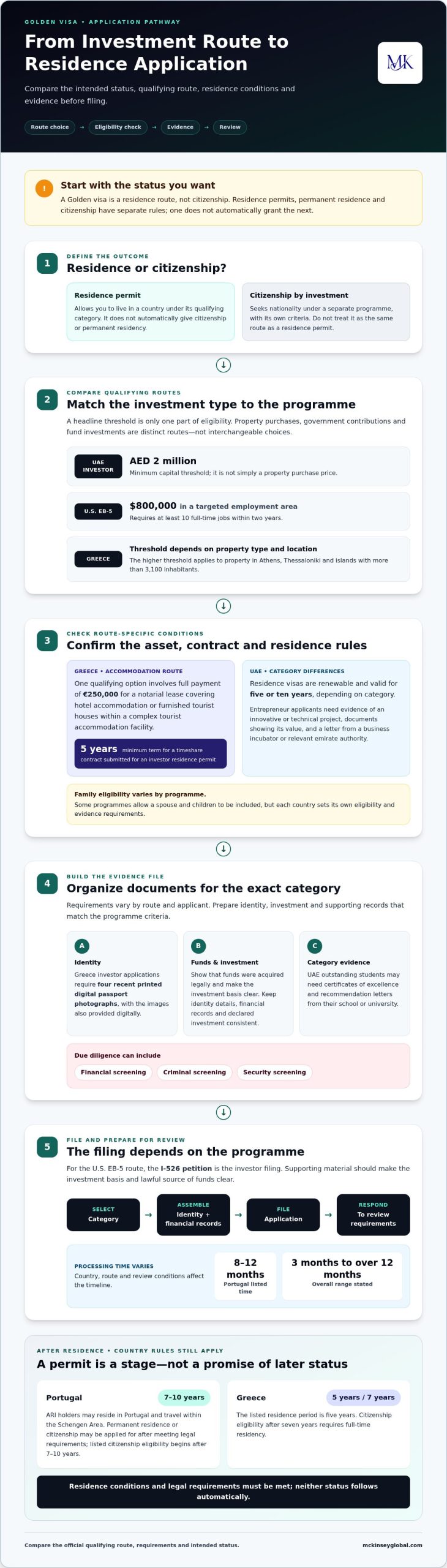
Investment thresholds vary by country, route, and status sought. A residence permit allows you to live in a country; citizenship by investment seeks nationality under a separate programme. Compare the qualifying contribution, investment type, and intended outcome before weighing migration options. Property purchases, government contributions, and fund investments are distinct routes, not interchangeable choices.
Examples illustrate the range and structure of requirements:
- The higher threshold applies to property in Athens, Thessaloniki, and islands with more than 3,100 inhabitants.
- The UAE investor category requires minimum capital of AED 2 million. This is a capital threshold, not a property purchase price alone.
- The United States EB-5 route lists an investment of $800,000 for a targeted employment area and requires at least 10 full-time jobs within two years.
Greece’s initial investor residence permit is subject to qualifying investment conditions. The applicable threshold depends on the property’s type and location. These distinctions matter before selecting an asset, since the same investment amount will not qualify every property in every area.
Citizenship routes follow different criteria. Caribbean and European programmes set minimum qualifying real-estate investments and financial contributions through their respective official governing units. Antigua and Barbuda, Dominica, and Türkiye also offer citizenship by investment, while Latvia and Portugal offer residency routes. Compare each official programme’s qualifying route and intended status; a lower threshold alone does not establish whether it fits an investor’s objectives.
What is a Golden Visa?
An investment-linked residence permit allows you to live in a country under a qualifying category. It does not automatically grant citizenship or permanent residency. Unlike employment or family routes, a Golden visa typically makes an eligible investment central to the application. Citizenship-by-investment programmes seek nationality and have separate criteria.
The next stage depends on the country and permit. Portugal’s ARI residence permit allows holders to reside in Portugal and travel within the Schengen Area. Holders may apply for permanent residence or citizenship after meeting legal requirements; listed citizenship eligibility begins after 7-10 years. In Greece, the listed residence period is five years, while citizenship eligibility after seven years requires full-time residency. Neither status follows automatically.
Greece also recognises specified hotel accommodation and tourist-residence arrangements. One qualifying route involves full payment of €250,000 for a notarial lease covering hotel accommodation or furnished tourist houses within a complex tourist accommodation facility. A timeshare contract submitted for an investor residence permit must have a minimum five-year term. Property form and contract duration can therefore affect eligibility.
Family eligibility differs by programme. Many allow applicants to include a spouse and children, but each country sets its own eligibility and evidence requirements. The UAE, for example, issues renewable residence visas valid for five or ten years, depending on category. A family member’s residence status follows the programme rules and does not itself establish eligibility for citizenship.
Conditional permanent residence is a separate feature of some systems, not a universal visa stage. In the United States, an EB-5 investor may file an I-829 petition within 90 days before the conditional Green Card expires. Tax residence is distinct from immigration permission: holding a Golden visa alone does not determine a person’s tax position, which depends on applicable national rules and circumstances.
Application documents and passport photographs
Document requirements depend on the route and applicant’s circumstances. A Greece investor application, for example, requires four recent printed digital passport photographs, with the images also provided digitally. Prepare both formats rather than assuming printed copies are enough. Organizing records by person helps separate the principal applicant’s documents from those of a spouse or other family members. The application file should also match the selected Golden visa category.
Evidence must establish investment eligibility and support due diligence. Applicants generally need to show that their funds were acquired legally, and applications may involve financial, criminal, and security screening. Keep records consistent: discrepancies across financial documents, identity details, and the declared investment can complicate review. National authorities assess applications under the rules for each route, so assemble the Golden visa documents around those criteria.
Requirements can differ even within the same country. For the UAE entrepreneur category, applicants need proof of an innovative or technical project, documents showing its value, and a letter from a business incubator or relevant emirate authority. Outstanding students may need certificates of excellence and recommendation letters from their school or university. These examples show why evidence should be organized for the specific category, not taken from a generic checklist.
For the United States EB-5 route, the I-526 petition is the investor filing. Supporting material should make the investment basis and lawful source of funds clear. A practical sequence is to select the category, assemble identity and financial records, file the application, then respond to review requirements. The exact evidence depends on the programme and applicant’s circumstances.
Processing times vary by country, route, and review conditions. Portugal’s listed application processing time is 8-12 months, while overall Golden visa processing timelines range from 3 months to over 12 months. As of 2026, backlogs affecting European programmes, including Greece and Portugal, were reported at 12-24 months or longer. Document readiness and route complexity are relevant planning factors.
Portugal’s golden visa history
Portugal launched its Golden Visa programme in 2012 to attract international capital after the sovereign debt crisis. By 2023, it had issued more than 10,000 investor visas, excluding accompanying family members. The programme’s scale made it a major channel for foreign investment, but its structure later shifted.
Portugal’s programme had attracted more than €7 billion in foreign investment by 2024. That figure captures its economic reach, while subsequent rule changes altered which investments could qualify. In February 2023, Portugal announced plans to end the visa program as part of a housing policy package. The announcement marked a policy turning point, not a description of every route’s later status.
In 2023, Portugal removed real estate investment as a route to obtain residence. That shift matters for applicants who associate a residence permit with a direct property purchase. Portugal also lists a cultural donation of at least €250,000 to national heritage, arts, or culture.
These routes differ in purpose as well as commitment. A fund investment directs capital through a qualifying financial route, while cultural support funds artistic production or heritage preservation. The comparison is not simply property versus fund: consider whether the qualifying route fits your investment preferences, documentation, and residence objectives.
Portugal’s history offers a practical lesson: a visa program can change materially after launch. The 2012 launch, 2023 housing response, and removal of real estate route form distinct stages. A passport was not the immediate outcome; the programme concerned residence first, with later status dependent on legal requirements. Anyone assessing Portugal currently should distinguish its earlier property model from its revised qualifying routes. Understanding that sequence helps place travel benefits and future eligibility in context.
McKinsey Citizenship and Residency Solutions: Antigua and Barbuda Citizenship by Investment
McKinsey Citizenship and Residency Solutions advises investors on whether citizenship or residency routes align with their objectives. Its offerings include Antigua and Barbuda Citizenship by Investment, St. Kitts and Nevis Citizenship, Greece Residency by Investment, and Dominica.
When weighing citizenship against residence, remember that they are different outcomes with separate programme criteria. The appropriate route depends on the status you seek and the requirements that apply. A focused discussion can clarify which option deserves further consideration and which application pathway is relevant.
For a considered next step, contact McKinsey Citizenship and Residency Solutions or visit mckinseyglobal.com.
Make the Next Decision with a Clear Framework
Start by turning your broader objectives into decision criteria: whether you prioritize residence or citizenship, how much flexibility you need around travel and presence, and how the route fits your family and investment plans. A Golden visa is one possible framework; the right route depends on the outcome that matters most and the requirements you can meet.
McKinsey Citizenship and Residency Solutions offers Antigua and Barbuda Citizenship by Investment and St. Kitts and Nevis Citizenship for those considering citizenship pathways, alongside Greece Residency by Investment for residence-focused planning. Comparing these options with your priorities can shape a focused discussion and clarify which programme merits closer consideration.
For guidance on your next step, contact McKinsey Citizenship and Residency Solutions. A well-defined objective is a sound starting point for a considered decision.
Frequently Asked Questions
How Many Countries Offer Golden Visas?
There is no fixed count that covers every programme, because the total changes depending on whether residency permits, citizenship-by-investment routes, and other investor visas are grouped together. Programmes also close or change eligibility rules. For example, Spain closed its programme in April 2025, while the Netherlands ended its scheme in January 2024. A useful comparison should identify the country, route, and current status.
Which countries offer golden visa programs in 2026?
Examples discussed in this guide include Portugal, Greece, the United Arab Emirates, Latvia, Italy, Hungary, Cyprus, France, and Panama. The United States has the EB-5 investor programme, which is a distinct immigration route. These options differ in investment type and residence outcome. Spain, by contrast, closed its programme in April 2025, so it should not be treated as an open option in a 2026 comparison.
What are the minimum investment amounts and fees for each golden visa?
Thresholds vary by route, and investment minimums are separate from application fees. Additional costs depend on the country and application category. Compare each programme’s investment condition separately from government charges and other application expenses.
What types of investments qualify for a golden visa?
Qualifying routes may include real estate, investment funds, government bonds, business investment, and contributions to cultural or public-interest projects. Portugal, for example, includes qualifying support for artistic production or cultural heritage preservation. Italy lists government bonds, investment in an Italian limited company, and philanthropic donations among its routes. The asset or contribution must meet the relevant programme rules.
What are the eligibility requirements and required documents?
Applicants generally need to meet the selected category’s criteria and document their identity, investment, and lawful source of funds. Screening may include financial, criminal, and security checks. Requirements vary by route: Greece’s initial investor permit requires four recent printed digital passport photographs, also supplied digitally. UAE entrepreneur applicants need project evidence, documents showing project value, and a letter from a relevant incubator or emirate authority.
How do you apply for a golden visa, step by step?
Choose the country and route that match your intended status, then map each eligibility condition to supporting evidence. Organize identity records, investment documents, and proof of lawful funds, along with category-specific materials such as project evidence for an entrepreneur route. Submit through the applicable process, respond to document requests, and follow the authority’s instructions during review and any later residence-permit formalities.