In an era of unprecedented fiscal transparency and shifting geopolitical alliances, a single passport is no longer merely a travel document; it’s the final line of defense for your family’s generational legacy. High-net-worth individuals often find that domestic legal structures provide insufficient security against aggressive tax jurisdictions or the threat of frivolous litigation. Securing St. Kitts and Nevis citizenship for asset protection addresses these vulnerabilities by establishing a sovereign shield that creates critical legal distance between your wealth and restrictive home environments.
This article provides a comprehensive 2026 strategic framework for utilizing this elite program as a cornerstone of your multi-layered wealth preservation architecture. We’ll detail the specific mechanisms of the Sustainable Island State Contribution, the enhanced privacy protocols of the 2026 vetting process, and the multi-jurisdictional security benefits that come with becoming a citizen of the world’s oldest investment migration program. By the end of this briefing, you’ll understand how to align your global holdings with a jurisdiction that prioritizes order, compliance, and long-term stability.
Key Takeaways
- Identify why a single-citizenship portfolio represents a significant strategic vulnerability in the current global regulatory climate.
- Analyze the unique legal synergy between St. Kitts and Nevis citizenship for asset protection and the federation’s established offshore trust statutes.
- Compare the security advantages of St. Kitts and Nevis against other Caribbean programs to understand why higher entry thresholds correlate with enhanced sovereign protection.
- Master a structured framework for aligning your citizenship acquisition with a comprehensive sovereign risk audit and the deployment of multi-jurisdictional wealth structures.
- Recognize the importance of a disciplined, advisory-led vetting process in ensuring the long-term stability and confidentiality of your international holdings.
The Strategic Intersection of Citizenship and Asset Protection
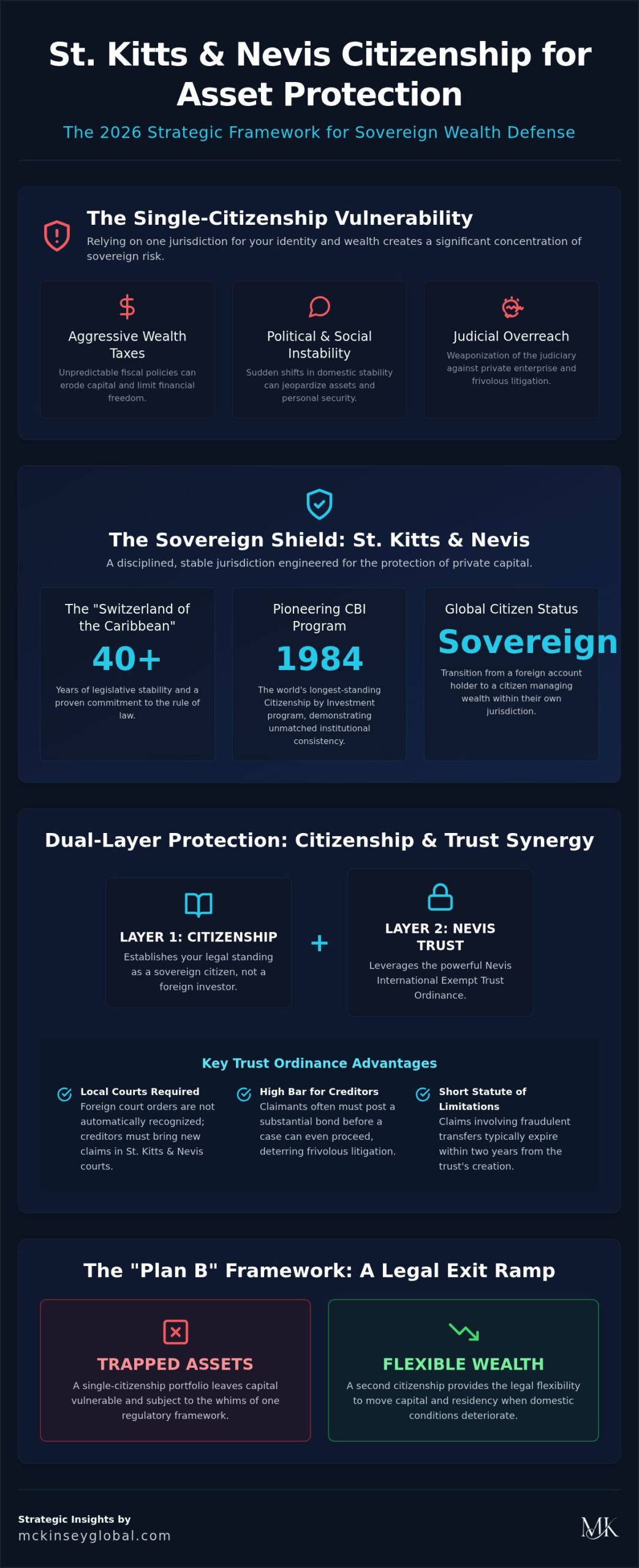
In the current global economic climate, traditional wealth management strategies that focus solely on asset class diversification are fundamentally incomplete. Relying on a single jurisdiction for both your personal identity and your global wealth creates a concentration of risk that most high-net-worth individuals wouldn’t accept in their investment portfolios. Utilizing st kitts and nevis citizenship for asset protection isn’t just about obtaining a travel document; it’s about establishing a sovereign hedge against the unpredictable actions of any single government.
St. Kitts and Nevis has earned a reputation as the “Switzerland of the Caribbean” due to its long-standing commitment to legislative stability and its pioneering role in the investment migration industry. Since establishing its program in 1984, the federation has provided a disciplined environment where wealth can be organized with a high degree of autonomy and legal distance from restrictive home jurisdictions. This historical consistency offers a level of predictability that’s rare in the volatile landscape of 2026.
Mitigating Sovereign Risk through Diversification
Sovereign risk is the probability that a government’s actions, whether through legislative changes, fiscal instability, or judicial overreach, will negatively impact the value or accessibility of an individual’s private assets. In 2026, these threats often manifest as aggressive wealth taxes, sudden shifts in domestic political stability, or the weaponization of the judiciary against private enterprise. A single-citizenship portfolio is a strategic vulnerability because it leaves the individual entirely subject to the whims of one regulatory framework. The “Plan B” framework utilizes a second citizenship as a legal exit ramp, ensuring that your assets aren’t trapped within a single political or economic ecosystem. It provides the necessary flexibility to move capital and residency when domestic conditions deteriorate.
Citizenship as the Final Layer of Defense
While offshore accounts and corporate structures offer some protection, they remain vulnerable to information exchange treaties and extra-territorial reach. Citizenship provides a deeper layer of defense by altering the legal standing of the investor in international disputes. When you hold a passport from the St. Kitts and Nevis Citizenship by Investment Program, you’re no longer a foreign national attempting to shield assets; you’re a citizen of a sovereign state exercising your right to manage wealth within your own jurisdiction. This transition from a mere account holder to a sovereign citizen provides both the legal framework and the psychological security required to navigate complex global landscapes with confidence. It establishes a permanent, stable home for your wealth that remains unaffected by the fiscal desperation of other nations.
St. Kitts and Nevis: A Sovereign Shield for Global Wealth
The federation of St. Kitts and Nevis provides a legislative environment specifically engineered for the rigorous protection of private capital. Since its inception in 1984, the country has maintained the world’s longest-standing Citizenship by Investment program, offering a level of institutional stability that few jurisdictions can match. This longevity is a critical factor for investors seeking st kitts and nevis citizenship for asset protection, as it demonstrates a multi-decadal commitment to the rule of law and the rights of global citizens. By establishing a permanent legal link to a jurisdiction with such a consistent track record, investors can insulate their wealth from the volatility of less stable regions.
The St. Kitts and Nevis Trust Act and Asset Safety
The synergy between the citizenship program and the federation’s trust legislation, specifically the Nevis International Exempt Trust Ordinance, creates a formidable barrier against external legal threats. Unlike many jurisdictions that readily recognize foreign court orders, St. Kitts and Nevis requires creditors to bring their claims before local courts. This process involves a significantly high bar for entry, often requiring a substantial bond to be posted before a case can even proceed. Additionally, the statute of limitations for claims involving fraudulent transfers is notably short, frequently expiring within two years from the trust’s creation. These provisions ensure that assets held within this framework are insulated from frivolous litigation and aggressive judicial overreach from foreign powers.
Tax Neutrality and Wealth Preservation
Wealth preservation is further enhanced by the federation’s tax-neutral status for non-resident citizens. St. Kitts and Nevis doesn’t levy personal income, gift, or inheritance taxes on income earned outside its borders. This allows for the legal restructuring of global liabilities according to official government citizenship guidelines, providing a stable environment for capital growth. It’s essential to understand that legal tax optimization through residency is a legitimate strategic practice focused on aligning one’s fiscal footprint with sovereign laws, which is distinct from illegal tax evasion. This distinction is vital for maintaining a compliant yet efficient global wealth architecture.
In a post-Common Reporting Standard (CRS) world, where global transparency is the norm, the federation maintains a disciplined approach to privacy. While it adheres to international regulatory requirements, it provides a layer of confidentiality by ensuring that the relationship between the citizen and their assets is governed by a stable, sovereign legal code. Those looking to integrate these benefits into a broader wealth strategy should consider how a bespoke advisory approach can navigate these complex regulatory requirements while maintaining maximum security.
Comparative Analysis: Why St. Kitts Leads in Asset Security
While several Caribbean nations offer pathways to secondary nationality, St. Kitts and Nevis distinguishes itself through a deliberate strategy of exclusivity and rigorous oversight. The federation’s decision to maintain higher investment thresholds than its regional counterparts, such as Antigua, Dominica, or St. Lucia, is a calculated move to preserve the program’s integrity. In the current regulatory environment, a higher barrier to entry serves as a natural filter, ensuring that the citizen body remains composed of high-caliber individuals. This exclusivity is a fundamental component of st kitts and nevis citizenship for asset protection, as it prevents the jurisdiction from being associated with high-risk actors who could compromise the program’s international standing.
Program Integrity and International Reputation
The 2023 and 2024 program reforms marked a significant shift in how the federation manages its sovereign identity. By transitioning the St. Kitts and Nevis Citizenship by Investment Unit into an independent statutory corporation in October 2024, the government established a more disciplined and transparent administrative framework. This evolution reinforces the “Platinum Standard” branding that McKinsey views as essential for long-term wealth security. Investors should recognize that “cheap” passports often carry hidden costs, including increased scrutiny from global financial institutions and a higher likelihood of visa-free travel revocations. For a detailed breakdown of the current financial requirements, consult our St. Kitts and Nevis Citizenship by Investment: The 2026 Strategic Guide.
Legal Stability and Judicial Independence
Asset protection is only as effective as the court system that enforces it. St. Kitts and Nevis benefits from its membership in the Eastern Caribbean Supreme Court (ECSC), a regional judicial body known for its independence and adherence to English Common Law principles. This judicial reliability provides a predictable environment for resolving disputes, which is often lacking in other jurisdictions where political influence can seep into the courtroom. The ECSC serves as a steady guardian of investor rights, ensuring that wealth structures remain governed by law rather than political whim. Beyond the legal protections, the mobility benefits of the program remain a top priority for global strategists. You can find more information on these advantages in our Strategic St. Kitts and Nevis Passport Benefits: A 2026 Executive Briefing. Choosing St. Kitts and Nevis means aligning your legacy with a jurisdiction that values procedural integrity and long-term stability above all else.
Implementing a Multi-Layered Protection Strategy in 2026
Transitioning from a single-jurisdiction vulnerability to a multi-layered defense requires a methodical approach that prioritizes long-term stability. In 2026, the process of securing st kitts and nevis citizenship for asset protection begins with a comprehensive sovereign risk audit. This audit evaluates your current portfolio against potential legislative shifts, aggressive fiscal policies, and geopolitical instability. Once these vulnerabilities are identified, the next step involves aligning your citizenship acquisition with the establishment of robust offshore structures, ensuring that your legal identity and wealth management vehicles operate in unison to provide a cohesive shield.
The 2026 regulatory landscape requires precise navigation of the available investment pathways to ensure full compliance and security. Applicants can choose between the Sustainable Island State Contribution (SISC), which requires a minimum non-refundable contribution of US$250,000 for a family of up to four, or the approved real estate option starting at US$325,000. It’s critical to observe the July 31, 2026, deadline for biometric ePassports and the mandatory interview requirement for all applicants over the age of 16. These steps aren’t mere formalities; they’re essential components of the federation’s enhanced vetting process that protect the longevity of your status.
Integrating Citizenship with Offshore Trusts
Holding assets through a Nevis International Exempt Trust as a citizen provides a superior level of protection compared to non-resident structures. This arrangement maximizes privacy and significantly minimizes probate complexity, as the assets are governed by a stable, local legal framework that doesn’t recognize foreign judgments. For entrepreneurs looking to scale, Second Passport Strategic Planning: A 2026 Executive Framework for Business Expansion offers a roadmap for integrating these protections into broader corporate growth strategies without compromising security.
Maintaining Compliance in a Transparent World
Effective asset protection in 2026 is founded on transparency and strict adherence to international standards like CRS and FATCA. It’s a common misconception that safeguarding wealth requires tax secrecy. Instead, a second citizenship should be used to simplify global compliance burdens by establishing a clear, legitimate fiscal home. By maintaining meticulous records and ensuring full disclosure to relevant authorities, you provide clarity to global financial institutions, which reduces the likelihood of account freezes or intrusive audits. This disciplined approach ensures that your “sovereign shield” remains impenetrable and respected by the international community.
Achieving this level of strategic alignment requires the insight of a seasoned advisor who understands the nuances of the current regulatory environment. To begin your sovereign risk audit and explore your options, contact our boutique advisory team today.
Navigating the St. Kitts Application with McKinsey Advisory
Securing st kitts and nevis citizenship for asset protection requires more than a financial contribution; it demands a partnership with an advisor who values procedural integrity and strategic foresight. McKinsey Citizenship and Residency Solutions approaches each mandate with the disciplined precision of a global strategist, ensuring that every variable is aligned before an application enters the government’s vetting queue. Our firm functions as a meticulous gatekeeper, prioritizing the long-term stability of your international status over the speed of processing.
The McKinsey approach is characterized by a formal, consultative methodology that mirrors the complexity of the global financial landscape. We don’t view the Sustainable Island State Contribution (SISC) as a mere transaction, but as a strategic investment in your sovereign identity. Our advisors manage the entire lifecycle of the SISC process, from initial capital allocation to the final issuance of the Certificate of Registration, ensuring that every step adheres to the federation’s rigorous 2026 standards.
Professional Vetting and Procedural Integrity
In the context of a 2026 application, pre-screening is the most critical phase of the process. McKinsey’s internal due diligence protocols are designed to identify potential hurdles, such as source-of-wealth complexities or jurisdictional restrictions, before they reach the Citizenship by Investment Unit. This proactive vetting is the first line of defense for your application, as a rejection in the Caribbean can have cascading effects on your global mobility and future asset protection strategies. We ensure that every document, from medical records to financial statements, meets the exact specifications required for a successful outcome.
Your Next Steps in Sovereign Wealth Protection
Finalizing your sovereign shift involves more than receiving a passport. It requires the seamless integration of your new status into your existing wealth structures, trusts, and corporate holdings. We guide you through this transition, ensuring that your international assets are fully aligned with your new jurisdictional identity and that all multi-jurisdictional reporting requirements are met with precision. This holistic approach ensures that your sovereign shield is not only established but also fully functional within your broader wealth preservation architecture.
To begin your sovereign transition and explore how this program can be tailored to your specific asset protection goals, the first step is a confidential briefing with our senior strategists. Contact McKinsey Citizenship and Residency Solutions to schedule a confidential consultation and initiate your strategic framework for 2026.
Securing Your Generational Legacy through Sovereign Diversification
Establishing a “Plan B” is no longer an optional luxury for the global investor; it’s a fundamental requirement for maintaining long-term financial autonomy. Throughout this framework, we’ve analyzed how the federation’s legal statutes and the 2026 SISC requirements create an elite environment for wealth preservation. By integrating a second passport with robust offshore trust structures, you create a multi-layered defense that transcends traditional portfolio management. Utilizing st kitts and nevis citizenship for asset protection is a strategic decision that aligns your family’s interests with one of the world’s most stable and disciplined jurisdictions.
McKinsey Citizenship and Residency Solutions has specialized in Caribbean investment migration since 2019, providing the meticulous vetting and confidential advisory required by high-net-worth individuals. We operate as your dedicated gatekeeper, ensuring every procedural detail meets the highest standards of compliance. Secure your global assets with McKinsey’s St. Kitts advisory services and ensure your legacy remains protected under a sovereign shield. Taking this step today provides the clarity and peace of mind necessary to navigate the complexities of tomorrow with absolute confidence.
Frequently Asked Questions
Is St. Kitts and Nevis citizenship recognized for asset protection by international courts?
International courts recognize the validity of sovereign citizenship, which fundamentally alters your legal standing in global disputes. While a foreign court may attempt to assert jurisdiction, your status as a St. Kitts and Nevis citizen allows you to invoke the federation’s domestic protections. This sovereign recognition ensures that your assets are governed by the laws of your chosen jurisdiction rather than the potentially aggressive statutes of a foreign power.
Can I include my family in the St. Kitts citizenship application for wealth protection?
You may include a spouse, children up to age 30, and parents from age 55 in your application. Extending st kitts and nevis citizenship for asset protection to your dependents is a critical strategic move. It ensures that your entire family unit operates under the same sovereign shield; this prevents individual members from being targeted by foreign jurisdictions seeking to gain leverage over your global wealth.
What is the minimum investment for St. Kitts citizenship in 2026?
The minimum investment for 2026 is US$250,000 via the Sustainable Island State Contribution (SISC) for a single applicant or a family of four. For those choosing the real estate pathway, the minimum investment in an approved project is US$325,000. These thresholds reflect the program’s commitment to the “Platinum Standard,” ensuring that the jurisdiction remains exclusive and respected by international regulatory bodies and global financial institutions.
How does the St. Kitts and Nevis Trust Act protect against foreign lawsuits?
The Nevis International Exempt Trust Ordinance provides a formidable defense by refusing to recognize foreign court orders. Creditors must initiate new legal proceedings within the federation and post a significant bond before the court will hear the case. Additionally, a strict two-year statute of limitations on fraudulent transfer claims ensures that once assets are settled into the trust, they become increasingly difficult for external litigants to reach.
Do I need to live in St. Kitts to benefit from its asset protection laws?
There is no requirement to reside in the federation to benefit from its robust asset protection framework. You can manage your global holdings and maintain your sovereign status from any international location. While physical residency is not mandatory, some high-net-worth individuals choose to establish a second home in St. Kitts to further solidify their jurisdictional ties and enhance their personal security in a stable, elite environment.
How does St. Kitts citizenship affect my tax reporting obligations under CRS?
Citizenship allows you to legitimately establish a new fiscal home, but it does not bypass the Common Reporting Standard (CRS). St. Kitts and Nevis is a compliant jurisdiction that adheres to global transparency requirements. The benefit lies in the ability to organize your wealth within a stable regulatory environment while ensuring that all reporting is handled through a jurisdiction that respects the privacy and legal rights of its citizens.
What happens if my home country does not allow dual citizenship?
If your home country prohibits dual nationality, you must approach the application with extreme caution. You may need to consider whether the benefits of st kitts and nevis citizenship for asset protection outweigh the loss of your original passport. In such high-stakes scenarios, we recommend a confidential briefing to explore alternative residency solutions or the strategic implications of renunciation, ensuring your global identity remains secure and legally sound.