In the current global economy, a second passport has evolved from a luxury travel document into a critical component of a disciplined corporate risk-management strategy. Utilizing a second passport for business expansion is no longer an optional advantage; it’s a necessary framework for maintaining operational continuity in an increasingly fragmented regulatory environment. You likely recognize that over-reliance on a single jurisdiction creates a dangerous bottleneck for your enterprise. Whether it’s restricted travel hindering short-notice deal-making or over-exposure to a single regulatory environment, the limitations of a single nationality can stifle global growth.
This executive framework details how sophisticated entrepreneurs are leveraging residency and citizenship programs to secure market access and mitigate systemic risks. You’ll discover how global leaders use dual citizenship as a sophisticated tool for market entry, risk mitigation, and talent mobility. We’ll examine the strategic advantages of specific pathways in regions like the Caribbean and Europe, focusing on how these programs establish a robust “Plan B” for business continuity. From gaining unrestricted access to the Schengen Area to enhancing corporate credibility in international banking, this briefing provides the clarity needed to align complex variables for long-term stability.
Key Takeaways
- Understand why modern executives are transitioning from tax-centric motivations to using a second passport for business expansion as a primary driver of operational agility.
- Evaluate how specific Caribbean and European programs facilitate the rapid establishment of satellite offices and provide streamlined access to high-value global markets.
- Analyze the role of alternative residency as a strategic hedge against regional instability, emphasizing the necessity of vetting compliance to protect corporate reputation.
- Apply a multi-jurisdictional evaluation framework to compare investment pathways based on capital efficiency, speed of processing, and long-term access objectives.
- Recognize the importance of procedural integrity and professional advisory in aligning complex global variables for a secure and compliant transition.
The Evolution of Investment Migration: From Lifestyle Asset to Strategic Corporate Tool
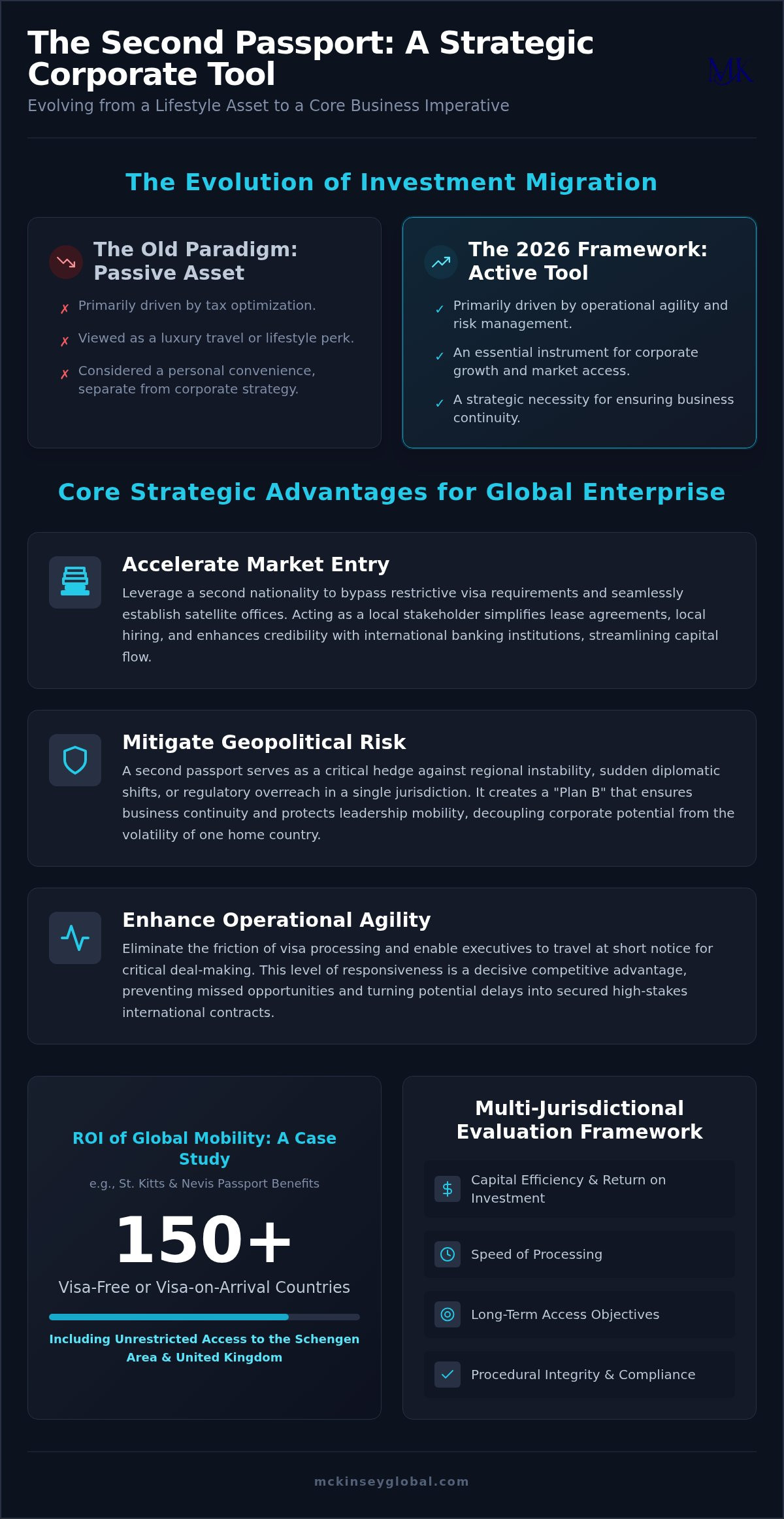
Strategic planning in the context of investment migration is the deliberate alignment of an individual’s legal identity with long-term corporate growth objectives. In the 2026 environment, the motivation for acquiring a second passport for business expansion has transitioned from passive tax optimization to active operational agility. The Evolution of Investment Migration demonstrates that these programs are no longer merely about personal convenience; they’re essential instruments for diversifying a global professional portfolio. Executive-level mobility isn’t a perk. It’s a prerequisite for competitive international trade. When your ability to close a deal depends on your presence in a foreign capital within forty-eight hours, the limitations of a single nationality become a liability that few firms can afford to carry.
The 2026 Geopolitical Context for Investors
As global alliances shift and trade blocs reorganize, the strength of a single passport fluctuates with unpredictable volatility. For a CEO, relying on one citizenship represents a single point of failure that can paralyze operations during sudden diplomatic shifts or regional conflicts. Sophisticated investors now practice jurisdictional arbitrage. This involves positioning corporate and personal interests across multiple legal environments to ensure stability and continuity. By decoupling business potential from the limitations of a home country, executives protect their enterprises against regional shocks and regulatory overreach. This methodical approach to residency ensures that a company’s leadership remains mobile and functional, regardless of domestic political changes or economic instability in their primary jurisdiction.
Defining the ROI of Global Mobility
Measuring the return on investment for citizenship requires looking beyond the initial capital outlay and focusing on the strategic value of market access. While many view the required contribution as a sunk cost, a strategic evaluation reveals it as an investment in friction-less commerce. The true value lies in the elimination of bureaucratic barriers. Consider the cumulative hours lost to visa processing for an executive team; these delays often result in missed opportunities and stalled negotiations. Utilizing st kitts and nevis passport benefits allows for short-notice deal-making in over 150 countries, including the Schengen Area and the United Kingdom. This level of responsiveness is often the deciding factor in securing high-stakes international contracts. A second passport for business expansion provides the enhanced corporate credibility necessary to open doors at international banking institutions, facilitating smoother capital movement and more efficient global operations.
Accelerating Market Entry: Leveraging Dual Nationality for Global Operational Agility
Securing a physical footprint in a new market often requires more than just capital; it requires legal standing. A second passport for business expansion facilitates the seamless establishment of satellite offices by bypassing the restrictive visa requirements that often delay corporate growth. Leveraging Dual Nationality for Global Operational Agility allows executives to act as local stakeholders, simplifying the process of lease agreements, local hiring, and utility setups. Beyond logistics, there’s a significant “credibility factor” associated with jurisdictions that maintain rigorous vetting standards. Banks and regulatory bodies view investors who have passed these high-level due diligence processes with greater confidence, which streamlines the opening of corporate accounts and the movement of capital.
Expanding into the Schengen Zone via Greece and Portugal
Establishing a logistical hub within the European Union provides a strategic advantage for firms targeting the EMEA region. Greece Residency by Investment remains a preferred choice for those requiring a physical base near major shipping lanes and trade routes. Meanwhile, the portugal golden visa serves as a premier gateway to a highly skilled EU workforce. It offers a path to residency that doesn’t demand immediate relocation, allowing executives to manage global operations while maintaining a foothold in the Schengen Zone. This flexibility is vital for leaders who must balance international travel with the need for a stable European corporate presence. For those evaluating these complex pathways, a confidential consultation can provide the necessary procedural precision.
Caribbean Gateways: Antigua, St. Kitts, and St. Lucia
Caribbean jurisdictions offer rapid entry points into global markets through their well-established citizenship programs. When comparing antigua and barbuda investment options, business-minded families often find the program’s flexibility ideal for multi-generational planning. For corporations requiring immediate speed to market, the St. Lucia and Dominica pathways provide some of the most efficient processing timelines in the industry. These programs allow for swift deployment of personnel and resources. Additionally, the strategic use of St. Kitts and Nevis remains a cornerstone for wealth protection. Its robust legal framework and established reputation in international banking make it an invaluable asset for securing corporate assets. Holding such a passport signals a commitment to transparency and compliance, qualities that are essential for long-term business expansion in a scrutinized global economy.
Mitigating Geopolitical Risk: Ensuring Business Continuity Through Alternative Residency
Alternative residency functions as a critical hedge against domestic political or economic instability, providing a secure foundation for business continuity. When an executive holds a second passport for business expansion, they possess the ability to maintain uninterrupted service even during regional crises. This mobility ensures that leadership remains present where they are most needed, regardless of local volatility. While some perceive the rigour of due diligence as a hurdle, it serves as a powerful trust-building mechanism for international partners. Successfully passing high-stakes vetting signals to global stakeholders that your corporate reputation and personal background meet the highest standards of procedural integrity.
The Role of Due Diligence in Wealth Protection
In 2026, Caribbean nations have refined their multi-tiered vetting processes to include independent intelligence firms, INTERPOL checks, and specialized local units. This comprehensive evaluation ensures that only individuals of the highest character are granted citizenship. From a strategic perspective, a clean second citizenship significantly enhances an executive’s global banking profile. Financial institutions in major hubs prioritize clients who have already been cleared by these rigorous national security frameworks. McKinsey Citizenship and Residency Solutions operates as a meticulous gatekeeper throughout this process; we manage the complexities of vetting to ensure that every application adheres to the strictest compliance standards. Executives seeking to leverage St. Kitts and Nevis citizenship for asset protection will find that the program’s enhanced privacy protocols and sovereign legal framework provide an additional layer of security for generational wealth preservation.
Supply Chain and Talent Mobility
Establishing residency in strategic locations like Türkiye or the United Arab Emirates provides a vital bridge between Eastern and Western markets. The United Arab Emirates Residency Solutions, particularly the pathways leading to the Dubai Golden Visa, have become a primary strategy for attracting and retaining top-tier global talent. This residency allows firms to offer their essential staff a stable environment with world-class infrastructure. During periods of regional volatility, the ability to relocate key personnel to a secure jurisdiction is a fundamental component of a robust Plan B. By utilizing a second passport for business expansion alongside strategic residency, corporations can protect their supply chains and ensure that their most valuable assets, their people, remain productive and safe.
Strategic Planning for Citizenship Acquisition: A Multi-Jurisdictional Evaluation Framework
Selecting the appropriate second passport for business expansion requires a methodical evaluation of competing priorities. An executive must determine whether the primary objective is immediate mobility or deep integration into the European Union’s economic infrastructure. While Caribbean programs offer a streamlined “Speed to Market” with processing times often ranging from four to eight months, European residency solutions provide a long-term pathway to the Schengen Zone. Capital requirements vary significantly between these regions; Caribbean citizenship typically involves a lower initial outlay compared to the more substantial investment thresholds required for European residency. Beyond capital considerations, the impact on an executive’s schedule is a critical variable. Most Caribbean jurisdictions impose no physical stay requirements, whereas European programs often mandate a minimum presence to maintain legal standing.
Matching Jurisdictions to Business Goals
A disciplined framework aligns a jurisdiction’s specific attributes with a firm’s expansion trajectory. For enterprises requiring immediate mobility and international banking credibility, St. Kitts and Nevis or Antigua and Barbuda represent the most efficient pathways. These programs facilitate rapid travel and capital movement without the need for relocation. Conversely, if the goal is EU Market Integration, programs in Greece, Portugal, or Latvia are superior. These jurisdictions allow for the establishment of a physical base within the world’s largest single market. For firms pursuing a Regional Hub Strategy, the United Arab Emirates and Türkiye offer unique advantages as bridges between diverse global markets. Each choice involves a careful evaluation of adherence to standards and long-term stability.
Tax and Compliance Realities of Dual Residency
It’s essential to distinguish between the acquisition of citizenship and the establishment of tax residency. While a second passport provides the legal right to reside in a country, tax obligations are typically determined by physical presence and the center of economic interests. Aligning a second citizenship with global tax planning strategies requires a high level of expertise to avoid unintended regulatory exposure. High-net-worth individuals who are concerned about aggressive fiscal environments should explore how St. Kitts and Nevis citizenship for asset protection can establish critical legal distance between personal wealth and restrictive home jurisdictions. Engaging professional citizenship by investment consultants is a necessary step in navigating these complex variables. A meticulous evaluation ensures that your global mobility strategy remains compliant with international standards while protecting your corporate assets. To begin your evaluation, you should request a formal program comparison from our advisory team.
Executing Your Global Mobility Strategy with McKinsey Citizenship and Residency Solutions
McKinsey Citizenship and Residency Solutions operates with a commitment to procedural integrity and absolute confidentiality. As a boutique advisory, we prioritize the alignment of complex variables to ensure your transition is seamless. We don’t just provide information; we act as a steady guide through the intricate international landscapes that define investment migration. By focusing exclusively on strategic pathways, we ensure that every client’s acquisition of a second passport for business expansion is handled with the precision required for high-stakes corporate planning. Our methodology involves a thorough assessment of your current portfolio and future expansion goals to identify the most resilient jurisdictions. This methodical approach ensures that your global mobility strategy is built on a foundation of long-term stability and risk mitigation.
The McKinsey Advisory Advantage
Our firm specializes in government-approved investment migration pathways, providing end-to-end support from the initial evaluation to the final acquisition of your document. We strictly exclude management consulting services from our portfolio. This specialization allows us to maintain a disciplined focus on the regulatory frameworks and vetting standards that govern global mobility. You’re in the hands of a partner who values order and compliance above all else. Our team manages every detail of the application process, ensuring that all documentation meets the rigorous standards of the host nation. This meticulous approach minimizes uncertainty and protects your corporate reputation. We understand that for an executive, time is the most valuable asset. Our process is designed to be efficient without compromising on the thoroughness required by international law. Consult with our strategic advisors for a bespoke residency plan.
Finalizing the 2026 Global Strategy
Jurisdictional diversification is a necessity for the modern entrepreneur who seeks to protect their enterprise from regional volatility. Waiting for a crisis to occur before seeking alternative residency is a strategic failure. You should take a proactive approach to mobility now, before regulatory windows tighten and investment thresholds increase. A second passport for business expansion is a functional asset that secures your company’s future. It provides the operational agility required to pivot in a changing global economy. For those requiring deep-dive technical details on specific programs, our St. Kitts and Nevis Strategic Guide offers an exhaustive analysis of the 2026 requirements. Aligning your business goals with the right global program requires foresight and a partner committed to your long-term stability. Secure your framework for expansion today by engaging with a consultant who understands the gravity of your international ambitions.
Securing Your 2026 Global Growth Framework
Adopting a second passport for business expansion is no longer a matter of personal preference; it’s a strategic necessity for the modern executive. By aligning your legal identity with your corporate objectives, you ensure that travel restrictions and regional instabilities don’t dictate your firm’s growth trajectory. This framework provides the operational agility required to capitalize on short-notice opportunities while maintaining a robust “Plan B” for business continuity. Success in this complex landscape requires a partner who prioritizes procedural precision and rigorous adherence to global compliance standards.
McKinsey Citizenship and Residency Solutions offers the boutique advisory services needed to navigate high-stakes vetting and multi-jurisdictional requirements. Whether your goals involve European residency or Caribbean citizenship in nations like St. Kitts and Nevis or Antigua and Barbuda, our focus remains on long-term stability and security. It’s time to move beyond the limitations of a single jurisdiction and embrace a more resilient international presence. Secure your business future with a bespoke global mobility strategy and take the first step toward a more secure, unrestricted commercial future. Your enterprise’s global potential is waiting.
Frequently Asked Questions
What is the primary business advantage of a second passport in 2026?
The primary advantage in 2026 is the achievement of operational agility through unrestricted global mobility. A second passport for business expansion allows executives to bypass bureaucratic travel delays, enabling short-notice attendance at high-stakes negotiations. Beyond travel, it facilitates the establishment of satellite offices in business-friendly regions. This strategic asset ensures that corporate leadership remains functional and responsive during regional geopolitical shifts or domestic regulatory changes.
How much does second passport strategic planning typically cost for an executive?
Total costs vary significantly based on the specific jurisdiction and the chosen investment pathway. While we don’t quote fixed fees without a formal evaluation, expenses generally include the government-mandated investment or contribution, due diligence fees, and professional advisory costs. It’s essential to view these outlays as a strategic investment in market access rather than a sunk cost. Each program has distinct capital requirements that must be aligned with your firm’s long-term liquidity and expansion goals.
Can a second passport help with corporate tax planning and wealth protection?
A second passport serves as a robust tool for wealth protection by diversifying your legal and economic footprint. While citizenship itself doesn’t automatically change tax obligations, it provides the legal framework necessary to establish tax residency in more favorable environments. This diversification protects corporate assets from over-exposure to a single regulatory or fiscal system. Strategic planning ensures that your global mobility goals are harmonized with international compliance standards to maintain a clean corporate reputation.
Which citizenship by investment program is fastest for business expansion?
Caribbean programs, specifically St. Kitts and Nevis or Antigua and Barbuda, are currently the most efficient pathways for rapid market entry. These jurisdictions often process applications within four to eight months, providing the fastest route to enhanced mobility. This speed is critical for executives who need to execute a second passport for business expansion on a condensed timeline. While European programs offer deeper market integration, they typically require a longer commitment and more extensive procedural timelines.
Do I need to live in the country to maintain my second citizenship or residency?
Physical stay requirements depend entirely on the jurisdiction you select for your residency or citizenship. Most Caribbean programs, such as those in St. Lucia or Dominica, don’t require applicants to reside in the country to maintain their status. In contrast, European residency solutions like the Portugal Golden Visa or Greece Residency by Investment often mandate a minimum annual presence. Understanding these logistical variables is vital for ensuring that your mobility strategy doesn’t conflict with your global operational schedule.
How does McKinsey Citizenship and Residency Solutions differ from other firms?
McKinsey Citizenship and Residency Solutions operates as a specialized boutique advisory focusing exclusively on high-stakes investment migration. Unlike larger firms, we don’t offer management consulting or real estate brokerage, ensuring our expertise remains concentrated on procedural integrity and vetting compliance. With over five years of experience, we act as a steady guide through complex international landscapes. Our disciplined approach prioritizes long-term stability and meticulous adherence to government-approved standards for every client we serve.
Is it possible to include my family and business partners in the application?
Most investment migration programs allow for the inclusion of immediate family members, including spouses and dependent children. While business partners typically need to submit individual applications, our firm can coordinate these filings to ensure a synchronized global mobility strategy for your entire executive team. This collective approach ensures that all key decision-makers possess the same level of access to critical markets. We manage these multi-party applications with the confidentiality and precision required for corporate leadership groups.
What are the vetting and due diligence requirements for 2026 programs?
Vetting requirements in 2026 are multi-tiered and involve rigorous due diligence by national security agencies and independent intelligence firms. Applicants must undergo comprehensive background checks, including INTERPOL screening and verification of the source of funds. These standards are designed to protect the integrity of the host nation’s passport and its international standing. Successfully navigating this process builds significant credibility with global banking institutions and international partners, signaling that your background meets the highest compliance standards.