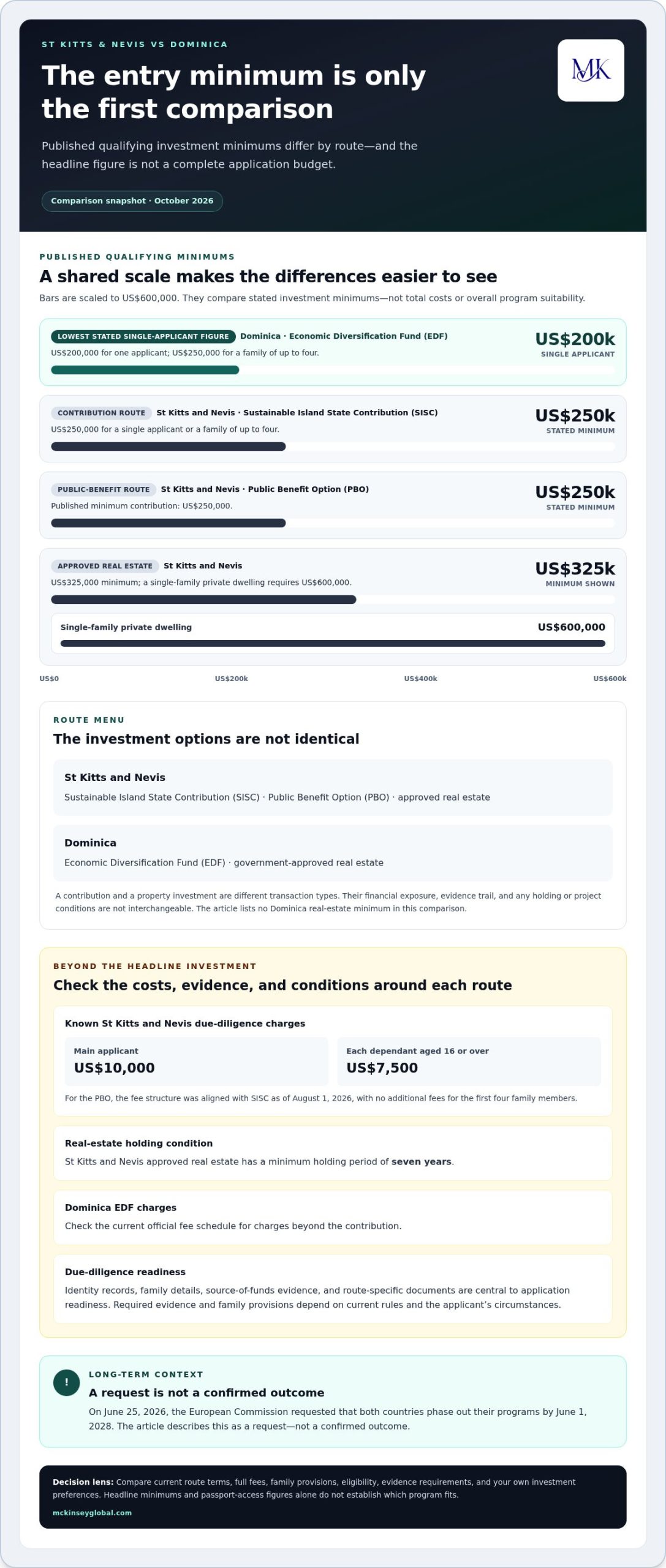
A lower entry threshold isn’t necessarily the better fit. For a single applicant, Dominica’s Economic Diversification Fund starts at US$200,000, compared with US$250,000 for St Kitts and Nevis’s Sustainable Island State Contribution. But headline investment figures reveal little about family costs, due diligence, physical-presence expectations, or the longer-term considerations behind St Kitts vs Dominica citizenship.
It’s understandable to start with cost or passport access, but neither alone determines which program aligns with your circumstances. Both programs face increased scrutiny, and their requirements and wider operating environment are evolving. The European Commission’s June 25, 2026 request for both countries to phase out their programs by June 1, 2028 also raises a long-term question. It is a request, not a confirmed outcome.
This comparison examines eligibility, qualifying investment routes, due diligence, and family applications, alongside practical factors that may shape your decision. You’ll see how to assess investment preferences, compliance responsibilities, and personal plans without relying on passport rankings alone, and what information to prepare before seeking professional application support.
Key Takeaways
- Assess personal eligibility, family circumstances, and investment preferences before narrowing your program options.
- Use the St Kitts vs Dominica citizenship comparison to evaluate qualifying pathways and application requirements, not passport rankings alone.
- Prepare a clear record of identity, family details, and source of funds to support due diligence readiness.
- Map your objectives and documentation needs before beginning an application, then consider how coordinated advisory support can assist with pathway assessment and application management.
St Kitts vs Dominica citizenship: what should investors compare first?
There is no universal winner. The more useful question is which program’s requirements, investment routes, and practical obligations fit your circumstances. A lower headline contribution or a higher passport-access figure may matter, but neither establishes personal eligibility or makes an application suitable for every family. Program rules, application costs, and travel access can change. Use the comparison below as a starting point, then review current official guidance.
What does “St Kitts vs Dominica citizenship” mean in practice?
Citizenship by investment is a legal pathway through which an eligible applicant may seek citizenship by making a qualifying investment and meeting the program’s application and due diligence requirements. Here, St Kitts refers to the Federation of Saint Kitts and Nevis. The comparison is between that federation’s citizenship program and Dominica’s citizenship program.
Citizenship, a passport, and an application are related but distinct. An application is the process of seeking approval; citizenship is the legal status sought; a passport is a travel document issued to a citizen. Residence by investment is different: it may grant a right to reside under specified conditions, but it does not, by itself, mean citizenship has been acquired. Keep these outcomes separate when deciding what you need.
Which decision factors matter beyond passport rankings?
Start with eligibility and personal objectives, then consider investment structure, family circumstances, and documentation readiness. For example, an investor considering a fund contribution should compare the available contribution routes, while a property-focused applicant should understand the approved real-estate pathway and its conditions. Family composition can affect the application scope and overall costs. These factors also shape the records and explanations needed for due diligence.
- St Kitts and Nevis: As of October 2026, qualifying routes include the Sustainable Island State Contribution, the Public Benefit Option, and approved real estate.
- Dominica: As of October 2026, the principal routes include the Economic Diversification Fund and government-approved real estate.
- For both: Eligibility, required evidence, fees, and family provisions depend on current program rules and the applicant’s circumstances.
- For either choice: Application readiness involves more than selecting a route. Documentation and due diligence are central considerations.
Passport-access figures describe reported travel privileges at a particular point in time. They do not measure eligibility, family fit, investment suitability, or the administrative demands of an application. Treat rankings as one reference point, not a decision rule. Before acting, verify current route terms, fees, family-member provisions, and travel-access claims against official sources, and record the date of your review. This first comparison helps identify which questions need closer examination in the program-specific review that follows.
How St Kitts and Dominica citizenship-by-investment pathways differ
As of October 2026, the clearest structural differences are the contribution and approved real-estate routes, along with their published minimums. The figures below are a comparison snapshot, not a full application budget. Check additional charges, eligibility rules, and document requirements against current program instructions before preparing an application.
Which qualifying investment routes are available in each program?
St Kitts and Nevis offers the Sustainable Island State Contribution (SISC), Public Benefit Option (PBO), and approved real estate. Dominica’s routes include the Economic Diversification Fund (EDF) and government-approved real estate. A contribution and a property investment are different transaction types. Their financial exposure, evidence trail, and holding or project conditions are not interchangeable.
| Program and route | Published minimum as of October 2026 | Eligibility and evidence considerations | Known charges |
|---|---|---|---|
| St Kitts and Nevis, SISC | US$250,000 for a single applicant or family of up to four | Applicant and family eligibility, identity records, source-of-funds evidence, and route documents must follow current program guidance. | Due diligence: US$10,000 for the main applicant and US$7,500 for each dependant aged 16 or over. |
| St Kitts and Nevis, PBO | US$250,000 | Evidence must support the application and the qualifying public-benefit project route. | As of August 1, 2026, the fee structure is aligned with SISC, with no additional fees for the first four family members. |
| St Kitts and Nevis, approved real estate | US$325,000; a single-family private dwelling requires US$600,000 | Property and transaction records are route-specific; the minimum holding period is seven years. | Due diligence charges above apply; other costs depend on the application and transaction. |
| Dominica, EDF | US$200,000 for one applicant; US$250,000 for a family of up to four | Applicant and family evidence, source of funds, and contribution records must align with current program requirements. | Check the current official fee schedule for charges beyond the contribution. |
| Dominica, approved real estate | US$200,000 | Property and payment documentation apply; the holding period is at least three years, or five years if resold to another CBI applicant. | Check the current official fee schedule for additional charges. |
For Dominica’s authoritative program information, consult the Official Dominica CBI Unit. Your route determines the evidence file. A contribution requires a traceable funding path and payment records, while real estate also requires transaction and property documentation. Source-of-funds review matters for both routes, but supporting records should explain the specific investment.
How do eligibility, family applications, and due diligence compare?
Don’t infer dependent eligibility from contribution thresholds alone. St Kitts and Nevis requires interviews for the main applicant and dependants over 16, according to the 2026 program information. Check age and dependency definitions, supporting documents, and current fees for each family member. Due diligence applies to the applicant and included dependants, and complete documentation does not assure approval.
In brief: St Kitts and Nevis has two contribution-based routes and an approved real-estate route, while Dominica offers a fund contribution and approved real estate, with distinct thresholds and route-specific evidence. Investors comparing St Kitts vs Dominica citizenship can use structured program pathway assessment to organize route, family, and documentation considerations before proceeding.
Which citizenship program fits your travel, family, and investment priorities?
A passport ranking can be a useful prompt, but it cannot tell you whether you qualify, whether a route suits your investment preferences, or how a program fits your family’s plans. For a sound comparison, start with the destinations you actually visit, the people you intend to include, and the investment conditions you can accept. Then weigh those priorities against current program rules rather than treating a ranking as a verdict.
How should families and globally mobile applicants assess fit?
Map each family member against the current dependent definitions and document requirements for both programs. A contribution threshold stated for a family of up to four does not, by itself, establish who qualifies as a dependant or what evidence each person must provide. For St Kitts and Nevis, the 2026 information specifies mandatory interviews for the main applicant and dependants over 16. Include this step in your family application planning.
Next, list your priority destinations and how often you travel to them. Visa-access rankings report entry privileges at a particular time, while individual destination rules can change independently of citizenship status. For example, U.S. Presidential Proclamation 10998, effective January 1, 2026, partially restricts new U.S. visa issuance for nationals of Dominica. Confirm the rules that apply to your nationality, travel purpose, and destination rather than assuming a second citizenship provides automatic entry.
How should investors evaluate contribution and investment routes?
Compare the commitment and conditions, not just the initial threshold. As of October 2026, Dominica’s EDF contribution is US$200,000 for a single applicant and US$250,000 for a family of up to four. Its approved real-estate route has a US$200,000 minimum and a holding period of at least three years, or five years if resold to another CBI applicant. St Kitts and Nevis offers contribution routes and approved real estate, with route-specific thresholds and a seven-year holding period for approved property. These obligations have different liquidity and investment characteristics. A contribution should not be treated as equivalent to property ownership.
| Priority | What to assess | Practical question |
|---|---|---|
| Destination access | Current entry rules for priority countries | Does the relevant travel permission match your actual itinerary? |
| Family inclusion | Dependent definitions, fees, documents, and interviews | Can each intended applicant meet the applicable criteria? |
| Capital and liquidity | Contribution versus property commitment and holding conditions | Which structure aligns with your risk tolerance and capital plans? |
| Long-term fit | Changing travel rules and program obligations | Would the citizenship remain useful if circumstances shift? |
Mobility benefits describe potential travel access; they do not determine eligibility or long-term suitability. Tax outcomes and rights associated with existing nationalities require separate, jurisdiction-specific analysis, not assumptions based on a second citizenship. Obtaining a passport should not be treated as automatic tax residence or proof that tax obligations elsewhere end. To compare how route structure can shape a decision, review this donation-versus-real-estate strategy comparison alongside current official program terms.
What to prepare before choosing St Kitts or Dominica citizenship
Start with your objectives, then organize the evidence that supports them. For a considered St Kitts vs Dominica citizenship decision, gather information that explains who is applying, why you are considering the route, and how the proposed investment will be funded. Forms, supporting records, and procedures vary by jurisdiction and can change, so use this sequence as general readiness guidance.
What information should applicants organise at the outset?
Build an overview of identity, family composition, residence history, finances, and the intended source of investment funds. For example, note relevant addresses and dates, identify each proposed family applicant and their relationship to the main applicant, and outline how the funds were accumulated and transferred. These are planning categories, not a complete list of official documents. Use current program requirements to identify the precise evidence needed for each person and route.
- Set your objectives. Record why you are considering citizenship, your priority travel destinations, intended timing, and any long-term family or business considerations.
- Map the applicants. List the main applicant and each family member you may include, with their relationship, age, nationality, and relevant residence details. Verify each person’s eligibility against current official definitions.
- Assess the investment structure. Identify whether a contribution or approved investment route better matches your objectives, liquidity preferences, and tolerance for route-specific conditions.
- Trace the source of funds. Prepare a coherent account of where the investment funds originated and how they will be transferred. Supporting records may need to connect income, business proceeds, asset sales, or other lawful sources to the available funds. The precise evidence depends on the case and official requirements.
- Reconcile the records. Compare names, dates, addresses, ownership details, and financial figures across forms and supporting documents. Resolve inconsistencies or prepare a clear explanation before planning submission.
How can applicants reduce avoidable process uncertainty?
An organized file makes it easier to identify missing information and address discrepancies, but it cannot guarantee approval or a particular timetable. Separate general preparation from program-specific rules. Check required forms, document validity, certification or translation standards, interview procedures, and any physical-presence obligations against current official instructions for the chosen jurisdiction. Processing periods can vary, and government authorities retain decision-making responsibility.
St Kitts and Nevis applicants can use this St Kitts and Nevis citizenship strategic guide as a planning reference while assembling questions and records. McKinsey Citizenship and Residency Solutions provides strategic guidance, document coordination, and application management for investors considering these pathways. Discuss your application preparation and pathway assessment as you move from initial objectives to a structured review.
How McKinsey supports a considered citizenship decision
A useful advisory process starts with the investor, not a predetermined program recommendation. McKinsey Citizenship and Residency Solutions advises on both St Kitts and Nevis citizenship and Dominica citizenship, helping applicants assess how their objectives, eligibility context, family needs, and investment preferences align with current program criteria. The firm is an independent boutique advisory, not a government authority; decisions on applications remain with the relevant authorities.
What does a structured program assessment cover?
The assessment connects your priorities to the current requirements of each pathway. It may include reviewing your intended investment structure, the family members you hope to include, and personal circumstances relevant to eligibility. Program rules can change, so assess route requirements and supporting information against current official guidance rather than relying only on older summaries or headline comparisons.
Two workstreams help organize preparation. Pathway assessment focuses on how available routes and their conditions align with your objectives. Documentation planning and due diligence preparation focus on assembling a coherent file, identifying information gaps, and coordinating relevant supporting records. Neither workstream can assure approval, but together they support a more deliberate process.
How can applicants move from comparison to application planning?
A considered progression keeps decisions and evidence connected while allowing the plan to reflect each applicant’s circumstances:
- Clarify objectives: Define the intended purpose of citizenship, family considerations, and investment preferences.
- Review the pathways: Compare current official criteria and route conditions against the applicant’s eligibility context.
- Plan the file: Identify documentation needs, organize source-of-funds information, and coordinate records for the main applicant and any dependants.
- Prepare for submission: Manage application preparation in line with applicable program procedures, while recognizing that authorities determine outcomes and processing periods can vary.
This sequence does not replace jurisdiction-specific requirements. It provides a framework for moving from broad comparison to a practical plan, tailored to the selected pathway and the people applying. If family composition or financial circumstances are complex, early coordination can help surface questions that need attention before the file advances.
The appropriate next step is an individual discussion of your objectives, eligibility context, family needs, and preferred investment structure. From there, pathway assessment and application management can be organized around the relevant program rules, without presuming either option suits every investor. Discuss your citizenship strategy to define a considered next step for your St Kitts and Nevis or Dominica application planning.
Make your next step a considered one
The most useful outcome of comparing St Kitts vs Dominica citizenship is a decision framework based on your priorities, not pressure to choose quickly. Before advancing, identify unresolved questions, such as how your family circumstances align with current criteria or which investment structure best fits your plans. These questions can guide a focused assessment and help you approach preparation with greater clarity.
McKinsey Citizenship and Residency Solutions advises investors on both St Kitts and Nevis and Dominica, providing strategic guidance and application management to support a structured process. The appropriate pathway is individual, and the relevant authorities retain responsibility for decisions. A clear discussion of your circumstances can help define what to examine next and how to organize the work ahead.
Discuss your citizenship strategy with McKinsey Citizenship and Residency Solutions and take the next step with a considered plan.
Frequently Asked Questions
Is St Kitts or Dominica citizenship better for investors?
Neither program is inherently better for every investor. The right fit depends on personal eligibility, the family members included, preferred investment structure, and the intended use of citizenship. For example, an applicant prioritising a contribution route may weigh different factors from someone considering approved real estate. When comparing St Kitts vs Dominica citizenship, assess current rules against your own requirements rather than treating passport rankings as a recommendation.
Can applicants include family members in a St Kitts or Dominica citizenship application?
Yes, both programs allow family applications, subject to current rules on eligible dependants and supporting evidence. As of October 2026, the stated SISC minimum in St Kitts and Nevis applies to a single applicant or a family of up to four, while Dominica’s EDF contribution has a family-of-four threshold. These thresholds do not determine every family member’s eligibility. Review each person’s relationship, age, dependency status, and documentation against current official criteria.
How much does citizenship by investment in St Kitts or Dominica cost in 2026?
As of October 2026, published minimums include US$250,000 for the St Kitts and Nevis SISC, US$250,000 for its PBO, and US$325,000 for approved real estate. A single-family private dwelling has a US$600,000 minimum. Dominica’s EDF starts at US$200,000 for one applicant and US$250,000 for a family of up to four, while approved real estate starts at US$200,000. These are investment minimums, not total application costs; fees and transaction expenses vary.
What happens if an applicant fails due diligence for a citizenship-by-investment program?
An application that does not meet due diligence standards may be refused, though the outcome and procedures depend on the relevant authority and program rules. Provide accurate, consistent information and disclose material facts rather than omitting issues in the hope they won’t be identified. If a record contains an error or a complex circumstance, organize a clear explanation and supporting evidence before submission. No advisor can guarantee that an authority will approve an application.
Do St Kitts and Dominica require applicants to live in the country?
Both programs have introduced physical-presence considerations, so applicants should not assume citizenship is entirely a documentary process. St Kitts and Nevis has introduced a genuine-link requirement. Dominica outlined a 30-day stay during the first five years of citizenship in an August 2026 budget address; implementation details had not been fully disclosed. Verify current rules and procedures before planning travel or making commitments.
Can a second citizenship change an investor’s tax obligations?
Acquiring another citizenship does not, by itself, establish an investor’s tax position. Obligations may depend on tax residence, income sources, assets, and the laws of each relevant jurisdiction, including the investor’s existing country of residence or nationality. Obtaining a passport should not be treated as automatic tax residence or proof that tax obligations elsewhere end. Seek advice from a qualified tax professional familiar with the jurisdictions involved.
How long does St Kitts or Dominica citizenship by investment take?
Processing for both programs is typically estimated at three to six months, but this is not a guaranteed timeframe. The actual duration may depend on the completeness of the file, due diligence, requests for further information, and the authority’s processing. Avoid making fixed travel or financial plans around an estimate, and rely on current program guidance when setting expectations.