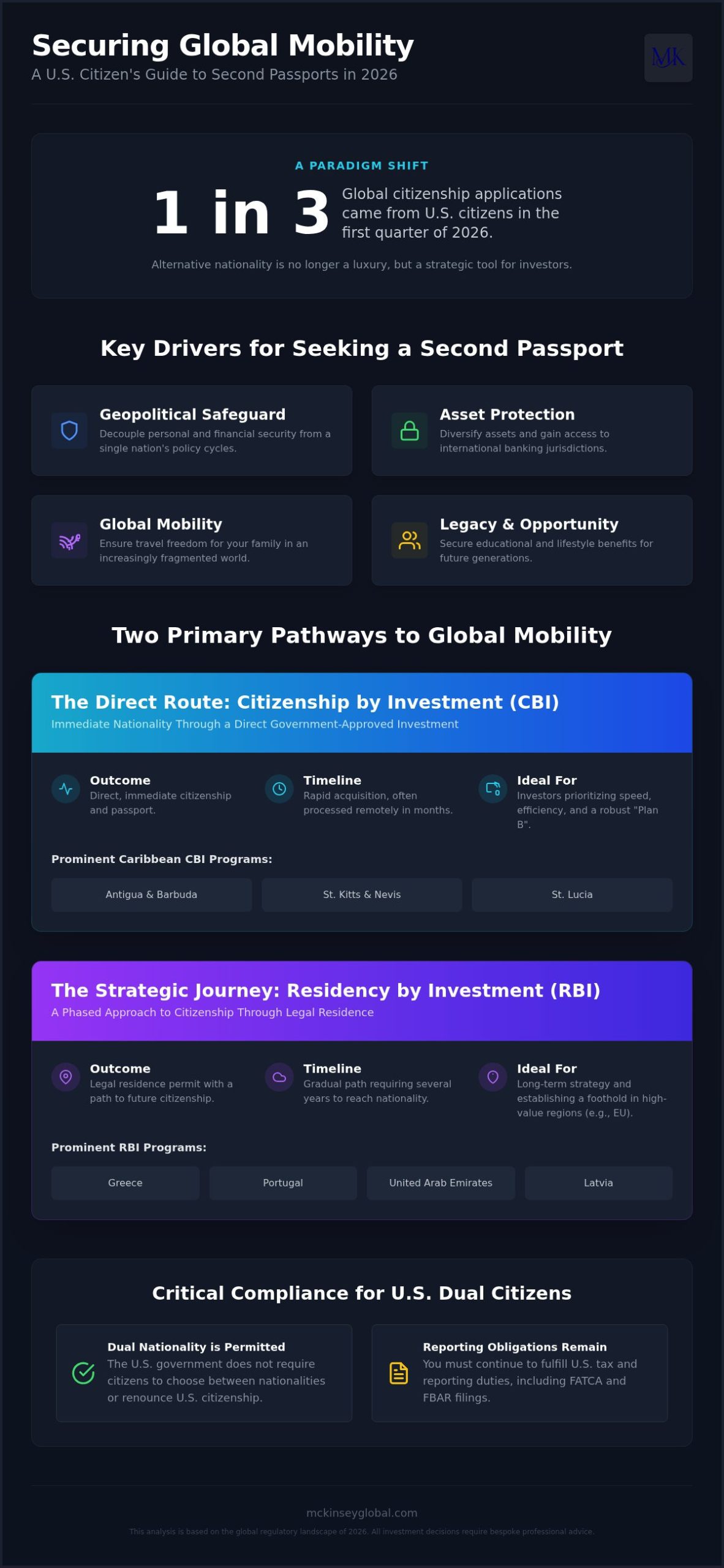
In the first quarter of 2026, US citizens accounted for nearly one in three global citizenship applications; this represents a stark departure from a decade ago when American interest in alternative nationality was a statistical outlier. You likely recognize that a second passport for US citizens is no longer a luxury for the ultra-wealthy, but rather a calculated necessity for any investor facing geopolitical instability and restrictive global tax reporting. It’s a prudent response to an increasingly volatile international landscape where jurisdictional diversification serves as a critical safeguard for your family and your capital.
This strategic guide offers a comprehensive analysis of investment-based citizenship and residency pathways designed to secure your global mobility and protect your assets. We will evaluate the most viable programs for 2026, including the refined donation frameworks in the Caribbean and the sophisticated residency solutions within Europe and the Middle East. By the conclusion of this briefing, you will possess the clarity required to align your international footprint with your long-term security and mobility objectives through a disciplined, compliant approach.
Key Takeaways
- Understand why a second passport for US citizens has transitioned from a travel luxury to a critical component of a disciplined global risk management strategy.
- Evaluate the strategic trade-offs between direct investment citizenship and residency-to-citizenship pathways to determine the most efficient timeline for your specific mobility goals.
- Review the 2026 regulatory updates for the “Platinum Standard” programs in Antigua and Barbuda and St. Kitts and Nevis to ensure your application meets the latest government-approved thresholds.
- Clarify the ongoing compliance requirements of FATCA and FBAR to maintain a secure and legal international footprint while holding dual nationality.
- Discover how a meticulous, expert-led advisory methodology minimizes application risk and ensures the strategic alignment of your new jurisdiction with your long-term asset protection needs.
The Strategic Imperative: Why US Citizens Seek a Second Passport in 2026
The global environment of 2026 has fundamentally altered the risk profile for American high-net-worth individuals. While the US passport historically provided unrivaled access, the contemporary landscape is defined by fragmentation and shifting diplomatic alliances. A second passport for US citizens is now viewed as a critical strategic asset rather than a secondary travel document. This shift is driven by a desire to decouple personal security and capital from the domestic policy cycles of a single nation. It’s a pragmatic response to a world where “Plan B” has become a standard requirement for wealth preservation.
Beyond the immediate benefits of travel freedom, alternative nationality provides a gateway to diverse banking and investment jurisdictions. Many international financial institutions have grown increasingly cautious regarding US-centric regulatory burdens. Holding a second citizenship can facilitate smoother access to global markets, allowing for asset diversification that remains insulated from specific regional shocks. This jurisdictional flexibility is a hallmark of the disciplined investor who prioritizes long-term stability over short-term convenience.
Defining Dual Nationality for the Modern Investor
Clarity regarding the legal framework is essential for any high-stakes application. Under the established principles of U.S. nationality law, dual citizenship is permitted. The US government does not require its citizens to choose between nationalities, provided they continue to fulfill their domestic obligations. It’s vital to distinguish between Residency by Investment (RBI) and Citizenship by Investment (CBI). RBI programs, like the Greece Residency by Investment or the Portugal Golden Visa, offer legal residence and a path to eventual nationality. Conversely, CBI programs in jurisdictions such as Antigua and Barbuda or St. Kitts and Nevis provide immediate citizenship. This second nationality acts as sovereign insurance, ensuring your family’s mobility isn’t dependent on a single government’s decisions.
Global Mobility and Access in a Fragmented World
Securing a second passport for US citizens addresses specific gaps in global access that a primary passport cannot always fill. Caribbean programs, for instance, offer streamlined entry to the United Kingdom and the Schengen Area, providing a redundant layer of travel security. European pathways offer the incomparable benefit of a foothold in the EU, which is invaluable for family legacy and educational opportunities. These programs are meticulously vetted to ensure compliance and long-term viability. By establishing residency in a stable jurisdiction like Latvia or the UAE, investors secure a base of operations that remains unaffected by domestic volatility. This strategic foresight protects not just the investor, but the safety and opportunity of future generations.
Evaluating Pathways: The Strategic Mobility Framework
Selecting a second passport for US citizens requires a disciplined evaluation of time-to-market versus long-term access. Investors must choose between direct Citizenship by Investment (CBI) and Residency by Investment (RBI) pathways. While CBI offers immediate sovereignty, RBI provides a strategic foothold in high-value regions like the European Union. We prioritize government-approved investment migration channels to ensure your application withstands the rigorous vetting procedures of 2026. This focus on procedural integrity minimizes the risk of jurisdictional instability affecting your status.
Compliance remains the foundation of this process. As outlined in the USA.gov guide to dual citizenship, maintaining legal standing is paramount for American investors. Our firm acts as a meticulous gatekeeper, ensuring that every selected pathway aligns with international regulatory standards. This strategic alignment is essential for protecting your family’s global legacy and capital. It’s a process that demands precision and a deep understanding of the evolving global regulatory framework.
The Caribbean Model: Speed and Efficiency
Caribbean jurisdictions like Antigua and Barbuda, St. Kitts and Nevis, and St. Lucia remain the most efficient routes for rapid acquisition. These programs allow for remote processing and expedited timelines; they often conclude within four to six months. For a detailed breakdown of current requirements, refer to our Antigua and Barbuda Investment Options: 2026 Guide. These nations have harmonized their regulations to maintain international reputation and security standards, making them a reliable choice for a second passport for US citizens.
The European and Middle Eastern Model: Long-term Presence
The European model focuses on residency as a precursor to citizenship. Greece and Portugal offer strategic access to the Schengen Zone, providing unmatched mobility within the continent. In the Middle East, the UAE Golden Visa serves as a premier hub for global commerce and tax efficiency, catering to those who require a stable base in a primary financial center. Türkiye offers a unique bridge between East and West, where strategic property acquisition leads to direct citizenship. Matching your profile to the correct jurisdiction is a meticulous task. You can explore our full range of residency and citizenship solutions to begin your strategic evaluation.
Top Investment Programs for US Citizens in 2026
The selection of a second passport for US citizens in 2026 involves a meticulous evaluation of jurisdictional integrity and long-term strategic value. As global standards for investment migration tighten, programs that prioritize rigorous due diligence and transparent investment channels have emerged as the most reliable options. We focus on government-approved pathways that balance the immediate need for mobility with the necessity of a secure, reputable nationality. These programs are not merely travel documents; they represent a fundamental alignment with stable, well-regulated sovereign entities.
Caribbean Excellence: Antigua and St. Kitts
Antigua and Barbuda has solidified its position as the premier family-oriented jurisdiction by offering diverse contribution models tailored to large households. Investors typically evaluate the National Development Fund (NDF) against the University of the West Indies (UWI) fund pathway. The UWI option is particularly strategic for households of six or more; it provides a direct contribution to regional education while securing citizenship for the entire family unit. This program remains a primary choice for Americans, who now constitute 50% of the applicant pool as of 2026.
St. Kitts and Nevis continues to uphold its reputation as the “Platinum Standard” of the Caribbean. The program has implemented enhanced vetting protocols, which include mandatory interviews for all applicants aged sixteen and older. These measures ensure that the jurisdiction maintains its prestigious standing and high level of visa-free access. By participating in these programs, investors gain the advantages of CARICOM membership, providing a redundant layer of regional security and economic access that complements their existing US interests.
Strategic Residency: Portugal, Greece, and the UAE
The European landscape has shifted toward more sophisticated, fund-based investment models. The Portugal Golden Visa has transitioned away from direct real estate acquisition; it now emphasizes investment in strategic private equity and venture capital funds. This model offers US investors a regulated, transparent entry point into the Schengen Area without the management burdens of physical property. It’s a disciplined approach to securing long-term residency in one of Europe’s most stable jurisdictions.
- Greece Residency by Investment: This program remains a cornerstone for family security, providing permanent access to the Schengen Zone through a straightforward residency-to-citizenship pathway.
- United Arab Emirates: The 10-year Golden Visa has become an essential tool for high-impact investors. It provides a stable, tax-efficient base for global commerce in a primary international financial hub.
- Türkiye: This jurisdiction offers a unique strategic bridge between East and West, where property acquisition serves as a gateway to immediate citizenship and expanded regional influence.
Each of these pathways requires a tailored approach to ensure full compliance with both host-country regulations and US reporting requirements. Our firm serves as a dedicated gatekeeper, matching your specific investor profile to the jurisdiction that best supports your global mobility and asset protection objectives.
Navigating Compliance: US Tax and Regulatory Realities
A second passport for US citizens is a powerful instrument for global mobility, yet it functions within a strict framework of domestic and international law. It’s a common misconception that acquiring an alternative nationality serves as a mechanism to sever one’s relationship with the Internal Revenue Service. The United States maintains a system of citizenship-based taxation; this means your worldwide income remains subject to US tax obligations regardless of where you reside or which passport you carry. Achieving true global flexibility requires a disciplined approach to compliance that integrates your new status into a broader wealth preservation strategy.
The Role of US Tax Obligations
Adherence to the Foreign Account Tax Compliance Act (FATCA) and the Foreign Bank Account Report (FBAR) is a prerequisite for any secure international presence. For the 2026 tax year, you must file a FinCEN Form 114 (FBAR) if the aggregate value of your foreign financial accounts exceeds $10,000 at any point during the calendar year. While holding a second citizenship can facilitate legal tax optimization, it doesn’t exempt you from reporting. You may be eligible for the Foreign Earned Income Exclusion (FEIE), which for 2026 allows for an exclusion of up to $132,900 on foreign earned income. Professional advisory is essential to ensure these exclusions are applied correctly while maintaining full transparency with regulatory authorities.
Vetting and Procedural Integrity
The 2026 standard for Citizenship by Investment (CBI) applications involves an exhaustive multi-tiered due diligence process. Governments now mandate comprehensive “Source of Funds” audits conducted by independent third-party firms to verify the legitimacy of all capital. This rigorous vetting ensures that only individuals of high repute enter the program, which ultimately protects the long-term value and visa-free access of the passport itself. This procedural meticulousness is a safeguard for your reputation: it confirms that your global footprint is established on a foundation of legal and procedural integrity.
Securing your international standing requires a partner who understands the high stakes of global regulatory adherence. Our firm acts as a meticulous gatekeeper, ensuring every aspect of your application meets the highest standards of transparency and compliance. You can secure a strategic consultation to discuss the alignment of your investment migration goals with your long-term wealth planning requirements. By prioritizing a compliant roadmap today, you ensure that your global mobility remains an asset rather than a liability.
Bespoke Advisory: Securing Your Global Future with McKinsey
Navigating the intricacies of international law in 2026 requires a partner who operates with the discretion and insight of a global strategist. For those seeking a second passport for US citizens, the margin for error is nonexistent. A failed application doesn’t just result in lost capital; it can compromise your future mobility and reputational standing. At McKinsey, we don’t treat investment migration as a simple administrative task. We approach it as a rigorous exercise in risk mitigation and strategic foresight, ensuring that your transition to dual nationality is seamless and fully compliant with both US and host-country regulations.
Our firm serves as a meticulous gatekeeper for high-stakes applications. By maintaining a focus on government-approved investment pathways, we provide a layer of security that generic service providers cannot match. This disciplined approach is essential for investors who prioritize long-term stability and asset protection over short-term expediency. We ensure that every selected jurisdiction aligns with your specific financial and lifestyle objectives, creating a redundant safety net in an increasingly fragmented world.
A Meticulous Approach to Global Strategy
Our methodology begins with a comprehensive evaluation of your specific investor profile and risk tolerance. We analyze your long-term objectives to determine whether a donation to the National Development Fund in Antigua or a fund-based investment in Portugal provides the most strategic alignment. Once the jurisdiction is selected, we manage the end-to-end documentation cycle with absolute precision. This includes overseeing the mandatory “Source of Funds” audits and coordinating with government authorities to ensure every regulatory threshold is met. By acting as your primary advocate, we minimize uncertainty and protect your interests throughout the submission process.
Securing Your Legacy
The value of a managed citizenship portfolio extends far beyond the initial approval. It establishes a foundation for family security and asset protection that spans generations. Our clients gain access to a global network of specialized legal and financial partners, ensuring that their international footprint remains robust against future geopolitical shifts. We prioritize pathways that offer enduring stability, such as the UAE Golden Visa for commercial hubs or the Greece Residency by Investment for permanent European access. To begin your journey, you can consult with our strategists to secure your second passport and establish a disciplined roadmap for your global future.
Establishing Your Global Strategic Reserve
The decision to pursue a second passport for US citizens is a calculated move toward long-term jurisdictional diversification and security. In 2026, the complexity of global regulatory frameworks demands a disciplined approach that balances immediate mobility with meticulous compliance. By aligning your capital with government-approved programs in the Caribbean or Europe, you establish a resilient sovereign insurance policy that protects your family’s legacy and your global assets.
Success in this high-stakes environment requires the insight of a seasoned strategist. McKinsey provides a specialized focus on high-net-worth US applicants; we offer expert guidance on government-approved investment programs and comprehensive due diligence management. Our methodology acts as a gatekeeper to ensure your international footprint remains stable and reputable. You can Secure Your Strategic Global Future with McKinsey Advisory to begin a confidential evaluation of your options. Taking this step ensures that your mobility remains an asset; it provides you with the clarity and freedom required to navigate an uncertain global landscape with confidence.
Frequently Asked Questions
Does a US citizen lose their original citizenship by acquiring a second passport?
Acquiring a second passport for US citizens does not result in the loss of original citizenship under current legal frameworks. The US Department of State permits dual nationality; it doesn’t require individuals to choose one over the other. You must continue to fulfill your obligations as a US citizen, including using your US passport for entry and exit. This legal standing provides the foundation for a secure, multi-jurisdictional personal strategy.
What is the fastest investment citizenship program available for US citizens in 2026?
Vanuatu remains the fastest investment citizenship program in 2026, with processing times often concluding within 30 to 60 days. Among Caribbean options, Antigua and Barbuda and St. Kitts and Nevis offer expedited timelines that generally range from four to six months. These programs are designed for investors who require rapid results without compromising on due diligence. Such efficiency is ideal for establishing an immediate “Plan B” in a volatile global environment.
How does holding a second passport affect my US tax filing requirements?
Holding a second nationality doesn’t alter your fundamental US tax filing requirements. The United States utilizes a system of citizenship-based taxation, meaning you’re required to report worldwide income to the IRS regardless of your residence. You must also remain compliant with FATCA and FBAR reporting if your foreign holdings exceed established thresholds. A second passport for US citizens is a mobility and security tool, not a mechanism for automatic tax expatriation.
Can I include my family members in a citizenship by investment application?
Most citizenship by investment programs allow for the inclusion of immediate and extended family members within a single application. This typically includes your spouse and dependent children under the age of 30. Several jurisdictions, such as Antigua and Barbuda, have expanded their criteria to include dependent parents over 55 and even unmarried siblings. This inclusive structure ensures that your strategic mobility plan provides long-term security and opportunity for your entire household.
What is the difference between residency by investment and citizenship by investment?
The primary distinction lies in the legal status and long-term rights granted to the investor. Residency by Investment (RBI) provides the legal right to live and work in a specific country, often serving as a pathway to eventual nationality. Citizenship by Investment (CBI) offers immediate nationality and a passport, providing full sovereign rights from the outset. While RBI programs like the Greece Golden Visa offer European access, CBI programs provide a more rapid solution for global mobility.
Are Caribbean citizenship programs still reputable and secure for US investors?
Caribbean citizenship programs remain highly reputable and secure due to the implementation of harmonized regulatory standards and price floor agreements in late 2024. These jurisdictions, including St. Kitts and Nevis and Antigua and Barbuda, utilize multi-tiered due diligence processes involving independent international vetting firms. This commitment to transparency ensures that the passports maintain high levels of visa-free access and global respect; this protects the integrity of your capital and your reputation.
What are the common reasons a citizenship by investment application is denied?
Applications are most frequently denied due to discrepancies in the “Source of Funds” audit or a failure to pass rigorous criminal background checks. Other common reasons include:
- Providing false or misleading information during the vetting process.
- A history of visa denials from countries with which the host nation shares a waiver agreement.
- Potential threats to national security or public health identified during due diligence.
Our meticulous advisory process is designed to identify and mitigate these risks before submission.
Is a physical residency required to maintain a second passport?
Most Caribbean Citizenship by Investment programs don’t require physical residency to maintain your status. For example, St. Kitts and Nevis has no visit requirements, while Antigua and Barbuda only requires a five-day stay during the first five years. Conversely, Residency by Investment programs in Europe, such as Portugal or Greece, typically mandate minimum stay requirements to maintain status or progress toward citizenship. We ensure your selected program aligns with your desired level of physical presence.