
What if a property appears to meet Türkiye’s USD 400,000 threshold but still fails to support a citizenship application? For turkish citizenship property investment, the purchase price is only one part of the test. The appraisal, documented payment, title-deed annotation, and required holding period also matter.
It’s understandable to focus first on finding a suitable property. But eligibility and asset quality are separate decisions. Overlooking title, zoning, valuation, or payment issues before transferring funds can create avoidable complications. As of September 2026, the real estate route requires a qualifying investment to be held for at least three years, with the property’s appraised value meeting the minimum threshold.
This guide explains the eligibility framework, the checks to complete before signing, and how to coordinate a purchase with an immigration application. It also outlines where independent property and legal review fits alongside specialist program guidance and application preparation, so you can assess the commitment before proceeding.
Key Takeaways
- Property ownership alone does not establish citizenship eligibility. Confirm the current program rules before committing funds.
- For turkish citizenship property investment, check how valuation, payment records, ownership, and retention requirements apply to the specific transaction.
- Assess the property as an asset as well as an immigration qualification. Review title status, seller authority, encumbrances, zoning, permits, and contract terms.
- Plan the process in sequence: preliminary eligibility review, independent property and legal due diligence, acquisition, document preparation, and application filing.
- Define the roles of immigration advisers and independent Turkish legal or property professionals, including their responsibilities and document-handling arrangements.
What Turkish Citizenship Through Property Investment Does, and Does Not, Offer
Turkish citizenship through property investment is a route under the Turkish Citizenship by Investment framework, subject to the law and official review in force when an application is assessed. In practical terms, it allows an applicant to seek citizenship through a qualifying property investment, provided the transaction and applicant meet current requirements verified with Turkish authorities.
Ordinary foreign property ownership and a qualifying citizenship investment are not interchangeable. A foreign buyer may be able to purchase property without the purchase meeting the program’s criteria. As of September 2026, the commonly stated minimum property value for the route is USD 400,000, but meeting the threshold alone does not establish eligibility. Current rules may also address valuation, payment evidence, ownership records, and how long the investment must be retained. Review official requirements before signing or transferring funds. Turkish nationality law offers a general overview of the legal framework, but it should not replace current government guidance or qualified advice.
How property investment connects to Turkish citizenship
The connection is conditional: the property transaction must qualify under the investment framework, and the application must pass official assessment. Buying, inheriting, or already owning real estate does not by itself show that the investment conditions have been met. For a turkish citizenship property investment, check the specific asset and transaction against current Turkish requirements instead of relying on a seller’s or intermediary’s general assurance.
What investors should not assume about the outcome
A completed purchase is not citizenship, and meeting an investment threshold does not guarantee approval. Applicants must submit an application and satisfy applicable legal and administrative conditions. Officials review each case. The property’s immigration eligibility is also separate from its commercial performance. A qualifying asset may not produce rental income, appreciate in value, or be easy to resell. Those outcomes depend on the property, market conditions, costs, and ownership decisions, so assess them independently of the citizenship application.
Citizenship, if granted, changes a person’s legal status. It does not automatically make the property a sound investment or remove obligations associated with owning it. Separately confirm the likely costs, legal responsibilities, and practical implications of the asset. Do not assume relatives can be included or that a particular retention period applies without checking current criteria. Program information available as of September 2026 identifies a three-year investment holding period and eligibility for a spouse and children under 18. Confirm how these conditions apply to your case before proceeding.
Keep the two decisions distinct: first establish whether the investment and applicants may qualify under current rules, then assess whether the property makes sense on its own merits. Specialist immigration guidance can help coordinate program requirements and application preparation. Independent Turkish legal and property review should address the asset and transaction.
Turkish Property Citizenship Eligibility: Verify the Rules Before You Commit
As of September 2026, the commonly cited minimum for the Turkish property-investment route is USD 400,000. Treat this figure as a starting point, not a complete eligibility test. Rules can change, and the relevant authorities assess whether the investment and supporting records meet the requirements in force when you apply. Confirm the latest criteria with official Turkish sources before making an offer or transferring funds.
Which investment and ownership conditions need checking?
Under the current framework, an eligible purchase may involve one property or several, but the required value must be supported by an official appraisal. The appraised value, not simply the price in a sales agreement, must meet the threshold. A government-licensed expert certified by the Capital Markets Board of Türkiye must prepare the appraisal. Payment must be traceable through documented bank transfers, and the title deed must carry an annotation preventing sale for at least three years.
Check that the ownership records and transaction documents align with program requirements. A seller’s assurance, marketing brochure, or informal valuation is not official confirmation. A property that qualifies for citizenship is not necessarily a sound commercial purchase. Consider its condition, location, likely costs, rental prospects, and resale considerations separately. The World Bank’s Türkiye economic outlook can provide broader context, but cannot determine an individual property’s value or performance.
How to confirm eligibility before making an offer
Before committing, ask qualified local professionals to review the property, payment structure, ownership evidence, and required title records against current rules. Check the main applicant’s circumstances and proposed family members’ eligibility separately. Do not assume a property purchase automatically establishes who can be included in an application.
Use this checklist as a preliminary screen, then verify each item against current official guidance:
- Threshold and valuation: Does the official appraisal meet the applicable minimum?
- Transaction evidence: Can the full payment be documented through the required banking records?
- Ownership and retention: Can the title and required no-sale annotation be recorded correctly?
- Applicant scope: Do the main applicant and proposed family members meet current criteria?
These legal details are current to September 2026 and should be reconfirmed before publication and before action. If you are weighing different jurisdictions, review this Turkey versus UAE residency comparison. For program guidance and application preparation, Türkiye citizenship advisory may help clarify immigration requirements. Keep property selection and transaction review with independent local professionals.
Property Due Diligence for Turkish Citizenship: Assess the Asset Separately
A property can appear to satisfy a citizenship threshold and still carry legal, practical, or financial risks. Run two assessments in parallel: whether the transaction may meet program requirements, and whether the property is acceptable as an asset. Neither assessment replaces the other.
| Citizenship eligibility checks | Commercial and legal property checks |
|---|---|
| Current qualifying investment criteria and valuation evidence | Title deed status, seller authority, encumbrances, and ownership rights |
| Payment records and required retention documentation | Zoning, permits, physical condition, and contract protections |
| Consistency of transaction records with application requirements | Location, liquidity, rental assumptions, maintenance, and exit options |
What should a document-based property review cover?
Ask qualified Turkish counsel to examine the Tapu title deed and relevant Land Registry records. Confirm who owns the property, whether the seller has authority to transfer it, and whether registered encumbrances, restrictions, or other matters affect ownership. Municipal and zoning records, permits, and the property’s documented use also warrant review. A sales presentation is not a substitute for official records.
Have counsel assess the contract before signing, including the property description, payment terms, transfer obligations, and remedies if a party does not perform. Compare the agreed transaction with current citizenship documentation requirements. As of September 2026, the program requires an appraisal by a government-licensed, Capital Markets Board-certified expert, full payment through documented bank transfer, and a title annotation restricting sale for at least three years. Confirm these requirements and the relevant evidence with current official sources before committing funds.
How to compare citizenship eligibility with investment quality
Eligibility does not establish investment quality. Assess whether the location suits your objectives, whether resale may be practical, and whether rental assumptions account for vacancies, upkeep, and ongoing costs. Ask for documentary support for claims about permits, expected income, or qualification. Seek independent confirmation rather than relying on a seller’s promise that a purchase will secure citizenship.
For turkish citizenship property investment, keep the decision records distinct: one should document program eligibility, the other the asset’s legal and commercial merits. If you are comparing property with other investment routes, consult this citizenship donation versus real estate strategy guide. Immigration advisers may help coordinate program requirements and application preparation. Independent local professionals should review the property and transaction.
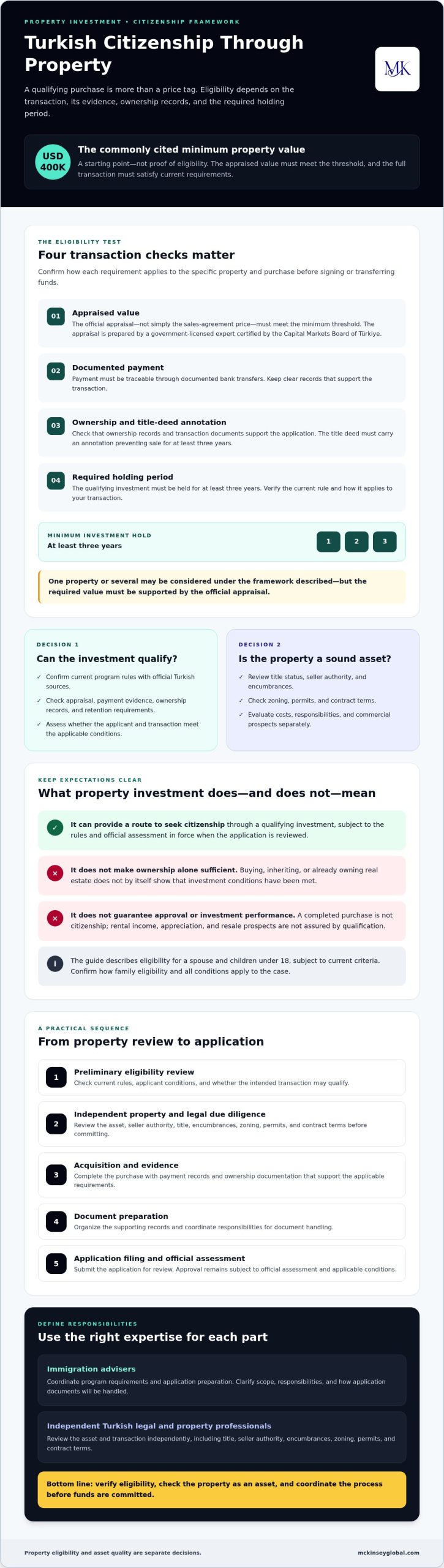
From Property Review to Application: A Practical Turkish Citizenship Roadmap
A carefully ordered process helps keep the property transaction and citizenship file aligned. For turkish citizenship property investment, treat each stage as a decision point: confirm the route, review the asset, document the acquisition, then prepare and submit an application under the procedures currently in force.
What to prepare before a property transaction
Start with a document inventory, not a signature. Exact requirements depend on the applicant and current official instructions, but an initial file should account for:
- Identity and civil status: Identity documents and records relevant to marital status, spouse, and children included in the application.
- Funds and transaction: Records showing the source and movement of funds, agreements, bank transfer evidence, and official correspondence.
- Property: The title deed, appraisal, ownership and transfer records, and other documents required to evidence the qualifying transaction.
- Representation: Any proposed power of attorney or other authority for a representative to act on the applicant’s behalf.
Before obtaining or submitting documents, ask qualified professionals to confirm which records require translation, notarization, apostille or other authentication, and whether originals or specific formats are needed. Requirements can differ by document and applicant. Check names, dates, property details, and payment references for consistency across contracts, banking records, title documents, and civil records. Keep copies of each version and of official correspondence.
How the application moves after acquisition
After the property and transaction have been reviewed, prepare the evidence file against the current official checklist. Submit the application through the applicable Turkish process, then allow for official review and possible requests for clarification or additional documents. Confirm current forms, authority names, filing sequence, and procedural terminology before submission. Do not rely on an old checklist or informal instructions. If a payment record does not match the contract, or a family record is incomplete, resolve the discrepancy with qualified professionals rather than assuming it will be accepted.
A complete file supports review, but it cannot ensure approval. Progress depends on the requirements in force, the quality and consistency of evidence, and official assessment. Avoid relying on a fixed timeline when planning travel or other commitments.
Specialist Türkiye citizenship advisers can help coordinate program requirements and application preparation, while Turkish legal professionals should address property and transaction matters. The Türkiye citizenship adviser can discuss program guidance and application preparation; confirm the precise support scope before proceeding.
Choosing Turkish Citizenship Advisory: Define Roles and Next Steps
For a turkish citizenship property investment, immigration guidance and property due diligence are related but distinct workstreams. An investment migration adviser can help clarify program requirements, coordinate application preparation, and identify documentation questions. Qualified Turkish legal or property professionals should independently assess title, seller authority, contract terms, zoning, and the asset’s commercial merits. Clear boundaries help prevent relying on one party for expertise outside its role.
Questions to ask an investment migration adviser
Before engaging an adviser, establish how the working relationship will operate and what is included. Ask how current program rules are verified, how potential changes are communicated, and who checks that the transaction evidence aligns with application requirements. Confirm whether property title, contracts, valuation, and payment records will receive independent local review. Do not assume immigration support includes a property assessment.
Request written confirmation of the service scope, each party’s responsibilities, document-handling and confidentiality arrangements, and any exclusions. Clarify which professionals prepare or review each document and who will respond if authorities request further information. McKinsey Citizenship and Residency Solutions is an independent boutique advisory firm focused on investment-based immigration pathways, including Türkiye Citizenship by Investment. It does not sell property or provide direct real estate brokerage. Confirm the precise application support available before proceeding.
How to proceed without rushing the investment decision
Before making a reservation or transferring funds, consider an initial eligibility discussion and confirm what information is needed to assess your circumstances. Coordinate that program review with independent property and legal due diligence. This sequence gives you an opportunity to raise eligibility or documentation concerns before they become harder to address, while keeping the property’s legal and commercial review separate from the immigration assessment.
- Confirm the pathway: Check current program rules and your proposed applicant and family scope.
- Define responsibilities: Agree in writing who handles program guidance, application preparation, and independent property review.
- Review before commitment: Obtain qualified local advice on the asset, transaction documents, and payment structure before signing or transferring funds.
McKinsey Citizenship and Residency Solutions provides investment migration guidance and application support within its confirmed scope. No adviser can guarantee citizenship or official approval. If you have reviewed the eligibility and due diligence considerations and would like to discuss your circumstances, Discuss your Türkiye citizenship pathway.
Make Your Next Decision With Clarity
The central principle of turkish citizenship property investment is to treat program eligibility and property quality as separate decisions. Confirm current requirements and supporting evidence before committing capital, then have qualified local professionals assess the title, transaction, and commercial merits of the asset. Careful sequencing can help identify gaps early, but complete documentation cannot guarantee approval.
McKinsey Citizenship and Residency Solutions lists Türkiye Citizenship by Investment among its advisory offerings and provides investment-based immigration guidance across Türkiye, the Caribbean, Europe, and the Middle East. Its role is program guidance and application support, not property brokerage. Independent property and legal review remains essential.
To clarify your potential pathway and the questions to resolve before proceeding, discuss your Türkiye citizenship pathway. A measured review of the requirements and responsibilities can help you make an informed decision.
Frequently Asked Questions
Is buying property in Türkiye enough to qualify for citizenship?
No. Owning property in Türkiye alone does not establish eligibility for citizenship. The acquisition must meet the Turkish Citizenship by Investment rules in force, and the applicant must document the transaction and complete the official application process. Before signing or transferring funds, verify the qualifying property criteria, appraisal basis, payment trail, ownership restrictions, and required retention period with authoritative sources and qualified Turkish professionals.
How much property investment is required for Turkish citizenship in 2026?
The commonly cited minimum is USD 400,000 in qualifying real estate, but confirm the current threshold with official Turkish sources before acting. A listing price alone does not establish eligibility. The transaction may also need to meet valuation, acquisition, payment, registration, and retention conditions. Ask qualified professionals to verify how the applicable rules apply to the specific property and transaction before making an offer or transferring funds.
Can family members be included in a Turkish citizenship application through property investment?
Yes, a spouse and children under 18 may be eligible to be included, subject to current rules and review of the individual application. Do not assume every relative qualifies automatically. Confirm which family members may be covered, what civil-status documents are required, and whether translations or authentication are needed. Requirements can vary with the applicant’s circumstances, so clarify eligibility and documentation before committing to a property purchase.
What documents should I check before buying property for Turkish citizenship?
Begin with the title deed and ownership records, seller authority, relevant zoning and municipal information, contract terms, valuation evidence, and proposed payment route. Check that the transaction documents will support the application under current program rules. The required file can depend on both the property and the applicant. Have qualified local professionals review the records before signing or transferring funds, and retain consistent copies of contracts, payments, and title documents.
What happens if the property does not meet citizenship-program requirements?
A property that fails to meet program requirements may not support the intended citizenship application, even if the purchase itself is valid. The implications depend on the transaction, the rules in force, and the applicant’s circumstances. Reduce the risk by verifying eligibility before commitment and keeping a record of the review. If a concern emerges, seek independent Turkish legal advice on possible options rather than relying on a seller’s informal assurance.
Does Turkish citizenship through property investment guarantee an approval timeline?
No. Do not assume a fixed approval date or guaranteed outcome. Progress can depend on document completeness, official review, procedural requirements, and the applicant’s circumstances. Before proceeding, ask for a clear explanation of the process, confirm which stages an adviser is responsible for, and agree how requests for additional evidence or updates will be handled. A well-prepared file can support review, but it cannot determine the authorities’ decision.