
What if a residency permit changes where you can live, but not where you owe tax? Offshore residency for investors can support mobility and long-term planning, yet legal residence and tax residence are distinct statuses. A permit alone does not automatically change tax obligations or remove reporting duties that may continue in other countries.
Investment thresholds and the right to reside matter, but they are only part of the decision. This guide explains what investor residency can and cannot achieve, and how to compare options with your personal, family, and business priorities. It covers routes in Portugal, Greece, the UAE, and Latvia, while noting that eligibility, investment structures, and residence conditions vary by program. It also explains why existing tax ties and cross-border reporting deserve attention before a move. A practical first step is to map your objectives and obligations, then narrow the jurisdictions that fit.
Key Takeaways
- Assess offshore residency for investors as a right to reside, not as a substitute for citizenship or a standalone tax strategy.
- Compare programs by investment route, eligibility, residence conditions, family provisions, and renewal requirements.
- Map your personal and business priorities alongside existing cross-border obligations before selecting a jurisdiction.
- Prepare for due diligence by organising source-of-funds records and background documents in line with the program’s current requirements.
- Use a structured review of objectives, eligibility, residence conditions, tax considerations, and ongoing compliance to shape a durable plan.
What offshore residency for investors means, and what it does not
Offshore residency for investors generally means permission to live in a jurisdiction outside a person’s current country of residence, obtained through an investment route that meets that jurisdiction’s rules. Depending on the program, the status may be temporary or renewable for a longer term. Investment requirements, eligibility criteria, and residence conditions differ. “Offshore” describes the location in relation to the investor’s current jurisdiction. It does not promise secrecy, tax-free status, or exemption from regulation.
Investor routes are often grouped under terms such as “golden visa,” although program structures differ. The overview of immigrant investor programs provides background on how countries frame investment-based immigration. For a decision, compare the specific program’s eligibility, investment route, and ongoing conditions with its current rules.
How investor residency differs from citizenship and tax residence
Immigration residence is permission granted under the destination jurisdiction’s laws. It may allow a person to live there subject to program conditions, but it does not itself confer citizenship or necessarily lead to permanent residence. Citizenship concerns nationality and may carry a broader set of rights and obligations, which differ by country.
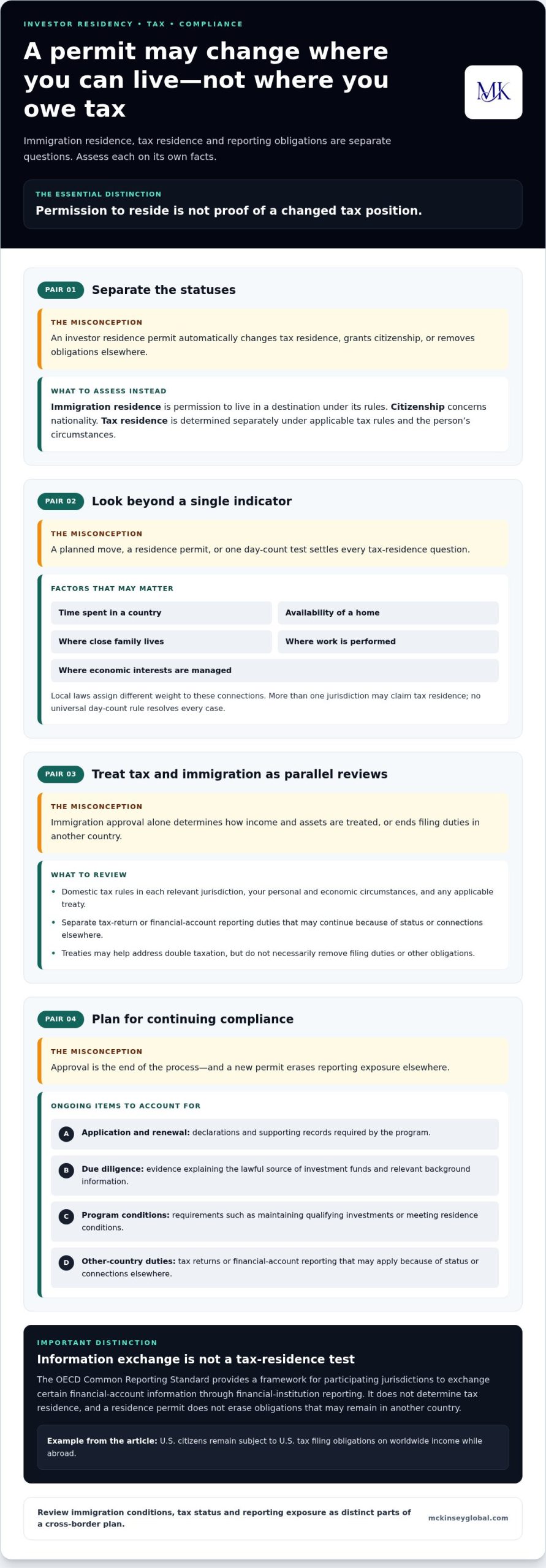
Tax residence is a separate, fact-specific determination. Authorities may consider applicable domestic rules, days spent in a country, personal and economic ties, and other circumstances. No single day-count test applies universally. A residence permit alone does not establish an individual’s tax position. Assess tax residence and reporting obligations in each relevant jurisdiction rather than inferring them from an immigration approval.
Why investors consider a second place of residence
A second residence may support personal mobility, family planning, access to business environments, or contingency planning. For example, an investor might compare a European residence route with a UAE option by considering family priorities, intended time in the destination, and business needs. These are planning considerations, not guaranteed outcomes. A permit does not ensure relocation, lower taxes, investment returns, or a particular degree of mobility.
The practical value depends on your circumstances, the program’s current terms, and the rules that apply to your personal and business affairs. Start by defining the purpose of the residence status. Then assess citizenship, tax treatment, and ongoing compliance as separate questions.
Does offshore residency reduce tax? Separate permits, tax residence, and reporting
A residence permit does not, by itself, change where you are tax-resident or reduce your tax bill. Immigration authorities decide whether you qualify to live in a destination; tax authorities apply their own rules to determine how your income and assets are treated. Keep these assessments separate when considering offshore residency for investors.
Tax outcomes depend on the laws of each relevant jurisdiction, your personal and economic circumstances, and any applicable tax treaty. Treaties may help address double taxation, but they do not necessarily remove filing duties or other obligations. The U.S. EB-5 Immigrant Investor Program illustrates how a government sets conditions for an investment-based immigration route. Its immigration criteria do not determine an applicant’s tax position.
Which factors may affect a tax-residence assessment?
Depending on local law, relevant connections can include time spent in a country, the availability of a home, where close family lives, where work is performed, and where economic interests are managed. The weight assigned to each factor varies. An individual may also have links to more than one jurisdiction, whose domestic tests can interact and create overlapping claims to tax residence.
There is no universal day-count rule that resolves every case. Before changing residence or investment arrangements, obtain advice from qualified tax professionals familiar with the jurisdictions involved. They can assess the facts, applicable domestic rules, and treaty provisions rather than relying on a permit, a planned move, or a single indicator.
What cross-border compliance should investors plan for?
Immigration approval is one part of an ongoing process. Depending on the program and jurisdiction, investors may need to prepare for:
- Declarations and supporting records required for an application or renewal;
- Evidence explaining the lawful source of investment funds and relevant background information;
- Continuing program conditions, such as maintaining qualifying investments or meeting residence requirements; and
- Separate tax returns or financial-account reporting obligations that apply because of their status or connections elsewhere.
The OECD’s Common Reporting Standard provides a framework under which participating jurisdictions exchange certain financial-account information through reporting by financial institutions. It is not a tax-residence test, and a residence permit does not erase obligations that may remain in another country. For example, U.S. citizens remain subject to U.S. tax filing obligations on worldwide income while abroad. Coordinate immigration conditions, tax status, and reporting exposure as distinct parts of a cross-border plan. Investment migration advisory can help organise jurisdiction research and application steps alongside appropriate tax review.
How to compare offshore residency options against investor priorities
Begin with the outcome you want, not a headline investment threshold. Someone seeking a place to relocate with family will weigh daily residence conditions and schooling differently from an investor seeking a secondary base for business travel. For offshore residency for investors, use the same comparison criteria for each route, then decide whether its conditions are practical to maintain.
| Assessment area | Greece | United Arab Emirates |
|---|---|---|
| Route and investment structure | Investment routes include qualifying real estate and, from early 2026, an investment in a registered start-up. Real estate thresholds vary by route and location. | Identify the current qualifying residency route and investment structure that matches the applicant’s circumstances. |
| Eligibility and family | Review applicant criteria and the current rules for including family members. | Review applicant criteria and the current rules for family eligibility. |
| Residence conditions and renewals | The program has no minimum stay requirement; verify current permit and renewal conditions. | Confirm current physical-presence, permit, and renewal conditions against official program guidance. |
For Greece, current published route details include real estate thresholds of €800,000 in designated prime areas, €400,000 in most other regions, and €250,000 for specified conversions or restorations. Check the route and threshold against current official rules before relying on them. A Greece residency by investment guide can help frame the jurisdiction-specific questions.
Which decision criteria matter beyond the investment route?
Eligibility is only the first test. Compare physical-presence expectations, application stages, renewal requirements, and family provisions using current official sources. Then consider practical fit: language, travel patterns, schooling, healthcare access, and how long you expect to stay. A route may be legally available yet poorly matched to your family’s routine or your ability to maintain its conditions.
How should an investor weigh European and Middle Eastern routes?
Greece and the UAE are distinct choices, not interchangeable solutions. Greece may suit an investor evaluating a European residence route; the UAE may warrant consideration where the intended base and business presence align with its current residency options. Neither example implies a particular tax result, lifestyle outcome, or visa-access benefit. Program features and governing rules can change, so verify them when comparing routes and before applying.
For a broader regional comparison, review the Turkey versus UAE residency comparison. A useful shortlist aligns eligibility, investment structure, family needs, and sustainable residence conditions with your actual objectives.
A compliance-first process for assessing offshore residency
Start your assessment before committing to a qualifying investment. For offshore residency for investors, early attention to eligibility, documentation, tax questions, and ongoing program conditions can reduce avoidable uncertainty and make the application process more orderly. It cannot guarantee approval or remove obligations in other jurisdictions.
What should investors clarify before selecting a program?
Record the facts that shape eligibility and practical fit: current residence, citizenship, family composition, business connections, and long-term objectives. Identify the immigration, tax, and reporting questions that need jurisdiction-specific professional review. This gives you a clear basis for comparing programs before selecting an investment route.
Organise the assessment in this sequence:
- Define objectives. Establish whether the priority is relocation, family arrangements, business presence, mobility, or contingency planning.
- Screen jurisdictions. Compare potential routes against eligibility criteria, investment structures, physical-presence rules, family provisions, renewal conditions, and your ability to maintain each requirement.
- Review cross-border considerations. Identify tax-residence and reporting questions for qualified professionals to assess in light of your circumstances and relevant local rules.
- Prepare supporting records. Collate identity, civil, financial, source-of-funds, and background documentation as required by the selected program. Evidence requirements differ, so use current program guidance rather than assuming one checklist applies everywhere.
- Coordinate submission and follow-up. Organise application materials, address procedural requests, track subsequent stages, and plan for renewals or continuing program conditions.
How does a well-managed application progress?
A typical process moves from an initial assessment to document collation, due diligence, submission, and any subsequent steps required by the program. The sequence, evidence, and timing vary by jurisdiction and application. Processing periods can change, and approval remains subject to the relevant authority’s decision.
Investment-based immigration advisory can structure jurisdiction research, organise application steps, and coordinate procedural requirements throughout the process. Tax conclusions and other legal questions should be reviewed by appropriately qualified professionals. Keeping these workstreams distinct helps prevent an immigration application from being mistaken for a complete cross-border plan.
Before proceeding, make sure the proposed route is eligible, its conditions are sustainable, and the supporting evidence can be prepared. Explore residency application options as part of a carefully coordinated assessment.
Build a durable investor residency strategy with specialist guidance
A sound investor residency strategy involves more than choosing an investment route. Bring together your objectives, legal eligibility, the conditions you can maintain, a review of tax questions, and continuing compliance. This framework helps distinguish a program that looks attractive on paper from one that fits your family and wider cross-border circumstances.
What investment migration advisory can coordinate
McKinsey Citizenship and Residency Solutions is an independent boutique advisory firm and is not affiliated with McKinsey & Company. It advises global investors on investment-based residency and citizenship pathways across Europe, the Caribbean, and the Middle East. Residency options include Portugal, Greece, the UAE, and Latvia.
For offshore residency for investors, specialist advisory can bring structure to program research and application management. Support includes assessing routes against your goals and eligibility, preparing application materials, and coordinating procedural steps. Destination selection should reflect your priorities, family needs, ability to meet residence and renewal conditions, and compliance context. Immigration approval is not a substitute for separate tax or legal review.
How to begin a considered residency assessment
Start by outlining the information that will shape a practical assessment:
- Your current residence and citizenship;
- Family composition and any relevant education or relocation needs;
- Investment objectives and the type of residence status you are seeking; and
- Your intended timeframe, travel patterns, and ability to meet ongoing program conditions.
These details help organise priorities and identify the program questions that need closer review, including eligibility, investment structure, required evidence, application stages, and renewal conditions. Assess tax-residence and reporting questions separately with appropriately qualified professionals, based on the jurisdictions and personal circumstances involved.
A measured next step is to discuss your objectives and identify which residency pathways merit further assessment. McKinsey Citizenship and Residency Solutions can organise program research and investment-based application steps. The appropriate route depends on your circumstances and the rules in force when you apply.
Make Your Next Residency Decision with Clarity
Assess investor residency as one part of a wider cross-border plan. A permit does not automatically determine tax residence or remove obligations elsewhere. The right program depends on your goals, eligibility, family needs, and ability to meet its conditions over time.
A disciplined comparison helps distinguish routes designed for different residence and investment objectives. Early attention to documentation and ongoing compliance also supports a more orderly process. The practical value of offshore residency for investors comes from aligning a suitable program with personal and business priorities, not from assuming a universal benefit.
McKinsey Citizenship and Residency Solutions is an independent boutique advisory firm, not affiliated with McKinsey & Company. Its end-to-end guidance supports investment-based residency and citizenship applications across the Caribbean, Europe, and the Middle East, with program selection shaped around each investor’s circumstances.
Outline your current residence, family considerations, investment goals, and intended timeframe. Discuss your investment residency objectives with our advisory team and begin assessing the options with greater clarity.
Frequently Asked Questions
Does offshore residency automatically change my tax residence?
No. An immigration residence permit grants permission to reside under a destination country’s rules; it does not automatically determine your tax residence. Tax authorities may consider factors such as time spent in a country, your home, family, work, and economic ties. The relevant tests vary, and more than one jurisdiction may have a claim. Seek qualified, jurisdiction-specific tax advice before making decisions based on an expected tax outcome.
Can investors obtain residency without moving permanently to another country?
Possibly. Some investment-based residence programs allow permit holders to spend limited time in the destination, while others impose physical-presence or renewal conditions that require a more substantial connection. The rules depend on the jurisdiction and route, and they can change. Before applying, compare the required stay and renewal terms with your travel patterns and intended use of the residence. A permit does not itself mean you have relocated permanently.
What is the difference between residency by investment and citizenship by investment?
Residency by investment provides an immigration status that permits residence under a destination’s program rules, often subject to renewal or other conditions. Citizenship by investment, where available, grants nationality through a separate process and confers citizenship rights and obligations under that country’s law. The two routes are not interchangeable: compare the legal outcome, eligibility, investment structure, and ongoing requirements rather than assuming residence automatically leads to citizenship.
How do investors compare residency programs across different countries?
Start with your objectives, then compare each route using consistent criteria: eligibility, qualifying investment structure, physical-presence rules, family inclusion, application stages, renewals, and continuing conditions. Consider practical fit as well, including travel, schooling, healthcare access, and intended length of stay. Verify current details against official program sources before committing, since thresholds and procedures may change. A route that meets formal eligibility may still be difficult to maintain in practice.
What documents may be required for an investor residency application?
Requirements vary by program, but applicants may need identity and civil-status records, evidence of investment eligibility, financial documentation, and information supporting the lawful source of funds. Background and due-diligence materials may also be requested. Treat these as common document categories, not a universal checklist: format, certification, translation, and submission rules differ. Use the current program instructions to prepare a complete file and address any program-specific evidence requirements.
Can I keep tax or reporting obligations in my current country after obtaining residency elsewhere?
Yes. A new residence permit does not automatically end tax-filing, financial-account reporting, or other obligations in your current country. Whether duties continue depends on your citizenship, tax status, income, assets, and applicable domestic rules. For example, U.S. citizens generally remain subject to U.S. tax filing on worldwide income while living abroad. Review obligations in every relevant jurisdiction with qualified professionals before and after relocating.
Is offshore residency the same as setting up an offshore company?
No. Offshore residency concerns an individual’s immigration permission to live in a jurisdiction outside their current one. Forming a company creates a separate legal entity and involves different rules, responsibilities, and reporting considerations. Neither status automatically provides the other, and neither should be treated as a shortcut to a particular tax result. Investors considering both should assess the immigration and business questions separately, then coordinate them within an appropriate compliance plan.