In 2026, U.S. passport holders can visit 179 countries without visas, placing the passport tenth in the Henley Passport Index. A passport index ranking helps compare the travel access associated with different passports, but its meaning depends on the index and the measures it uses. It’s a useful reference for understanding mobility, not a complete measure of a country or its citizens.
It’s reasonable to treat a passport’s rank as a shorthand for international access. But a position on one list may differ from another because indexes use different criteria and weight them differently. Understanding those distinctions makes the rankings more useful for travel planning and broader comparisons.
This guide explains the purpose of passport indexes, how their scores and rankings are calculated, and what passport power can and can’t tell you about human development. It also distinguishes the 2026 Henley Passport Index from the broader Global Passport Index, so you can interpret each ranking in context.
Key Takeaways
- Use passport rankings to compare travel access, while distinguishing visa-free entry from other access categories.
- Read each score in the context of its index: different measures can produce different rankings.
- Compare the 2026 Henley rankings with broader passport indexes to understand what each ranking measures.
- See how mobility, investment conditions, and quality-of-life indicators contribute to a broader index score.
- Keep passport power in perspective by considering how travel access relates to, but does not by itself define, human development.
What is the purpose of the Passport Index?
The Passport Index compares how passports connect holders with destinations and travel access. In 2026, the United States ranks tenth in the global passport index ranking, with access to 179 countries without visas; its position shifts as destination access changes relative to other passports.
The figures differ across indexes because each may classify access differently. Reported travel access can vary depending on how an index classifies visa-free and other visa-access categories.
Visa-Free Access by Passport
Visa-free access by passport refers to the destinations a passport holder can visit without obtaining a visa before travel. It offers a practical way to compare passports, but the reported total depends on which access categories the index counts.
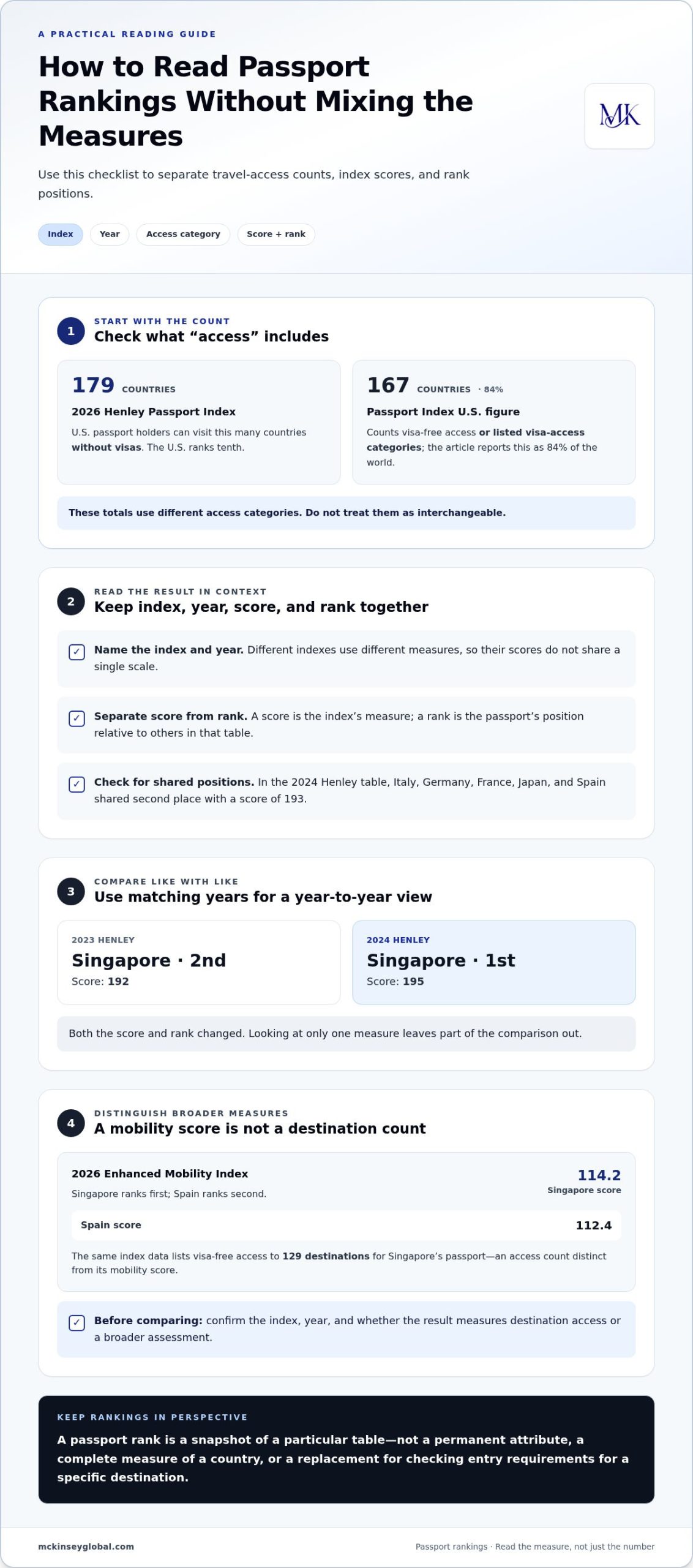
For U.S. passport holders, the Passport Index reports access to 167 countries through visa-free or listed visa-access categories, equal to 84% of the world. According to the 2026 global passport index ranking, U.S. passport holders can visit 179 countries without visas, placing the U.S. passport tenth. These figures describe different index counts, so they shouldn’t be treated as interchangeable totals.
Visa Requirements and Destination Access
Destination access describes the entry options associated with a passport, including whether a visa is required before departure. A total can summarize a passport’s reach, but it does not replace checking the requirements for a specific destination.
For example, the Passport Index’s U.S. figure includes visa-free access and its listed visa-access categories, while the 2026 U.S. figure specifies countries accessible without visas. The category used affects the comparison. A traveler planning a trip should identify the destination and review the applicable entry process, rather than relying on a single overall rank.
Enhanced Mobility and Visa Access
Enhanced mobility describes how readily a passport connects its holder with international destinations. Visa access is one practical part of mobility: fewer advance visa requirements can make travel planning more straightforward.
In the 2026 Enhanced Mobility Index, Singapore ranks first with a score of 114.2, while Spain ranks second with 112.4. The same index data lists visa-free access to 129 destinations for Singapore’s passport. These figures show why readers should distinguish an index’s broader mobility score from a destination-access count.
For a useful comparison, first identify the index and year, then note the access category behind its figures. The 2026 global passport index ranking places the United States tenth, while the Passport Index reports a separate access figure. Neither number alone describes every travel condition or predicts how a specific journey will proceed. The destination, passport, and entry category all shape the practical meaning of a ranking.
Passport index scores
A passport index score is a numerical measure used to compare passport access or attributes. To interpret it, first identify the index, year, and ranking table. Figures from different indexes do not share a single scale.
Reading Scores in Context
A score can show how many destinations an index counts as accessible, while the rank shows its position against other passports. In the 2024 Henley Passport Index table, Singapore ranked first with a score of 195. Afghanistan ranked 103rd with a score of 26. The difference illustrates the spread between the top and bottom entries in that table.
Shared scores can also produce tied positions. In 2024, Italy, Germany, France, Japan, and Spain shared second place with a score of 193. That result means readers should examine the table’s stated placement rather than assume each rank belongs to one passport.
Comparing Results Across Years
Year-to-year comparisons show how a passport’s position can change within the same index. Singapore ranked second with a score of 192 in the 2023 Henley table, then first with 195 in the 2024 table. The score and rank both changed, so examining only one measure would leave part of the comparison out.
The 2022 Henley table provides another example: Japan ranked first with 193, while Germany and Spain shared third place with 190. Comparing these results with 2024 requires matching the same index and noting each year. A rank is a snapshot of a particular table, not a permanent attribute of a passport.
Different Indexes, Different Scales
A global passport index may combine factors beyond destination access, so its score should not be read as a Henley score. In the 2026 Global Passport Index, Sweden ranks first overall, Switzerland second, and Finland third. These placements belong to that index’s overall ranking and are distinct from Henley’s destination-access results.
For a useful comparison, record the index name, year, score, and rank together. Then check whether the figure describes destination access or a broader assessment. For example, Singapore’s 2024 Henley score of 195 and Sweden’s 2026 overall Global Passport Index position describe different measures and years. Treating them as directly comparable would blur what each result actually represents.
Use scores as a structured starting point for comparing mobility, not as a complete measure of a country or an individual’s circumstances. The phrase “passport index ranking” is most useful when paired with the index and publication year, since those details identify what the result measures. If your mobility planning also involves residence options, review residency solutions for international mobility as a separate consideration.
2026 Henley Passport Index rankings
The 2026 Henley table compares passports by visa-free destination access. Its ranking is accurate as of January 2026, and positions reflect the access totals recorded for that edition.
Latest Passport Ranking Positions
A passport ranking position shows where a passport sits relative to others in the same edition. Singapore ranks first with access to 192 countries without visas; Japan is second with 188, and Sweden is third with 186.
The next positions also show how closely grouped access totals can be. Denmark, Luxembourg, Spain, Sweden, and Switzerland have access to 186 countries, while Austria, Belgium, Finland, France, Germany, Greece, Ireland, Italy, the Netherlands, and Norway have access to 185. These groupings help explain shared positions within a table.
Weakest Passports in the Latest Rankings
The weakest passports in a ranking are those with the lowest recorded access totals. Afghanistan is ranked 101st in the 2026 Henley Passport Index, with access to 23 countries without visas.
This position contrasts with Singapore’s first-place result and 192 destinations. The gap indicates a substantial difference in visa-free travel access, but it describes the index’s mobility measure rather than citizens’ personal circumstances or every aspect of a country. Readers comparing lower-ranked passports should note both the position and the access count, rather than relying on rank alone.
Passport Rankings Across Three Countries
A country comparison places each passport’s rank and access total alongside the others. In 2026, the United States is tenth, with access to 179 countries without visas; Canada has access to 181, and the United Kingdom has access to 182.
These totals place Canada and the United Kingdom above the United States for visa-free access in this edition. Passports from 37 countries offer greater global mobility than a U.S. passport, including Canadian and British passports. Malaysia also ranks above the United States, at ninth, with access to 180 countries. For a practical comparison, record the edition, rank, and access total together; the access figure clarifies what separates nearby positions.
Ranking Update Frequency
Update frequency describes how often a ranking edition reflects changes in destination access. The 2026 Henley table is accurate as of January 2026; its stated date identifies the point in time represented by these results.
To follow changes, compare successive editions of the same index and look for shifts in access totals and rank. Entry rules can change over time, so a published table is a comparative reference, not a substitute for destination-specific travel requirements. The 2026 positions show the current snapshot used in this guide, while a later edition may reflect changed access.
For a concise comparison, note the index, edition date, rank, and visa-free total for each passport. The United States, Canada, and the United Kingdom illustrate why all four details matter: the 2026 table places them at different positions, with access totals of 179, 181, and 182 countries respectively. Those figures help readers interpret relative mobility without treating a ranking as a complete assessment of citizens or national conditions.
Index weighting and indicators
Index weighting is the method used to assign importance to different measures within an overall score. The 2026 Global Passport Index analyzes 200 countries using 15 indicators, grouped into three weighted components.
Enhanced Mobility measures destination access and contributes 50% of the overall Global Passport Index score. The Investment Index contributes 25%, while the Quality of Life Index contributes the remaining 25%. Together, these weights show that mobility has twice the influence of either other component in the combined calculation.
- Enhanced Mobility: This component carries 50% of the total score, making it the largest weighted category.
- Investment Index: This component accounts for 25% of the calculation and assesses investment-related conditions.
- Quality of Life Index: This component accounts for 25% and adds quality-of-life measures to the overall assessment.
The three weights total 100%, so each component contributes a defined share. A passport can therefore rank well overall through a combination of results, rather than through mobility alone. Singapore illustrates the distinction: it ranks first in the 2026 Enhanced Mobility Index with a score of 114.2, and first in the Investment Index with 84.0. Finland leads the Quality Index with 89.6, showing that separate categories have separate leaders.
To interpret a country’s overall position, first identify the index and its component weights. Then distinguish the overall score from a category score. For example, Singapore’s Enhanced Mobility result of 114.2 describes that component, not its overall Global Passport Index score. The same principle applies to Finland’s Quality Index result of 89.6. Keeping those measures separate prevents direct comparisons between unlike scores.
The 15 indicators provide the inputs used across the 2026 Global Passport Index’s categories. Weighting determines how strongly each grouped category affects the final result; indicator values determine performance within the assessment. The published framework therefore gives readers a way to understand why a country’s overall position may differ from its position in one component.
Passport rankings have limits for travelers because a combined country score cannot answer every question about an individual journey. The 2026 Global Passport Index includes investment and quality-of-life measures alongside mobility, so its overall result is broader than destination access alone. For a specific trip, the destination and the traveler’s passport determine which entry requirements matter.
Independent comparison is most useful when it matches like with like: compare the same index, year, category, and score type. For instance, use Singapore’s 2026 Enhanced Mobility score against another country’s Enhanced Mobility result, not against Finland’s Quality Index score. This method clarifies what the ranking measures and avoids treating one composite position as a complete picture of travel access.
Individual Passport Power Rank and Human Development Index
An Individual Passport Power Rank describes the mobility associated with a person’s passport, while the Human Development Index (HDI) assesses broader human development. They answer different questions: one concerns international access, the other the conditions that shape people’s lives.
Individual Passport Power Rank
A passport power rank compares the travel access associated with different national passports. It does not measure an individual’s education, income, health, or personal freedom of movement. Instead, it reflects the access categories used by the ranking and the passport a person holds.
For example, a traveler can use a passport ranking to compare access across destinations, then review their itinerary and entry requirements separately. People with different passports may face different visa processes for the same destination. A rank summarizes relative access; it cannot establish every requirement for an individual trip.
Human Development Index
The Human Development Index is a composite measure based on health, education, and income. It offers a broader view of development than a measure focused on international mobility.
That distinction matters when interpreting country comparisons. A passport may provide broad travel access, while the HDI considers other aspects of people’s well-being. Neither measure substitutes for the other. The 2026 Global Passport Index reflects mobility alongside investment and quality-of-life components, while passport access alone cannot describe those wider conditions.
How to Interpret Both Measures
To compare passport power with human development, first identify what each index measures. Then note the unit of comparison: a passport rank concerns relative mobility, while an HDI result concerns human development. Do not treat a country’s position in one index as an explanation for its position in the other.
A relationship between two rankings does not, by itself, explain why either result occurs. Travel access can reflect destination policies and passport-based entry arrangements, while human development covers distinct social and economic dimensions. Treat each index as evidence about its defined subject, not as a single verdict on a country.
For practical decisions, use passport-power information to frame mobility questions, then assess the destination and traveler’s circumstances. Use HDI comparisons for broader development context, not to predict visa outcomes. This keeps individual travel planning separate from country-level comparisons and avoids mistaking a composite score for personal eligibility.
For readers considering how mobility options fit into longer-term plans, explore global mobility options as a separate planning step alongside index comparisons.
McKinsey Citizenship and Residency Solutions: Antigua and Barbuda Citizenship by Investment
McKinsey Citizenship and Residency Solutions guides individuals considering Antigua and Barbuda Citizenship by Investment as part of a wider mobility plan. A passport index can frame questions about international access, while citizenship planning calls for a separate assessment of personal objectives and the relevant program.
This option may suit people exploring a second citizenship alongside their existing nationality and travel needs. McKinsey also supports St. Kitts and Nevis Citizenship, Greece Residency by Investment, and Dominica, offering distinct citizenship and residency pathways to consider.
To discuss whether Antigua and Barbuda Citizenship by Investment aligns with your mobility objectives, contact McKinsey Citizenship and Residency Solutions.
Turn Mobility Insights Into a Considered Plan
A passport index ranking can inform your perspective, but your next decision should begin with the mobility outcome you want. Clarify whether you are exploring citizenship or residency, then consider how each route aligns with your personal and long-term priorities. The index is a reference point, not a decision in itself.
McKinsey Citizenship and Residency Solutions can guide you through Antigua and Barbuda Citizenship by Investment, St. Kitts and Nevis Citizenship, and Greece Residency by Investment. A discussion can help you identify the pathway relevant to your objectives and understand the next steps.
When you are ready to discuss your plans, contact McKinsey Citizenship and Residency Solutions. A deliberate first conversation can help turn global mobility considerations into a clearer plan.
Frequently Asked Questions
Why is Passport Power important?
Passport power helps travelers compare how passport-based access may shape international mobility. If you regularly travel for business or family visits across several destinations, the comparison can highlight where advance visa processes may affect your plans. A passport index ranking is a starting point for evaluating access, not a substitute for reviewing each destination’s entry requirements.
What is the latest Henley Passport Index ranking?
In the 2026 Henley Passport Index, Singapore ranks first with visa-free access to 192 countries. Japan ranks second with access to 188, and Sweden ranks third with access to 186. The United States is tenth, with access to 179 countries without visas. These positions describe the 2026 edition, which is accurate as of January 2026, so use that date when comparing its results.
Which passports rank highest in the latest global passport rankings?
The leaders depend on which index you mean. In the 2026 Henley Passport Index, Singapore, Japan, and Sweden hold the top three positions. In the 2026 Global Passport Index, Sweden ranks first overall, Switzerland second, and Finland third. The lists differ because the indexes assess different measures. For a sound comparison, match both the index name and the year, rather than comparing country positions across separate tables.
How many destinations can U.S. passport holders visit visa-free or with visa on arrival?
The Passport Index states that U.S. passport holders can access 167 countries through visa-free or its listed visa-access categories, representing 84% of the world. The 2026 Henley Passport Index gives a different figure: access to 179 countries without visas. The totals use different category definitions, so they are not interchangeable. For a particular trip, identify the destination and its entry category before using either total.
What is the United States passport ranking and how has it changed?
The United States ranks tenth in the 2026 Henley Passport Index, with visa-free access to 179 countries. Its position can shift as destination access changes relative to other passports, but no specific past U.S. ranking is provided.