
Could a second passport change your tax position, or does the answer depend on where you live and how your circumstances are structured? For anyone considering second citizenship for tax planning, the distinction is critical: citizenship may expand immigration options, but it does not automatically change tax residence, tax liability, or filing duties.
It is understandable to seek greater flexibility, security, or choice across borders. But immigration status and tax outcomes are governed by different rules. A move or new citizenship can also raise reporting and compliance questions that call for careful review. A passport alone is not a tax plan.
This guide explains what a second citizenship can and cannot change, and how to assess investment migration pathways as one part of a broader cross-border plan. It covers the personal, financial, and residence details a qualified tax or legal adviser may need to review, why obligations can continue after a change in citizenship, and how to compare citizenship and residency options without relying on promises of tax savings. The aim is to help you make decisions that align immigration objectives with compliant, independently assessed planning.
Key Takeaways
- Assess second citizenship for tax planning against documented immigration and family objectives, not as a tax outcome in itself.
- Keep citizenship, immigration residence, tax residence, and filing obligations distinct when reviewing your cross-border position.
- Compare programs by family eligibility, residence requirements, application process, and due diligence, then assess tax rules separately.
- Organize travel records, residence details, income sources, assets, and relevant filings for a complete review of your circumstances.
- Investment migration application guidance can support program evaluation, while tax and legal analysis remain separate disciplines.
What a second citizenship can, and cannot, change in tax planning
A second citizenship is nationality in an additional country. It may expand travel, residence, and family mobility options, but it is distinct from tax residence, which is assessed under the relevant jurisdiction’s rules and the person’s circumstances. Put simply: “Second citizenship adds a nationality; it does not, by itself, establish a new tax residence or end obligations elsewhere.”
This distinction is central to second citizenship for tax planning. A passport may support a wider plan if it enables future relocation or provides flexibility for family members. However, acquiring one does not guarantee lower taxes, remove existing filing responsibilities, or automatically change how income is treated. Its value depends on what the individual actually does and which rules apply to their situation.
What does second citizenship mean for a globally mobile investor?
Citizenship identifies a person as a national of a country. It is not the same as moving there or becoming tax-resident there. Multiple nationality can be acquired in different ways, and Multiple citizenship may carry obligations connected with more than one country. The specific implications depend on applicable rules.
For an investor and their family, another citizenship may broaden mobility choices or support longer-term planning. Consider those possibilities alongside actual residence, family needs, and the practical requirements of maintaining a connection with a jurisdiction. A passport alone does not determine tax treatment.
Why does tax planning require more than a passport?
Tax analysis may need to distinguish citizenship from tax residence, immigration residence, domicile, and the source of income. These concepts do not necessarily align, and their relevance varies by jurisdiction. A person may hold one or more nationalities, live elsewhere, and receive income connected with several jurisdictions. Each connection may need separate review.
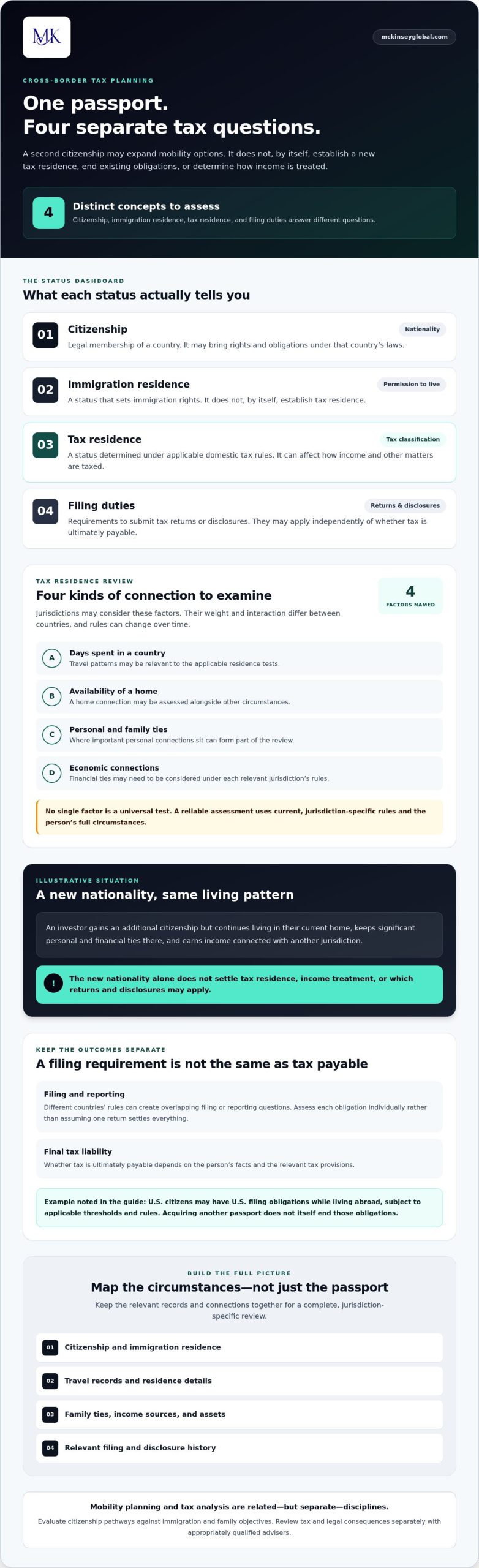
For example, an investor may gain an additional citizenship but continue living in their current home, maintain significant personal and financial ties there, and earn income from another jurisdiction. The new nationality would not, on its own, settle where that person is tax-resident, how the income is treated, or which returns or disclosures may apply. Those questions require current, jurisdiction-specific analysis of the person’s full circumstances.
Assess immigration choices and tax consequences as related but distinct parts of a cross-border plan. Investment migration guidance can help evaluate citizenship pathways against mobility and family objectives. Tax and legal analysis should be conducted separately by appropriately qualified advisers.
How citizenship, tax residence, and filing duties differ
These concepts answer different questions. Nationality concerns legal membership of a country; immigration residence concerns permission to live there; tax residence concerns how a person is classified under tax rules; and filing duties concern whether a return or disclosure must be submitted. The concepts can overlap, but one status does not automatically determine the others. “Nationality is one part of a tax profile, not a complete account of where a person is taxed or what they must report.”
| Concept | What it describes | Why it matters |
|---|---|---|
| Citizenship | Nationality or legal membership of a country | May bring rights and obligations under that country’s laws |
| Immigration residence | Permission or status to live in a country | Sets immigration rights, but does not by itself establish tax residence |
| Tax residence | A status determined under applicable domestic tax rules | Can affect how income and other matters are taxed |
| Filing duties | Requirements to submit tax returns or disclosures | May apply independently of whether tax is ultimately payable |
What determines tax residence?
Jurisdictions may consider days spent in a country, the availability of a home, personal and family ties, or economic connections. The weight assigned to each factor, and how the tests interact, can differ between countries and change over time. Do not treat any single factor as a universal test. A reliable assessment requires current rules for every relevant jurisdiction.
Can dual citizens have filing duties in more than one country?
Potentially. Different countries’ rules can create overlapping filing or reporting questions, so assess obligations individually rather than assuming one return settles everything. U.S. citizens, for example, may have U.S. filing obligations while living abroad, subject to applicable thresholds and rules. Filing duties are distinct from final tax liability, which may depend on the person’s facts and relevant tax provisions. The IRS explains separate consequences that can arise when citizenship is relinquished in its guidance on Expatriation Tax; acquiring another passport does not itself end U.S. obligations.
If you are considering second citizenship for tax planning, map citizenship, residence, travel, income connections, and potential filing requirements together. Then verify each jurisdiction’s current rules with qualified tax or legal advisers. Investment migration guidance can help evaluate citizenship or residency pathways against documented mobility objectives. Explore investment migration pathways as one component of a broader, independently assessed plan.
How to assess second citizenship programs without assuming tax benefits
Assess a program against the immigration outcome you actually need, not an assumed tax result. A second citizenship may provide an additional nationality, while an investment-based residence pathway may offer permission to reside without conferring citizenship. These routes are not interchangeable, and neither should be treated as a tax outcome in itself.
Which factors should investors compare across programs?
Start by clarifying whether your priority is an additional nationality, residence rights, greater mobility, or continuity for your family. Then compare programs against practical criteria:
- Eligibility: Review who may apply, which family members may be included, and what supporting information is required.
- Ongoing obligations: Identify any residence or other continuing requirements using current official program information.
- Process and due diligence: Understand the application stages, documentation, and assessment requirements.
- Pathway type: Distinguish citizenship routes from residence programs, including those that may offer a route to citizenship over time.
For example, the Antigua and Barbuda investment options guide provides context for reviewing that program’s investment pathways. Treat it as immigration information, not as evidence of a particular tax result.
How should tax implications be reviewed alongside program criteria?
Keep program selection and tax assessment connected, but separate. Before relying on an anticipated outcome, map where you currently live and may live, where income arises, what assets and economic connections you hold, and where close family members are based. Then obtain jurisdiction-specific tax and legal analysis from appropriately qualified professionals. Rules vary, and individual facts affect how they apply.
This distinction is central to second citizenship for tax planning: a program may align with mobility or family objectives, but citizenship acquisition requirements are not the same as the tax rules that may apply after relocation. Avoid ranking jurisdictions as tax havens or assuming that a passport will reduce tax, remove filing duties, or resolve existing obligations.
Investment routes also differ in structure and requirements. A comparison of citizenship investment pathway types can help frame questions about available routes. Use current program rules and personal objectives to guide the evaluation. Investment migration application guidance can support the assessment of immigration options and process requirements, while independent tax or legal analysis addresses the separate consequences of residence, income, and personal connections.
A practical sequence for compliant second-citizenship tax planning
A structured review helps keep immigration decisions aligned with personal objectives and identify tax questions before an application or relocation. For second citizenship for tax planning, use this sequence as a preparation framework, not a substitute for jurisdiction-specific advice:
- Define your goals. Clarify whether you seek additional nationality, future residence options, greater mobility, or continuity for family members.
- Map your current and anticipated ties. Record citizenships, current residence, travel patterns, homes, family connections, and any intended relocation dates.
- Obtain independent tax analysis. Ask appropriately qualified tax or legal advisers to assess residence, income sources, assets, reporting responsibilities, and potential consequences of a move.
- Compare immigration programs. Evaluate eligibility, family inclusion, process requirements, due diligence, and any ongoing obligations against your stated goals.
- Plan implementation and review. Use current official guidance, document advice received, and coordinate application and relocation steps with relevant professional support.
What information should be assembled before making a decision?
Prepare a concise record set so advisers can assess the facts rather than rely on assumptions. Include travel dates and residence history; citizenships and family circumstances; income sources and business interests; assets and relevant connections in each jurisdiction; and prior or current tax returns, disclosures, and other relevant filings. Note uncertainties, such as incomplete travel records or a proposed move without a firm date. Treat these as open questions, not conclusions about tax residence or liability.
How can investors reduce compliance and planning risks?
Before changing residence or submitting an application, review the relevant jurisdictions’ current official guidance and record the advice that informs your decision. Ask qualified advisers to consider residence rules, possible exit implications, filing and reporting duties, and any treaty questions relevant to your circumstances. Information-exchange and disclosure frameworks, including CRS or FATCA, may also be relevant. Applicability depends on the person, accounts, and jurisdictions involved, so do not assume a passport or relocation removes a reporting duty.
Keep immigration application materials distinct from tax analysis and filing records. This makes it easier to identify which documents support program eligibility and which substantiate residence, income, assets, or reporting positions. McKinsey Citizenship and Residency Solutions provides guidance on government-approved investment migration applications, while tax and legal analysis remains a separate, qualified assessment.
Once your objectives and records are organized, explore investment migration pathways that can be evaluated against your documented immigration priorities as part of a broader cross-border plan.
How investment migration advisory fits into a long-term tax-aware plan
A sound cross-border plan keeps immigration decisions and tax analysis connected while recognizing that they serve different purposes. Investment migration guidance can help assess government-approved citizenship and residency pathways, application requirements, and how program features align with documented mobility and family objectives. It does not determine tax residence, interpret a person’s tax position, or establish that a move will reduce tax or end filing obligations.
What can investment migration guidance contribute?
Application support can help organize a comparison of routes by eligibility, family considerations, process requirements, and ongoing program obligations. For example, an investor considering citizenship options in Antigua and Barbuda or St. Kitts and Nevis can assess those programs against the family’s immigration priorities and application circumstances. These are program examples, not tax recommendations. Review each jurisdiction’s current requirements separately.
The role is practical: clarify the immigration objective, identify relevant pathways, and guide the government-approved application process. Separate tax and legal professionals can assess how a possible change in residence, income, assets, and personal connections may affect the individual’s wider position. This division helps prevent a citizenship application from being mistaken for a complete tax strategy.
What are the next steps for an informed review?
Before evaluating routes, summarize the outcome you seek, who in your family may be included, where you live now, and whether relocation is being considered. Bring together relevant travel, residence, income, asset, and filing information. Note uncertainties rather than assuming they have a settled tax consequence. This gives immigration and tax professionals a clearer basis for their distinct assessments.
Next, coordinate the program review with separate, qualified tax and legal analysis. Investment migration advice can address pathway selection and application requirements; advisers with appropriate tax or legal qualifications can review jurisdiction-specific obligations and potential consequences. For a decision involving second citizenship for tax planning, keeping those responsibilities distinct supports a disciplined and compliant process.
McKinsey Citizenship and Residency Solutions is an independent investment migration advisory firm providing guidance on citizenship and residency applications. If you are assessing mobility or family objectives, arrange a discussion about your investment migration priorities and suitable pathways.
Build your next steps on clear objectives
A second citizenship can broaden immigration and family mobility options, but it does not, by itself, determine tax residence, reduce tax, or end filing duties. Effective second citizenship for tax planning starts by separating those questions: define your goals, document relevant personal and financial ties, and assess tax and legal implications independently before choosing or implementing an immigration pathway.
Investment migration guidance can help you compare government-approved citizenship and residency application routes against your documented priorities. McKinsey Citizenship and Residency Solutions provides end-to-end application guidance across Caribbean, European, and Middle Eastern pathways. This work complements, but does not replace, qualified tax or legal analysis.
If you are considering a pathway, take the next step with a clear understanding of your mobility and family objectives. Discuss your investment migration objectives and explore suitable options as part of a broader, independently assessed cross-border plan. A careful, well-documented approach can help you move forward with greater clarity.
Frequently Asked Questions
Can a second citizenship reduce my taxes?
A second citizenship alone does not guarantee a lower tax bill or change your tax residence. Any tax outcome depends on the rules of the relevant jurisdictions and your circumstances, including where you live, the sources of your income, your assets, and other personal connections. Before making an immigration or relocation decision, obtain current, individualized advice from appropriately qualified tax professionals. No passport should be treated as universally tax-favourable.
Does getting a second passport change my tax residency?
No. Getting a second passport does not, by itself, change your tax residency. Nationality and tax residence are separate concepts; residence is generally assessed under the rules and facts relevant to each jurisdiction. Location, time spent in a country, access to a home, and personal or economic ties may matter, depending on local law. Review the applicable current rules rather than assuming a new citizenship changes your tax status.
Do dual citizens have to file taxes in both countries?
Possibly, but filing duties depend on the countries involved, your citizenship and residence, your income, and applicable rules. More than one jurisdiction may require a return or disclosure, so assess each potential obligation separately. A filing requirement does not automatically mean that tax is owed twice; the final liability depends on relevant rules and your circumstances. Consult current official guidance and seek individualized professional review before making filing decisions.
Is a second citizenship the same as tax residency?
No. Citizenship is a legal nationality relationship with a country, while tax residence is a status determined under relevant tax rules. You may hold citizenship in a country without being tax-resident there, or have tax obligations in a country where you are not a citizen. The precise tests and consequences vary by jurisdiction, so assess each relevant connection under current local rules rather than treating passport status as a complete tax position.
Can a citizenship-by-investment program guarantee tax benefits?
No. An investment migration program grants an immigration status under its rules; it does not, by itself, guarantee a tax outcome. Any tax implications depend on your residence, income, assets, personal circumstances, and applicable domestic and international rules. Avoid relying on tax-haven claims or anticipated savings when selecting a program. Review current program requirements and obtain jurisdiction-specific tax advice before making a decision or relocating.
What should I review before applying for second citizenship for tax planning?
Before applying, document your objectives, current and intended residence, travel patterns, income sources, assets, family circumstances, and existing filing duties. Review the immigration criteria separately from the tax analysis, while coordinating both before making a decision. Check current official program requirements and obtain jurisdiction-specific tax advice before changing residence or submitting an application. This preparation helps identify unresolved questions without mistaking preliminary information for a tax conclusion.
Can a US citizen avoid US tax obligations by obtaining another passport?
No. Obtaining another passport does not, by itself, end U.S. citizenship or the tax filing considerations associated with it. U.S. citizens may remain subject to U.S. filing requirements while living abroad, depending on current law and individual circumstances. A second citizenship is not a simple way to remove those obligations. Verify requirements using current official sources and consult qualified tax professionals about your specific situation before taking action.