In the current global climate, relying on a single citizenship has transitioned from a point of national pride to a critical institutional risk. For the sophisticated investor, the traditional boundaries of residency are increasingly viewed as a vulnerability, leading many to evaluate the strategic utility of economic citizenship programs. You likely recognize that geopolitical volatility and tightening travel restrictions are no longer outlier events; they’re persistent variables that require a disciplined response. The necessity for a secure “Plan B” has never been more acute for families seeking to preserve both mobility and legacy.
This analysis explores how the St. Kitts and Nevis Citizenship by Investment Program serves as a sophisticated tool for risk mitigation and global mobility in 2026. By understanding the strategic alignment of these assets, you can secure a position of strength in an unpredictable international landscape. We’ll examine the latest regulatory updates: including the Sustainable Island State Contribution thresholds, the mandatory interview protocols, and the refined fee structures that enhance value for multi-generational families.
Key Takeaways
- Understand the transition of economic citizenship programs from simple mobility tools to sophisticated instruments for long-term wealth preservation and risk management.
- Evaluate the diverse investment structures available in 2026, including the Sustainable Island State Contribution and the increasingly prominent Public Benefit Option.
- Assess the impact of heightened international regulatory standards on due diligence requirements to ensure your portfolio remains compliant and secure.
- Compare the strategic advantages of the Caribbean “Big Five” against European standards to determine which jurisdiction aligns with your specific global mobility goals.
- Recognize the critical role of specialized advisory in navigating complex application frameworks and mitigating the procedural risks of direct government filings.
The Evolution of Economic Citizenship: A 2026 Strategic Priority
The concept of global belonging has undergone a fundamental transformation within the framework of 2026 international commerce. Modern immigrant investor programs have evolved from simple transactional arrangements into sophisticated partnerships between private capital and sovereign development. This shift signifies a departure from the outdated perception of “passport sales,” moving instead toward a model of nation-building investments that prioritize long-term economic stability and institutional integrity. For the high-net-worth individual, participating in economic citizenship programs is no longer merely a lifestyle choice; it’s a strategic imperative designed to secure a foothold in a stable, compliant jurisdiction. These programs now function as a critical bridge between private wealth and public infrastructure, fostering a symbiotic relationship that benefits both the investor and the host nation.
Beyond Mobility: Citizenship as a Sovereign Hedge
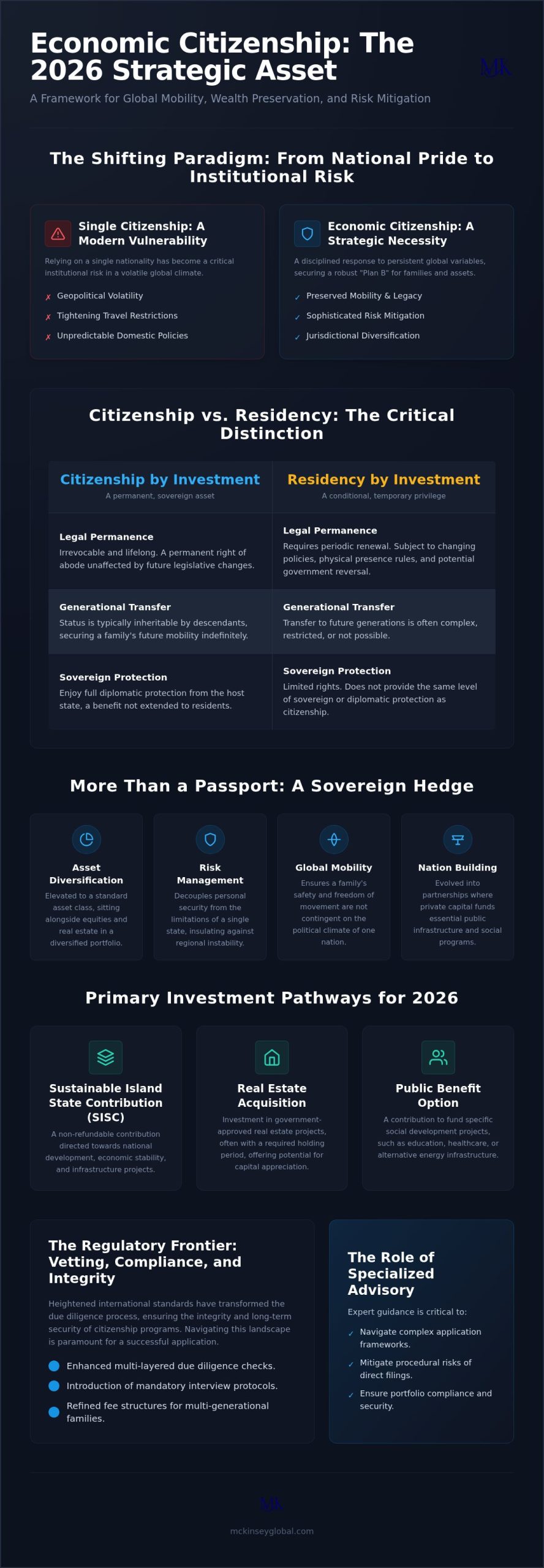
Geopolitical volatility has elevated second citizenship to a standard asset class within diversified portfolios, sitting alongside traditional equities and real estate. As international alliances shift and domestic policies become increasingly unpredictable, the necessity for a robust “Plan B” has become undeniable for those with global interests. Security is paramount. Adopting economic citizenship programs as a risk management tool reflects a broader trend toward decentralizing one’s legal identity. Unlike temporary travel permits or visas, citizenship provides a permanent, irrevocable right of abode that remains unaffected by future legislative changes or sudden diplomatic tensions. Economic citizenship is a strategic tool for jurisdictional diversification that allows investors to decouple their personal security from the limitations of a single state. This sovereign hedge ensures that a family’s safety and mobility aren’t contingent on the political climate of their primary residence, providing a level of insulation against regional instability.
Economic Citizenship vs. Residency by Investment
Discerning the nuances between residency and citizenship is vital for long-term strategic planning. While residency programs, such as various European Golden Visas, offer the right to live and work in a specific country, they remain subject to renewal and potential policy reversals by host governments. In contrast, citizenship represents the right to belong, providing a level of absolute security that residency cannot match. A passport is a permanent asset. Conversely, residency is a conditional privilege often tied to ongoing investment requirements. Understanding the strategic benefits of citizenship by investment for global mobility allows investors to choose the most resilient path for their wealth and family. By opting for citizenship, one gains the full protection of a sovereign state and the ability to pass this status to future generations; this creates a legacy of mobility that is immune to the expiration dates of residency cards.
To evaluate these options effectively, consider the following distinctions:
- Legal Permanence: Citizenship is irrevocable and lifelong, whereas residency requires periodic renewal and adherence to changing physical presence rules.
- Generational Transfer: A passport typically allows for the inheritance of status by descendants, securing the family’s future mobility indefinitely.
- Sovereign Protection: Citizens enjoy the full diplomatic protection of their state, a benefit not extended to temporary or permanent residents.
Primary Pathways: Decoding Investment Structures for 2026
In 2026, the architecture of economic citizenship programs has matured, moving toward higher investment thresholds that reflect the increased value of a secure second passport. Investors must choose between three primary pathways: non-refundable contributions, real estate acquisition, and social development projects. A Commonwealth report on economic citizenship highlights how these capital inflows provide a vital lifeline for small states, funding essential infrastructure and social programs. This macroeconomic impact has led to the rise of specialized infrastructure bonds, where capital is deployed into specific, state-sanctioned developments. This model offers a sophisticated alternative for those seeking a more direct link between their investment and national progress, ensuring that capital is utilized with high-stakes precision.
Non-Refundable Contributions: The Efficiency Model
The contribution pathway remains the most streamlined method for acquiring citizenship. In St. Kitts and Nevis, the Sustainable Island State Contribution (SISC) serves as the primary fund for national development. For a single applicant or a family of up to four, the minimum investment is $250,000. This model is favored for its speed and administrative simplicity; it bypasses the complexities of property management and title transfers. By August 1, 2026, new rules removed separate fees for a spouse and up to two children within this threshold, making it a highly efficient option for families. For many, the lack of ongoing maintenance costs justifies the non-refundable nature of the capital.
Real Estate Acquisition: Building Tangible Global Assets
Investors seeking a return on capital often prefer the real estate pathway. This requires a minimum investment of $325,000 in an Approved Development, typically involving shares in luxury resorts. Alternatively, a $600,000 investment in a private home offers greater autonomy. These assets must be held for a minimum of seven years before they can be resold to another citizenship applicant, or five years for general market resale. While the upfront capital is higher, the potential for rental income and capital appreciation provides a hedge against the initial cost. For a broader perspective on regional requirements, reviewing the Antigua and Barbuda investment options can help in benchmarking these costs against neighboring jurisdictions.
Selecting the right path within economic citizenship programs requires a meticulous evaluation of your long-term liquidity needs and residency goals. If you’re weighing these options, you might find it beneficial to consult with a strategic advisor to align your investment with your broader wealth management strategy.
The Regulatory Frontier: Vetting, Compliance, and Integrity
The integrity of economic citizenship programs is now the primary metric of their long-term value. Following the significant regulatory adjustments of 2024 and 2025, the industry has transitioned to a model of extreme transparency and high-stakes precision. Programs that previously prioritized speed over scrutiny have been effectively sidelined by the international community. Today, jurisdictions like St. Kitts and Nevis utilize independent, third-party intelligence firms to conduct exhaustive due diligence. This process ensures that every applicant is vetted against global security databases and financial watchlists, maintaining the program’s reputation as a secure and elite asset class. The “cheap and fast” era has been replaced by a disciplined environment where compliance is the cornerstone of sovereign security.
The Six-Point Vetting Standard
Modern vetting involves a rigorous evaluation of an applicant’s background. It’s no longer sufficient to provide a clean police record; the standard now requires a deep-dive into an individual’s entire financial and professional history. The standard protocol includes:
- KYC and AML Compliance: Comprehensive Know Your Customer and Anti-Money Laundering protocols to verify identity and financial integrity.
- Source of Wealth (SOW) Verification: A meticulous audit of how the investment capital was accumulated over time.
- Mandatory Interviews: All main applicants and dependents aged 16 or older must attend a mandatory interview, a requirement formalized in the 2026 landscape.
- Biometric Integration: The issuance of new biometric e-passports requires the collection of physical data to ensure document security.
A rejection from one Caribbean jurisdiction often results in a global blacklist. Regional governments now share vetting data to protect their collective borders and program reputations. Engaging in pre-screening with a qualified advisor is essential to identify potential compliance hurdles before a formal submission is made to the Citizenship by Investment Unit.
Global Tax Transparency and Reporting
It’s a common misconception that acquiring a second citizenship is a method for tax evasion. In reality, modern economic citizenship programs operate within the strict confines of the Common Reporting Standard (CRS) and the Foreign Account Tax Compliance Act (FATCA). These frameworks ensure that financial data is shared between jurisdictions, making non-disclosure impossible. While St. Kitts and Nevis offers a favorable tax regime with no tax on foreign income, citizenship doesn’t exempt an individual from their global tax obligations in their country of primary residence. Strategic tax and wealth planning must be conducted in parallel with immigration advisory to ensure full adherence to international regulatory standards. Professional vetting and advisory are the only ways to ensure that your “Plan B” remains a secure and compliant asset.
Comparative Analysis: Matching Jurisdictions to Wealth Goals
Selecting a jurisdiction within the landscape of economic citizenship programs requires a bespoke evaluation matrix that prioritizes long-term legacy over mere travel convenience. While many indices rank programs based on simple visa-free counts, a sophisticated investor evaluates jurisdictional stability, regulatory alignment, and the specific strategic utility of a region. For high-net-worth families, the choice often hinges on whether a program serves as a primary residence, a tax-efficient hub, or a gateway to larger markets like the United States or the European Union. In 2026, the “Big Five” Caribbean nations continue to lead the market, yet each offers distinct advantages tailored to specific wealth preservation goals.
Caribbean Excellence: The Efficiency and Mobility Leaders
St. Kitts and Nevis remains the “Platinum Standard” of the industry, a reputation built since its inception in 1984. Its refined 2026 fee structure is particularly advantageous for families; the Sustainable Island State Contribution (SISC) now covers a family of four for a single $250,000 investment. This contrasts with Antigua and Barbuda, which remains a strong contender for larger households due to its flexible dependent policies. For those seeking access to the United States, Grenada offers a unique strategic advantage through its E-2 Investor Visa treaty, a benefit not shared by its neighbors. Processing timelines across these jurisdictions have stabilized between three and nine months, provided that the initial due diligence is handled with meticulous precision.
The European Tier: Residency as a Path to Citizenship
European options typically follow a residency-first model, where citizenship is the final stage of a multi-year integration process. The Portugal Golden Visa remains a premier residency asset, offering a clear path to EU citizenship after five years of maintained investment and basic language proficiency. Similarly, Greece and Latvia serve as strategic entry points into the Schengen Zone, providing immediate mobility and a secure “Plan B” within a stable regulatory environment. For those requiring direct citizenship without the residency period, Malta remains the gold standard for EU access, though it demands a significantly higher capital commitment and a more rigorous vetting process than its Caribbean counterparts.
Beyond traditional hubs, Türkiye and the United Arab Emirates have emerged as critical hubs for investors seeking Middle Eastern access and diversified residency assets. Türkiye’s program is particularly valued for its rapid processing and its role as a bridge between East and West. To determine which of these economic citizenship programs aligns with your family office’s specific requirements, you should evaluate your global mobility strategy with a disciplined advisor who understands the nuances of each jurisdiction.
The Role of Specialized Advisory in Program Selection
Navigating the complexities of 2026 investment migration requires more than just capital; it demands a disciplined advisor who understands the intersection of regulatory compliance and private wealth. Most economic citizenship programs strictly mandate the use of authorized agents to manage the application process. Direct government applications are rarely feasible, as the state relies on licensed practitioners to perform the initial layers of due diligence. Distinguishing between a “sales agent” and a “strategic consultant” is critical for the long-term security of your investment. While an agent focuses on the transaction, a consultant ensures the program aligns with your broader jurisdictional diversification goals.
The McKinsey Advisory Framework
McKinsey Citizenship and Residency Solutions utilizes a boutique approach that prioritizes risk mitigation and procedural integrity. With over five years of disciplined advisory experience, our firm manages the multi-month application cycle with meticulous attention to detail. We begin with a rigorous pre-screening process that mirrors the standards of international intelligence agencies. This evaluation identifies potential compliance hurdles before they become formal rejections. Our framework ensures that every stage, from the mandatory interviews to the final issuance of biometric e-passports, is handled with the discretion of a global strategist.
Taking the Next Strategic Step
Preparing for the future involves more than just the initial approval. Post-citizenship services, such as passport renewals and the addition of new dependents, require ongoing administrative support. Building a multi-jurisdictional portfolio might involve combining a St. Kitts and Nevis citizenship with a Portugal Golden Visa or UAE residency solutions to maximize global mobility. This holistic strategy provides a level of insulation against regional instability that a single residency cannot offer. The process is thorough. It requires patience and precision.
Securing your family’s future in an unpredictable landscape requires a partner who values order and accuracy above all else. A confidential initial consultation allows for a thorough assessment of your specific objectives. We invite you to contact our specialists for a bespoke global mobility briefing to explore how economic citizenship programs can be integrated into your wealth management strategy. Our focus remains on long-term stability and the meticulous alignment of your residency assets.
Securing Your Global Legacy Through Strategic Alignment
The landscape of international mobility has evolved into a complex environment where legal residency and citizenship are essential components of a robust wealth management strategy. You now understand that economic citizenship programs serve as more than just travel documents; they’re permanent hedges against sovereign risk and jurisdictional instability. By prioritizing programs with rigorous vetting standards, such as St. Kitts and Nevis, you ensure your family’s security remains a secure and compliant asset for generations. The process is thorough. It requires precision.
Successful acquisition requires a disciplined approach that aligns your investment with long-term family office objectives. McKinsey Citizenship and Residency Solutions provides this level of meticulousness through our compliance-first advisory model. With over five years of strategic investment migration experience and a specialized focus on Caribbean and European jurisdictions, we guide you through every stage of the process with the discretion of a seasoned strategist. Take the first step toward securing your global future by choosing to Consult with a McKinsey Global Mobility Strategist for a confidential briefing. We look forward to helping you navigate these complex international landscapes with clarity and professional foresight.
Frequently Asked Questions
Is economic citizenship legal and recognized by international bodies?
Economic citizenship is a legally codified process within the sovereign laws of the host nation. International bodies, such as the IMF and the World Bank, recognize these programs as legitimate mechanisms for small states to attract foreign direct investment. While organizations like the EU maintain rigorous oversight to ensure transparency, properly structured economic citizenship programs remain a valid and lawful pathway for jurisdictional diversification and risk mitigation.
How long does it typically take to obtain citizenship by investment in 2026?
The standard processing timeline in 2026 ranges between three and nine months. This duration accounts for the initial documentation phase; the mandatory interview protocol; and the exhaustive third-party due diligence process. While some jurisdictions previously offered accelerated processing, the current international regulatory environment prioritizes meticulous vetting over speed to maintain program integrity and the security of the nation’s visa-free travel privileges.
Can my family members be included in an economic citizenship application?
The primary applicant can include a spouse, children under 18, and financially dependent children up to age 25 who are in full-time education. Additionally, parents aged 55 or older who are fully supported by the applicant are eligible. Recent changes in St. Kitts and Nevis have refined the fee structure to be more inclusive for families, ensuring that a secure “Plan B” protects the entire household’s mobility and future.
Do I need to reside in the country to maintain my second citizenship?
Most Caribbean programs, including St. Kitts and Nevis, do not require physical residency to maintain citizenship status. Once the investment is completed and the passport is issued, you possess the permanent right to live and work in the country, but there is no obligation to do so. This flexibility is a primary reason why global investors utilize these assets as a sophisticated tool for portfolio diversification.
What are the most common reasons for an application being rejected?
Rejections typically stem from failures in the due diligence process; specifically, discrepancies in the source of wealth or an undisclosed criminal history. Providing inaccurate information during the mandatory interview or failing to meet the rigorous KYC and AML standards will also lead to a denial. Because a rejection can lead to a global blacklist among regional programs, professional pre-screening with an authoritative advisor is essential to ensure procedural integrity.
How much does an economic citizenship program cost for a family of four?
Under the Sustainable Island State Contribution in St. Kitts and Nevis, the minimum investment for a family of up to four is $250,000. This figure represents the non-refundable contribution to the state. Additional costs include mandatory due diligence fees of $10,000 for the main applicant and $7,500 for each dependent aged 16 or over; plus government processing fees and professional advisory costs required for a disciplined application.
What is the difference between economic citizenship and a Golden Visa?
The primary distinction lies in the legal status granted: citizenship provides a passport and the right to belong, whereas a Golden Visa offers residency and the right to live. Residency is often conditional and requires periodic renewal; conversely, citizenship is irrevocable and can be passed to future generations. Choosing between these economic citizenship programs and residency solutions depends on whether your goal is immediate mobility or long-term sovereign security.
Can I hold dual citizenship if my home country does not allow it?
While St. Kitts and Nevis permits dual citizenship, your ability to hold it depends entirely on the laws of your country of primary citizenship. Some nations require citizens to renounce their original nationality upon acquiring another. It’s critical to obtain confidential legal advice to understand the implications for your specific nationality before proceeding with an application to avoid unintended legal complications or the loss of your primary status.