The United Arab Emirates has evolved into the definitive jurisdiction for American capital seeking a stable, tax-efficient gateway to the MENA and Asian markets. Securing a UAE golden visa for american entrepreneurs represents a sophisticated strategic move to protect assets and scale operations within a regulatory framework that prioritizes stability. While the allure of a 9% corporate tax rate on income above AED 375,000 is compelling, the path to residency requires more than just capital. It demands meticulous alignment with UAE Ministry of Economy standards and a disciplined approach to US tax compliance.
You likely recognize that the complexity of dual-jurisdiction reporting, particularly concerning FATCA and the Foreign Earned Income Exclusion, remains a significant hurdle for global expansion. This guide provides a comprehensive roadmap to navigate these requirements, ensuring your transition remains secure and your wealth-preservation goals are achieved. We shall examine the specific 2026 eligibility criteria: the AED 1 million revenue threshold for SMEs and the AED 7 million valuation required for founders of sold projects. This briefing outlines the exact steps to secure five-year residency for your family and team so you’ll optimize your global fiscal footprint.
Key Takeaways
- Understand the structural advantages of 10-year residency, which facilitates 100% foreign ownership and eliminates the traditional requirement for a local Emirati sponsor.
- Verify your eligibility for the UAE golden visa for american entrepreneurs by reviewing the 2026 financial benchmarks, including the AED 1 million annual revenue requirement for accredited SMEs.
- Explore the strategic fiscal benefits of the UAE regulatory environment, such as the 0% personal income tax and the robust asset protection frameworks within the DIFC.
- Learn the methodical phases of application management, moving from initial Ministry of Economy registration to securing formal nominations from local authorities.
- Identify how professional pre-submission vetting and strategic foresight minimize procedural risks while aligning your residency with a broader global citizenship strategy.
What is the UAE Golden Visa for American Entrepreneurs?
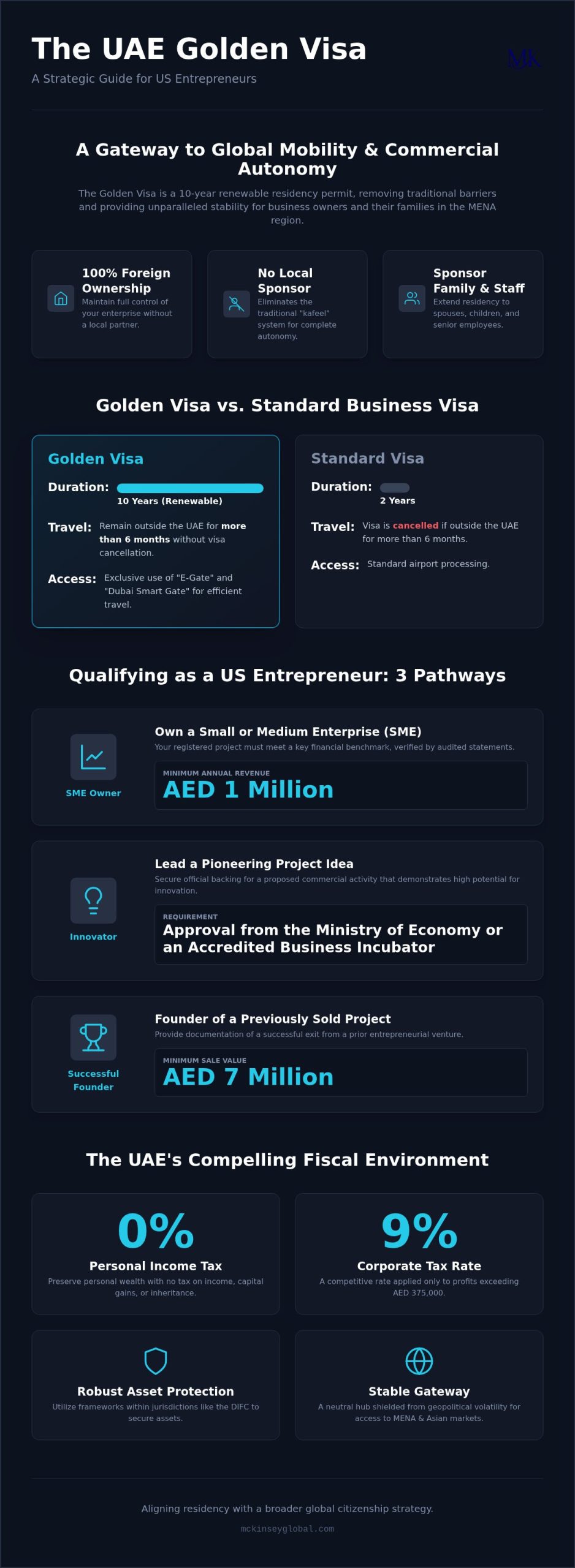
The UAE Golden Visa for American entrepreneurs represents a paradigm shift in how US-based business owners interact with the Middle Eastern market. Historically, foreign investment required a local partner, but the modern framework grants 100% foreign ownership of enterprises. This program is a long-term, 10-year renewable residency permit that functions as a tool for unrestricted global mobility and commercial autonomy in the Middle East. By removing the traditional requirement for a local Emirati sponsor, known as the “kafeel” system, the UAE has established a direct pathway for Americans to maintain full control over their strategic assets.
Understanding What is a Golden Visa in a global context reveals that the UAE’s offering is uniquely tailored toward high-stakes commercial stability and risk mitigation. The residency grant extends its benefits beyond the primary applicant to ensure organizational and familial continuity. It includes spouses and children without the standard age restrictions, while also permitting the sponsorship of senior employees to maintain leadership stability. This allows founders to relocate their core team and family under a single, unified regulatory umbrella.
The Evolution of UAE Residency in 2026
The landscape of Gulf residency has transitioned from temporary, employment-based models toward a permanent, investment-led architecture. In 2026, the UAE serves as a neutral hub for American tech and finance sectors, providing a disciplined environment that is shielded from broader geopolitical volatility. This strategic pivot aligns with the UAE Centennial 2071 goals, which prioritize the integration of global innovation and diversified capital into the nation’s core economic fabric. It’s a calculated move toward long-term stability for those operating in complex international landscapes.
Distinction Between the Golden Visa and Standard Business Visas
American business owners often confuse the Golden Visa with standard entry permits, yet the operational differences are significant. While standard business visas operate on a restrictive two-year cycle, the Golden Visa offers a decade of security. A critical advantage is the freedom to remain outside the UAE for more than six months without the visa being cancelled, a flexibility not afforded to standard residents. Securing a UAE golden visa for american entrepreneurs provides a level of certainty that standard residency simply cannot match. Additionally, holders gain exclusive access to “E-Gate” and “Dubai Smart Gate” facilities, ensuring that high-frequency travel between the US and the UAE remains methodical and efficient.
Eligibility Criteria: Qualifying as a US Entrepreneur
Qualifying for the UAE golden visa for american entrepreneurs requires a meticulous demonstration of commercial viability and innovation. The UAE authorities have established specific financial and qualitative benchmarks that distinguish high-impact founders from general business owners. To initiate the process, an applicant must either own a pioneering project registered with the Ministry of Economy or have successfully exited a prior venture. These standards ensure that the residency program remains exclusive to individuals who contribute to the nation’s strategic economic goals.
The primary pathways for eligibility include:
- Ownership of a small or medium enterprise (SME) generating no less than AED 1 million in annual revenue.
- Approval from an accredited business incubator or the Ministry of Economy for a proposed commercial activity.
- A documented history as a founder of a previous project sold for a total value of no less than AED 7 million.
Consulting the Official UAE Golden Visa requirements ensures that your documentation aligns with current federal standards. Precision in these early stages prevents the risk of procedural delays or application rejection.
Financial Thresholds and Revenue Verification
Revenue verification is a rigorous phase where precision is paramount. Applicants must provide audited financial statements that clearly substantiate the AED 1 million threshold for registered projects. For those backed by accredited incubators, the threshold for eligibility is often tied to the specific project’s scale and potential. Beyond the numbers, the Ministry of Economy evaluates the “pioneering” status of the project. This designation is typically reserved for technology, renewable energy, or biotech sectors. The Ministry acts as a gatekeeper, certifying that the business model is both viable and strategically relevant to the UAE’s long-term vision.
Nomination Pathways for Tech Founders
Founders in the technology sector often pursue nomination through the Dubai Future Foundation or similar local authorities. This pathway prioritizes “disruptive innovation,” a term used to identify businesses that challenge traditional market structures through advanced software or hardware solutions. During this vetting process, American intellectual property (IP) is treated with high levels of confidentiality; however, the applicant must demonstrate how this IP will be operationalized within the UAE. Securing a formal letter of nomination is a critical milestone that bridges the gap between a standard application and a successful residency grant.
For those managing complex portfolios, aligning these requirements with broader UAE residency solutions ensures that every regulatory variable is accounted for before submission. This disciplined approach minimizes uncertainty and reinforces the long-term stability of your global footprint.
Strategic Advantages for the American Business Owner
Securing the UAE golden visa for american entrepreneurs provides a structural advantage that extends far beyond simple residency. The primary draw remains a highly efficient fiscal environment, characterized by 0% personal income tax and a standard corporate tax rate of only 9% on taxable income exceeding AED 375,000. This framework allows for significant capital retention when compared to domestic US rates or other global jurisdictions. For a detailed analysis of how this compares to other regional options, review our Turkey vs. UAE Residency by Investment: A Strategic 2026 Comparison.
Beyond taxation, the UAE offers a robust legal architecture for asset protection. Operating within the Dubai International Financial Centre (DIFC) provides access to an independent, English Common Law based judicial system. This creates a familiar and secure environment for American business owners to structure their holdings. Additionally, the UAE’s geographic position serves as a logistical nexus, providing efficient access to high growth markets in Africa, India, and Southeast Asia. Reviewing the Official UAE Golden Visa Requirements confirms that these strategic benefits are accessible to those who meet the rigorous 2026 eligibility standards.
US Tax Compliance and the UAE Golden Visa
American entrepreneurs must approach UAE residency with a disciplined strategy for dual jurisdiction compliance. While the UAE doesn’t levy personal income tax, US citizens remain subject to taxation on their worldwide income. It’s essential to leverage the Foreign Earned Income Exclusion (FEIE), which for the 2026 tax year allows an exclusion of up to $132,900. Strategic planning ensures that you remain compliant with FBAR and FATCA reporting requirements, which are mandatory for any American holding significant foreign financial assets. This meticulous approach to the US-UAE bilateral relationship minimizes the risk of audits and ensures long-term stability.
Wealth Preservation and Global Mobility
The 10-year security of the Golden Visa serves as a foundational element for sophisticated estate planning. By diversifying your residency, you mitigate the risks associated with domestic political or economic volatility in the United States. While some may consider St. Kitts and Nevis Citizenship by Investment for immediate global mobility, the UAE Golden Visa offers a unique combination of commercial infrastructure and long-term residency. It provides a stable base from which to manage a global portfolio while ensuring that your family’s future is anchored in one of the world’s most secure and innovative environments.
Step-by-Step Application Management for US Citizens
Securing the UAE golden visa for american entrepreneurs requires a methodical, multi-phase approach that prioritizes procedural integrity. Unlike standard residency routes, the entrepreneur category necessitates a preliminary validation of the commercial entity’s strategic value. This structured progression ensures that each regulatory milestone is met before capital or personal assets are committed to the relocation process. The application is a guided journey through several government entities, each serving as a gatekeeper for the nation’s economic ecosystem.
The management of this process is divided into four distinct phases:
- Phase 1: Initial project evaluation and registration with the Ministry of Economy to verify the pioneering nature of the business.
- Phase 2: Securing a formal nomination from relevant local authorities, such as the Dubai Future Foundation (DFF), which is essential for tech-driven ventures.
- Phase 3: Submission of the formal residency application via the Federal Authority for Identity and Citizenship (ICP) or the GDRFA.
- Phase 4: Completion of the mandatory medical screening within the UAE and the subsequent issuance of the physical Emirates ID card.
Document Attestation and US-Specific Requirements
Documents issued in the United States, such as university degrees or corporate articles of incorporation, must undergo a rigorous authentication cycle. This process begins with notarization at the state level, followed by certification from the US Department of State, and concludes with attestation by the UAE Embassy in Washington, D.C. Additionally, all legal documents must be translated into Arabic by a certified legal translator in the UAE. For those already present in the country, it’s necessary to process a “change of status” and pay the associated “Fee inside the country” to transition from a tourist or work visa without departing the territory.
Timeline and Processing Expectations in 2026
The nomination phase typically requires one to four weeks, depending on the complexity of the technical evaluation conducted by the Dubai Future Foundation or the Ministry of Economy. Once this approval is secured, the final residency processing through the ICP usually concludes within 7 to 14 business days. It’s vital to manage expectations regarding family sponsorship; the sponsorship of a spouse or children can only commence once the primary applicant’s Emirates ID has been officially issued. This methodical sequence ensures that the entire family unit is anchored to a secure, long-term residency status.
Navigating these regulatory frameworks requires precision and strategic foresight. To ensure your application remains compliant with the latest federal standards, explore our UAE residency solutions for a guided and secure transition.
Why Professional Advisory is Essential for UAE Residency
The transition from understanding the procedural roadmap to executing a successful filing requires a high degree of precision and strategic foresight. For the UAE golden visa for american entrepreneurs, the margin for error is slim; a single discrepancy in document attestation or a failure to align a project’s description with “disruptive innovation” standards can result in immediate rejection. Professional advisory acts as a meticulous gatekeeper, providing pre-submission vetting that ensures every variable is compliant before it reaches the Ministry of Economy. This disciplined approach minimizes uncertainty and protects the applicant’s time and capital.
Advisory services provide several critical advantages:
- Managing complex cross-border compliance, particularly regarding US-UAE tax treaty nuances.
- Accessing a confidential network of legal and financial experts in Dubai and Abu Dhabi.
- Ensuring the long-term adherence to regulatory frameworks that govern 10-year residency.
- Facilitating the seamless integration of family and team members into the residency grant.
McKinsey’s Meticulous Approach to UAE Solutions
McKinsey Citizenship and Residency Solutions operates with the insight of a global strategist, moving beyond mere administrative support. Our methodology begins with a tailored evaluation of entrepreneur projects, specifically testing them against the rigorous 2026 criteria for innovation and commercial viability. We provide end-to-end management of the attestation and nomination process, acting as a steady guide through the complexities of the DFF and ICP. This focus on procedural integrity ensures that American clients don’t just apply for residency but secure a stable foundation for their international operations.
Integrating Residency into a Global Wealth Strategy
Residency shouldn’t be viewed as an isolated administrative task; it’s a component of a much larger Global Residency and Citizenship Strategy. A well-structured residency plan accounts for long-term estate planning, business growth, and domestic political risk mitigation. While the UAE offers unparalleled access to Eastern markets, some investors may find that Greece Residency by Investment provides a more suitable gateway for European market integration. Choosing the correct jurisdiction requires an objective analysis of your commercial objectives and personal security requirements.
To begin your transition with the confidence of a disciplined partner, schedule a confidential consultation with McKinsey Citizenship and Residency Solutions.
Securing Your Strategic Commercial Future in the Emirates
The transition to the United Arab Emirates represents a definitive step toward commercial autonomy and long-term asset protection. By securing a UAE golden visa for american entrepreneurs, you’re not just obtaining a residency permit; you’re establishing a permanent foundation for growth in a tax-efficient, neutral hub. Success in this landscape requires meeting the AED 1 million revenue threshold while maintaining absolute compliance with US-UAE fiscal reporting standards. It’s a complex process that demands the insight of a seasoned strategist to minimize procedural risks.
McKinsey Citizenship and Residency Solutions operates as a boutique advisory specializing in investment-based migration. We apply a meticulous, compliance-first approach to ensure that your application aligns with the latest 2026 regulatory standards. Our global network of residency experts provides the precision needed to manage your transition with the strategic foresight your portfolio deserves. When you’re ready to optimize your global footprint, we’re prepared to act as your steady guide through this complex international landscape.
Secure your UAE Golden Visa with McKinsey’s expert advisory and take the first step toward a secure, ten-year residency for your family and leadership team. It’s time to anchor your business in a jurisdiction that prioritizes your stability and innovation.
Frequently Asked Questions
Do American entrepreneurs need to live in the UAE to maintain the Golden Visa?
Yes, you don’t need to reside in the UAE continuously to maintain your status. A primary advantage of the UAE golden visa for american entrepreneurs is the flexibility to remain outside the country for more than six months without the residency becoming invalid. This allows you to manage global operations or maintain a presence in the US while retaining your long-term residency. It’s a strategic benefit for founders with a distributed commercial footprint.
Can I sponsor my family and employees under the UAE Golden Visa?
You can sponsor your spouse, children, and senior staff members under this residency framework. The Golden Visa allows for the inclusion of immediate family members regardless of their age, provided they meet the standard health requirements. Additionally, you may sponsor senior employees to ensure the continuity of your leadership team within the UAE. This comprehensive sponsorship capability facilitates a unified relocation of both your personal and professional support structures with high-stakes precision.
What are the corporate tax implications for a UAE-based business in 2026?
The UAE implements a federal corporate tax rate of 9% on taxable income exceeding AED 375,000. Income below this threshold is subject to a 0% rate, which remains highly competitive compared to the OECD average of 23.5%. This structure is designed to support SMEs while ensuring the UAE aligns with international fiscal standards. Business owners should conduct a meticulous evaluation of their taxable base to ensure full compliance with the Ministry of Finance and local regulations.
Is a local Emirati partner required for a Golden Visa entrepreneur project?
A local Emirati partner is not required for projects qualifying under the Golden Visa program. Holders of this residency permit are entitled to 100% foreign ownership of their commercial entities. This eliminates the traditional “kafeel” or sponsorship requirement that previously necessitated a local majority shareholder. It provides American founders with total commercial autonomy and full control over their strategic assets and intellectual property within the UAE’s disciplined regulatory framework for international commerce.
How does the UAE Golden Visa affect my US citizenship or tax status?
Obtaining the Golden Visa has no impact on your US citizenship, but it doesn’t exempt you from US tax obligations. As a US citizen, you’re required to report worldwide income to the IRS regardless of your residency. However, you can utilize the Foreign Earned Income Exclusion, which is $132,900 for the 2026 tax year. Meticulous dual-jurisdiction planning is essential to manage FATCA reporting and optimize your global tax position while maintaining your UAE golden visa for american entrepreneurs.
What happens if my business revenue falls below the AED 1 million threshold?
If your annual revenue drops below the AED 1 million threshold, your residency status isn’t automatically revoked during the visa’s current validity period. Eligibility criteria are primarily assessed during the initial application and at the time of renewal. However, maintaining the pioneering nature of your project is critical for long-term stability. We recommend a disciplined approach to financial reporting to ensure your business continues to meet the Ministry of Economy’s strategic standards for innovation and commercial viability.
Can I apply for the UAE Golden Visa while I am still in the United States?
You can initiate the application process while remaining in the United States. The preliminary phases, including project evaluation by the Ministry of Economy and securing a nomination from authorities like the Dubai Future Foundation, are managed through digital platforms. Once you receive the initial approval, you’ll be issued a six-month entry permit to complete the final procedural steps. These include medical screenings and Emirates ID issuance, which must be finalized within the UAE territory for compliance.
What is the difference between the 5-year and 10-year Golden Visa for entrepreneurs?
The distinction between 5-year and 10-year permits often depends on the specific project valuation and Ministry of Economy accreditation. While the entrepreneur category is frequently associated with a 5-year renewable term, certain strategic investments or high-value projects may qualify for the 10-year duration. Both options provide 100% ownership and the removal of local sponsorship requirements. We provide a disciplined evaluation of your assets to determine which residency pathway best supports your long-term commercial and personal security goals.