
The greatest operational risk in sovereign migration isn’t rigorous government scrutiny; it’s an unauthorized intermediary operating without statutory oversight. In an environment defined by heightened international compliance and centralized oversight, understanding what to look for in a CBI advisor has become an essential exercise in capital protection. You’re entirely right to question promotional claims and opaque retainers. Trusting an unaccredited promoter doesn’t just invite unexpected financial liabilities; it exposes your family to irreversible compliance rejections and severe reputational harm.
Securing dual citizenship demands fiduciary discipline rather than salesmanship. This guide establishes the mandatory vetting criteria, regulatory standards, and institutional safeguards required to separate authorized practitioners from unregulated brokers. We examine how to audit government accreditations, evaluate client escrow protocols, and choose an authentic strategic partner who protects your global standing from day one.
Key Takeaways
- Distinguish authorized sovereign representatives from unregulated intermediaries by demanding verifiable licensing directly from national Citizenship by Investment Units.
- Determine what to look for in a CBI advisor across core benchmarks: institutional longevity, geographic expertise, and comprehensive pre-screening protocols.
- Evaluate how an advisor’s internal compliance audits shield your capital and protect your profile against irreversible sovereign denials.
- Recognize critical industry red flags, such as unauthorized discounting schemes and deceptive guarantees that compromise procedural integrity.
- Utilize a structured due diligence framework to audit client escrow mechanisms, jurisdictional liability clauses, and formal representation agreements.
Defining the Role: What Does an Authorized CBI Advisor Actually Do?
Sovereign migration isn’t a transactional commodities purchase; it’s a rigorous administrative legal procedure governed by statutory national frameworks. Within global immigrant investor programs, sovereign governments do not accept direct, unvetted dossiers from individual foreign nationals. Instead, statutory Citizenship by Investment Units (CIUs) mandate that all formal submissions route through licensed marketing agents and authorized legal representatives. When assessing what to look for in a CBI advisor, the foundational requirement is understanding this legal mandate. An authorized advisor acts as a licensed fiduciary, maintaining direct government accreditation to represent your interests before sovereign adjudicators while safeguarding your legal standing.
Statutory Mandates vs Unregulated Intermediaries
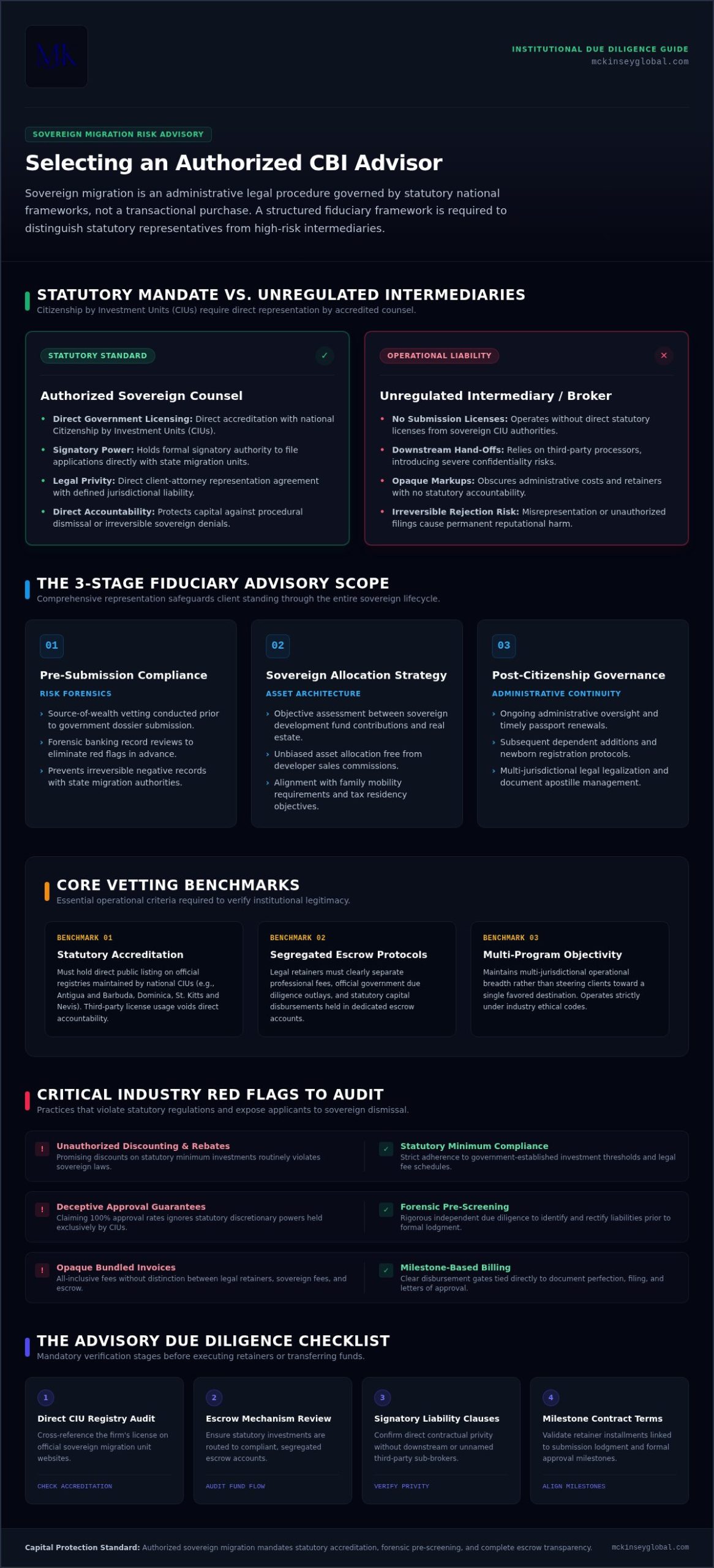
Unregulated intermediaries and referral brokers represent a severe operational liability for high-net-worth applicants. Unlike authorized firms, third-party brokers lack formal submission licenses with sovereign CIUs. They routinely collect sensitive client dossiers only to pass them to downstream local processors, introducing severe data confidentiality risks and untraceable administrative markups. Authorized counsel assumes direct legal accountability for submission accuracy, possessing official signatory power before state migration units and insulating your capital against procedural dismissal.
The Full Spectrum of Fiduciary Advisory Services
A competent advisory practice operates as a risk mitigation partner rather than a sales agency. Determining what to look for in a CBI advisor requires examining the firm’s end-to-end operational scope across three critical stages:
- Pre-Submission Compliance Auditing: Conducting proactive source-of-wealth vetting and forensic banking reviews before state authorities examine your file, eliminating potential red flags in advance.
- Sovereign Allocation Strategy: Providing objective assessments between non-refundable national development fund contributions and government-approved real estate assets, free from developer sales commissions.
- Post-Citizenship Governance: Delivering ongoing administrative continuity, including timely passport renewals, subsequent dependent additions, and document apostille management across multiple jurisdictions.
The Core Criteria: What to Look for in a CBI Advisor
Selecting sovereign advisory representation requires looking past slick marketing collateral to conduct an objective institutional audit. Unregulated promoters often mask their lack of credentials behind glossy web portals, yet they cannot legally file an application with sovereign authorities. Knowing what to look for in a CBI advisor centers on verifying statutory oversight, fee clarity, and procedural governance before releasing sensitive personal records or deploying capital.
Statutory Accreditation and Direct Government Licensing
Direct accreditation is non-negotiable. Prospective investors must audit advisory credentials directly against the public registries maintained by sovereign Citizenship by Investment Units. Tier-one consultancies maintain direct representation rights for primary jurisdictions like Antigua and Barbuda, Dominica, and St. Kitts and Nevis. Operating through intermediaries who rely on third-party licenses eliminates legal privity, creates severe confidentiality liabilities, and removes direct accountability if administrative disputes arise with the state.
Fee Transparency and Retainer Structure
Institutional integrity reveals itself in contractual clarity. A compliant retainer strictly separates professional legal advisory costs, sovereign due diligence outlays, and statutory capital disbursements into designated escrow accounts. Beware of promoters offering opaque all-inclusive discounts or rebate mechanisms; these practices routinely violate statutory minimum investment laws. Reliable advisory firms align their legal compensation with clear, verifiable administrative milestones, such as document perfection, submission lodgment, and formal letter-of-approval issuance.
Jurisdictional Depth and Multi-Program Objectivity
A true fiduciary maintains multi-program operational breadth rather than steering clients toward a single favored jurisdiction. Program selection should mirror your specific family asset architecture, tax residency goals, and global mobility footprint. Adherence to ethical codes established by bodies like the Investment Migration Council (IMC) ensures an advisor objectively weighs sovereign solutions across regions. For instance, comparing European residency pathways alongside Caribbean programs like Antigua and Barbuda investment options allows families to select mechanisms that match their long-term estate planning needs. If your family requires an objective assessment across established sovereign frameworks, reviewing your profile with a licensed specialist at McKinsey Citizenship and Residency Solutions provides a structured, compliant starting point.
Evaluating Due Diligence, Compliance, and Vetting Protocols
Adjudication standards across sovereign migration programs have shifted decisively toward forensic compliance. Sovereign Citizenship by Investment Units collaborate directly with international intelligence agencies, joint regional databases, and independent investigative firms to probe every applicant. Consequently, knowing what to look for in a CBI advisor requires inspecting how an advisory firm vets you before presenting your file to state adjudicators. A firm that bypasses initial compliance screening leaves your family vulnerable to procedural dismissal and public reputational exposure.
Internal Pre-Screening Before Government Submission
Tier-one practices deploy the same institutional intelligence platforms used by multinational financial institutions, including World-Check and LexisNexis. Rigorous preliminary vetting identifies potential media mischaracterizations, political exposure issues, or unresolved legal filings that could trigger an immediate rejection. Proactive compliance audits prevent the total forfeiture of non-refundable government processing and vetting expenses. Rigorous internal due diligence functions as an indispensable shield, resolving potential anomalies before state investigators initiate their background assessments.
Structuring Source of Funds and Source of Wealth
Sovereign intelligence panels scrutinize capital origins with forensic precision. Today’s in-depth due diligence process demands clear documentary evidence linking total net worth to legitimate commercial activities, family inheritances, or investment exits. A competent advisory team translates complex balance sheets, holding company dividends, and trust structures into clear, auditable disclosures. Unregulated brokers frequently stumble here, submitting poorly structured financial filings that lead to protracted regulatory queries or formal application denials.
Sovereign Escrow and Capital Protection Measures
Capital preservation must remain central when identifying what to look for in a CBI advisor. Statutory programs dictate that primary investment disbursements sit within segregated, government-monitored escrow accounts rather than general operating accounts. This safeguard is especially vital when evaluating citizenship by investment donation vs real estate strategies. Real estate acquisitions require binding developer contracts that release funds only upon formal government approval. Robust representation agreements must explicitly outline escrow refund timelines, guaranteeing that capital returns securely if statutory authorities decline to grant citizenship.
Critical Red Flags: How to Spot an Unreliable CBI Broker
The sovereign migration sector attracts predatory intermediaries who exploit administrative opacity for short-term gain. These operators rely on aggressive marketing tactics to capture retail investors, concealing fundamental legal risks that compromise an applicant’s long-term nationality. Learning what to look for in a CBI advisor requires an equally sharp understanding of what to actively avoid. Engaging an unscrupulous broker doesn’t just result in lost capital; it can trigger regulatory blacklisting across international immigration authorities.
Illegal Discounting Schemes and Legislative Revocation Risks
Under-the-table financing mechanisms and illicit developer rebates represent the single greatest existential threat to an investor’s legal status. Sovereign statutes mandate strict minimum capital thresholds, which all participating nations enforce by law. When a promoter offers backdoor rebates or promises artificial loan structures to reduce the required outlay, they violate national immigration statutes. Sovereign governments retain constitutional authority to annul naturalization certificates retroactively if an audit reveals that an applicant underfunded the statutory threshold. Permanent, irrevocable legal nationality requires uncompromising adherence to published sovereign fee schedules.
Unrealistic Guarantees and Bypassed Compliance Promises
Run from any operator guaranteeing 100% approval or promising expedited clearance without statutory background screening. Sovereign cabinets and independent Citizenship by Investment Units hold exclusive administrative sovereignty over naturalization approvals. No private firm, regardless of size, can bypass statutory intelligence screening or override government adjudicators. Deceptive claims asserting that mandatory biometric checks or criminal history clearances can be circumvented represent fraudulent inducements that guarantee administrative refusal.
Aggressive Real Estate Pushing Without Strategic Fit
A persistent conflict of interest occurs when consultancies push distressed or unapproved property assets they own, build, or heavily commission. These captive sales operations masquerade as neutral legal advisors, yet their recommendations serve developer liquidity rather than your family’s global strategy. A genuine fiduciary objectively evaluates statutory pathways, contrasting real estate holding periods with contribution funds across premier jurisdictions such as St. Kitts and Nevis citizenship by investment. When assessing what to look for in a CBI advisor, insist on total independence from developer balance sheets. To protect your family against predatory brokerage structures, schedule a confidential compliance audit with McKinsey Citizenship and Residency Solutions.
The Advisory Selection Process: Your Strategic Due Diligence Checklist
Engaging legal counsel for sovereign migration requires the same forensic rigor applied to an enterprise acquisition. Before executing retainers or entrusting sensitive records to external parties, investors must subject candidates to a systematic vetting framework. Clear guidelines on what to look for in a CBI advisor ensure you retain an accountable partner rather than an unvetted sales agent.
Key Questions to Ask Prospective CBI Advisors
Direct interrogation quickly separates authorized fiduciaries from referral intermediaries. Structure your initial interview around these operational questions:
- Direct Filing Longevity: How many years has your firm directly processed files with Caribbean and European authorities, and can you evidence active filing privileges?
- Statutory Credentials: Can you provide your registered marketing agent license numbers for verification on official government CIU portals?
- Forensic Intake Protocols: What specific third-party screening platforms and compliance procedures do you execute prior to submitting client dossiers to sovereign units?
Contractual Clarity and Professional Liability
Contractual terms reveal a firm’s willingness to stand behind its representation. An engagement contract must name an onshore, legally accountable corporate entity rather than an opaque offshore shelf corporation. Ensure the agreement details professional indemnity insurance coverage, unambiguous non-performance definitions, and clear dispute resolution venues. Given the personal nature of biometric and financial disclosures, the contract should also enforce strict non-disclosure obligations and robust institutional data privacy protections.
Initiating Your Strategic Sovereign Advisory
Holistic sovereign wealth planning often demands multi-regional diversification. A well-rounded advisory balances Caribbean direct nationality solutions with European residency strategies, such as Greece residency by investment, ensuring your global access strategy matches evolving mobility requirements. Discerning what to look for in a CBI advisor ultimately means identifying an independent fiduciary whose compliance discipline shields your family’s assets across generations.
Securing Your Sovereign Future Through Principled Advisory
Navigating sovereign investment migration requires moving beyond marketing allure to implement disciplined fiduciary risk management. Recognizing what to look for in a CBI advisor ensures your family partners with an authorized representative possessing direct statutory accreditation, forensic intake vetting, and strictly segregated escrow protocols. These operational safeguards protect your capital from speculative intermediaries while insulating your legal standing across sovereign jurisdictions.
As global mobility frameworks tighten, establishing dual nationality becomes an enduring generational asset when managed with procedural precision. Schedule a confidential consultation with McKinsey Citizenship and Residency Solutions to review your mobility portfolio with an independent boutique partner dedicated to uncompromising compliance and strategic longevity.
Frequently Asked Questions
How do I verify if a CBI advisor is officially licensed by a government?
You verify an advisor’s license by cross-referencing their company name and registration number against the public registries maintained directly on sovereign Citizenship by Investment Unit (CIU) websites. Sovereign bodies like those in Antigua and Barbuda, Dominica, or St. Kitts and Nevis publish searchable lists of licensed marketing agents. If a promoter cannot provide an official government license number or claims their license is held by an unnamed third party, they are an unauthorized intermediary.
Can an advisor guarantee that my citizenship application will be approved?
No advisor can legally guarantee application approval. Sovereign cabinets and statutory Citizenship by Investment Units retain absolute, discretionary authority over naturalization grants. When evaluating what to look for in a CBI advisor, treat any guarantee of success as an immediate warning sign. Ethical practitioners conduct rigorous internal pre-screening to identify potential clearance issues early, but they will never promise statutory outcomes that rest entirely within sovereign government jurisdiction.
What is the difference between an authorized agent and a marketing intermediary?
An authorized agent holds direct statutory licensing from a sovereign government, giving them formal signatory rights and direct submission access to the Citizenship by Investment Unit. A marketing intermediary or sub-agent lacks regulatory standing; they merely collect client dossiers to broker them downstream to third-party processors. Working directly with authorized counsel ensures legal privity, protects sensitive data under strict professional secrecy laws, and eliminates unregulated broker commissions.
Why do top-tier CBI advisors conduct internal background checks before filing?
Top-tier consultancies run forensic background checks using global intelligence databases like World-Check to identify adverse media, sanction exposure, or banking discrepancies before state submission. This internal audit protects your capital by resolving documentation flaws before sovereign authorities begin formal vetting. Because official due diligence fees and submission retainers are non-refundable, thorough preliminary compliance screening prevents catastrophic procedural denials and protects your international reputation from being compromised.
What happens if an advisor offers citizenship below the legal minimum investment?
Accepting an offer below statutory minimums constitutes participation in an illegal scheme that invalidates your application. Sovereign immigration laws mandate exact capital thresholds for national funds and approved real estate. When unlicensed brokers use artificial financing tricks or under-the-table kickbacks to reduce pricing, they breach national statutes. Governments audit these transactions and hold constitutional power to revoke naturalization certificates retroactively, leaving investors without citizenship or legal recourse.
Should my CBI advisor also handle European residency by investment options?
Engaging an advisor with multi-jurisdictional depth ensures objective mobility planning tailored to your family’s strategic needs. A multi-program advisory evaluates direct nationality solutions across the Caribbean alongside European Golden Visas, such as Greece residency or the Portugal Golden Visa, without funneling you toward a single outcome. Broad cross-border capability is a vital element of what to look for in a CBI advisor, ensuring long-term flexibility as global travel regulations and tax treaties evolve.
What documents should a trustworthy advisor request during the initial consultation?
A professional advisory begins onboarding with certified identification and preliminary source-of-wealth records under a formal non-disclosure agreement. They will request valid passport copies, basic curriculum vitae summaries, proof of residential address, and high-level banking or corporate ownership statements. Reputable firms never demand full financial transfers or sensitive statutory medical files during initial discovery; they review core background fundamentals first to verify basic program eligibility.