In an environment governed by the automated oversight of the EU Entry/Exit System and the mandatory UK Electronic Travel Authorisation, a single passport is no longer a sufficient tool for international freedom; it’s a potential point of failure for the global elite. You recognize that unpredictable visa processing times and geopolitical instability aren’t merely inconveniences. They represent fundamental risks to your family’s long-term security and your business’s operational continuity. Achieving true global mobility for non-EU citizens requires a shift in perspective, moving away from viewing residency as a luxury and toward treating it as a strategic asset class that demands meticulous management.
This article provides a disciplined 2026 framework to help you transcend travel restrictions through a sophisticated portfolio of investment-based residency and citizenship. You’ll discover how to navigate recent regulatory shifts, such as the elimination of real estate routes in Portugal’s Golden Visa and the tiered investment thresholds now enforced in Greece. We’ll preview the essential components of a robust “Plan B” strategy, including the harmonized minimum investment floors across the Caribbean and the growing importance of venture capital funds. By aligning your capital with these rigorous regulatory frameworks, you ensure visa-free access to major economic hubs and provide your family with a secure, permanent anchor in an uncertain world.
Key Takeaways
- Understand how the universal digitization of international borders, including the EES and ETIAS systems, necessitates a more sophisticated approach to global mobility for non-EU citizens.
- Distinguish between the immediate travel access provided by Caribbean citizenship-by-investment programs and the strategic long-term residency pathways available through European Golden Visas.
- Navigate the 2026 investment landscape by evaluating the unified minimum price floors in the Caribbean and the transition toward non-real-estate investment classes in Portugal and Greece.
- Learn to design a diversified mobility portfolio that prioritizes jurisdictional stability and provides a robust “Plan B” for family security and international business continuity.
- Discover the importance of a disciplined, advisory-led approach to ensure full regulatory compliance and the successful mitigation of complex procedural risks.
The Evolving Landscape of Global Mobility for Non-EU Citizens
The definition of global mobility has undergone a fundamental transformation following the geopolitical shifts of the early 2020s. In 2026, the international landscape is characterized by a “hardened” border environment where biometric tracking and pre-travel authorizations are the standard. For the high-net-worth individual, global mobility for non-EU citizens is no longer a matter of mere travel convenience; it’s evolved into a critical asset class that requires the same level of strategic oversight as a diversified financial portfolio. This shift reflects a move away from seeking “vacation ease” toward a disciplined focus on comprehensive risk mitigation and long-term stability.
Identifying the Mobility Gap in a Post-Schengen Era
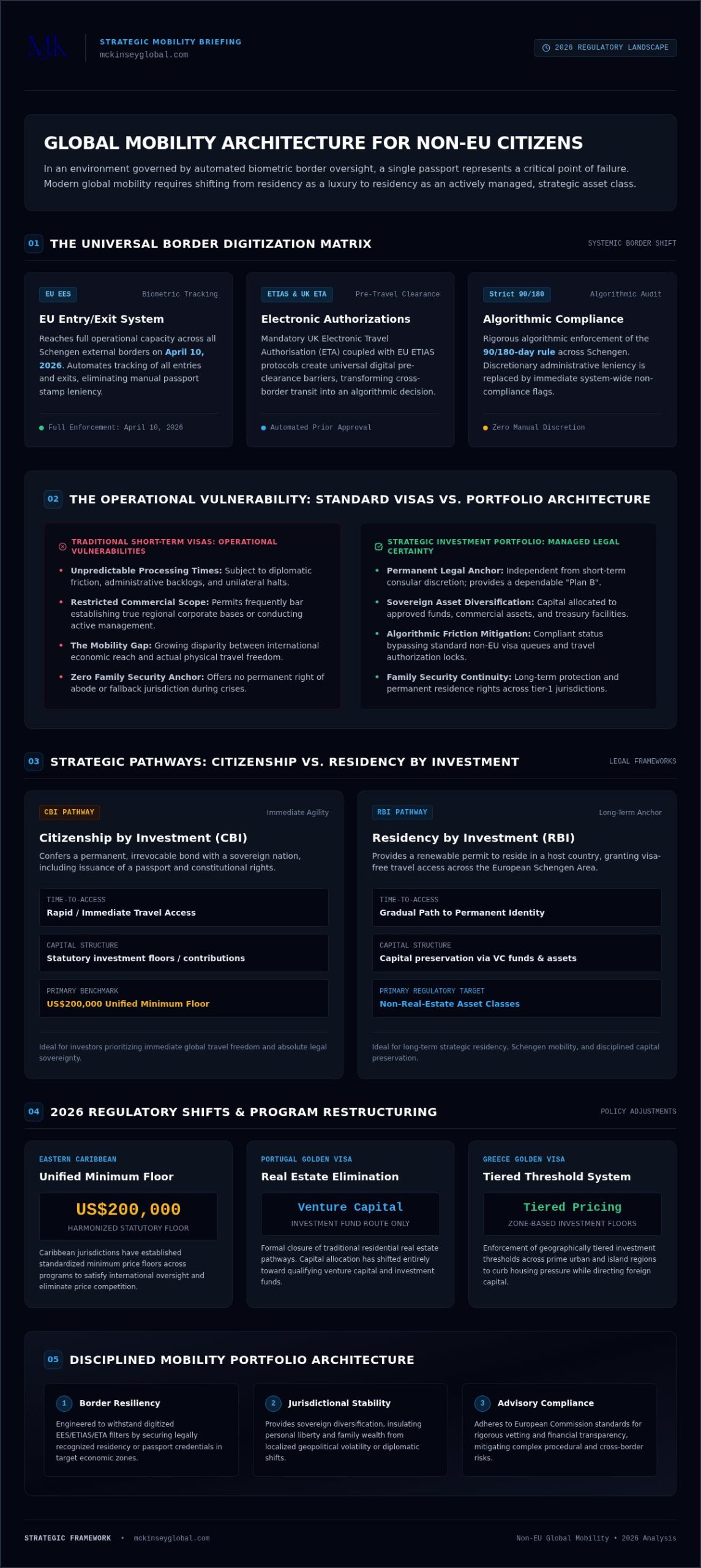
The implementation of the EU’s biometric Entry/Exit System (EES), which reached full operational capacity across all Schengen external borders on April 10, 2026, has introduced significant administrative friction for those relying on traditional travel documents. Coupled with the ETIAS requirements, non-EU nationals now face an environment where every movement is algorithmically tracked, and the 90/180-day rule is strictly enforced without the leniency of manual passport stamps. The mobility gap is the disparity between economic reach and travel freedom. As global commerce becomes more interconnected, the inability to move freely between economic hubs creates a tangible bottleneck for business expansion and family security. Many investors are turning to immigrant investor programs to bridge this gap, securing government-approved pathways that bypass the uncertainties of standard border protocols.
Why Standard Visas No Longer Suffice for Global Investors
Relying on short-term business or tourist visas presents a series of operational risks that are increasingly incompatible with high-level international commerce. The unpredictability of visa processing times, which can fluctuate based on diplomatic tensions or administrative backlogs, creates a precarious foundation for time-sensitive business engagements. Standard permits often carry restrictive clauses regarding the duration of stay and the nature of permitted business activities, often barring the holder from establishing a true regional base. In contrast, securing long-term residency or citizenship provides a permanent “Plan B” that standard visas can’t replicate. This strategic advantage ensures that global mobility for non-EU citizens remains a constant, providing the legal certainty required to manage international interests with precision and confidence.
Strategic Pathways: Citizenship vs. Residency by Investment
Selecting the appropriate legal framework is a foundational step in securing global mobility for non-EU citizens. While residency and citizenship are often discussed interchangeably, they represent distinct legal statuses with different long-term implications. Residency by investment (RBI) provides a renewable permit to reside in a host nation and, in the case of European programs, grants visa-free access to the Schengen Area. Citizenship by investment (CBI) confers a permanent, irrevocable bond with a sovereign state, including the issuance of a passport and the full suite of constitutional rights. Investors must determine whether their primary objective is immediate travel freedom or a gradual path toward a new national identity.
Evaluating the “Time-to-Access” against the “Cost-of-Entry” requires a disciplined analysis of current regulatory standards. As highlighted in the European Commission report on investor citizenship and residence schemes, security vetting and financial transparency have become increasingly rigorous. Programs that offer immediate citizenship typically demand a higher non-refundable contribution or a specific statutory investment floor, such as the US$200,000 minimum now harmonized across the Eastern Caribbean. Conversely, residency pathways often allow for capital preservation through investment funds or commercial assets, though they require several years of maintained status before naturalization becomes a possibility.
The Mechanics of Economic Citizenship
Economic citizenship serves as the most direct route to enhancing global mobility for non-EU citizens. By making a government-approved contribution, an investor can bypass the years of physical presence usually required for naturalization. Caribbean jurisdictions remain the primary providers of these solutions, especially since the European Union’s 2025 judicial rulings effectively ended direct CBI programs within its borders. For those seeking the highest standards of due diligence and international standing, St. Kitts and Nevis citizenship by investment remains a benchmark option, offering a streamlined process for families and business leaders who require rapid, secure travel access.
Residency by Investment: Access Without Immediate Relocation
Residency frameworks, commonly known as “Golden Visas,” offer a flexible alternative for those who don’t wish to relocate their primary tax domicile immediately. These programs are particularly effective for maintaining a foothold in the European market. The Portugal Golden Visa now focuses on venture capital and collective investment funds, while Greece Residency by Investment utilizes a tiered property threshold reaching up to €800,000 in high-demand zones. These permits act as a bridge, allowing investors to secure their family’s future while maintaining their current international business operations. You can refine your selection criteria by consulting with a strategic advisor to align these pathways with your specific wealth preservation goals.
Comparing Tier-1 Mobility Hubs: Caribbean and European Solutions
Strategic asset allocation in the context of global mobility for non-EU citizens involves selecting jurisdictions that provide both immediate access and long-term wealth preservation. While Caribbean programs are often prized for their rapid processing and travel rights, European residency frameworks offer a critical gateway to the world’s largest single market. Investors must also consider the growing strategic importance of Middle Eastern hubs. For instance, a Turkey vs. UAE residency by investment comparison reveals how these regions serve as vital bridges between East and West, providing unique regulatory environments for international commerce and family security.
Caribbean Programs: Rapid Access and Global Travel Rights
Caribbean jurisdictions have successfully harmonized their regulatory standards to provide a transparent and secure environment for investors. Under the OECS Memorandum of Agreement, statutory investment floors are now set at a minimum of US$200,000, ensuring that these programs maintain their elite status while providing significant capital for regional development. When evaluating Antigua and Barbuda investment options for 2026, you’ll find a choice between a US$230,000 donation to the National Development Fund or real estate acquisitions starting at US$300,000. While donation-based models offer the most direct path to citizenship, real estate investments in Dominica or St. Lucia provide a tangible asset within a tax-neutral environment, serving as a pillar for wealth diversification beyond simple travel freedom.
European Residency: Strategic Investment in the Schengen Zone
European residency remains the gold standard for those requiring consistent access to EU markets and the Schengen Area. The distinction between these residency permits and direct citizenship is clearly outlined in the European Commission report on investor citizenship and residence schemes, which emphasizes the rigorous due diligence applied to these high-stakes pathways. The Greece residency by investment program continues to attract significant interest due to its tiered structure; however, investors must now navigate a €800,000 threshold in high-demand zones like Athens and Thessaloniki. In Portugal, the shift away from residential real estate has redirected capital into €500,000 venture capital funds, focusing on innovation and commercial growth. For those seeking a strategic entry point into Northern Europe, Latvia’s residency program offers a disciplined alternative, providing a stable regulatory environment for non-EU citizens to establish a presence within the Baltic region.
Achieving optimal global mobility for non-EU citizens requires a balanced approach that accounts for both geographic reach and financial stability. By diversifying your mobility portfolio across these tier-1 hubs, you ensure that your family and business interests remain shielded from regional instability and shifting border policies.
Designing Your Mobility Portfolio: Key Selection Criteria
Strategic global mobility for non-EU citizens isn’t a one-off transaction; it’s a long-term commitment to a specific jurisdiction that requires meticulous evaluation. You must look past the initial “passport power” and analyze the underlying legislative stability of the host nation. A program’s reputation directly impacts its longevity and the continued validity of its travel privileges. If a jurisdiction maintains lax standards, it risks losing its visa-free treaties with major economic blocs. This makes rigorous due diligence a benefit to you, not a hurdle, as it preserves the long-term value of your alternative residency or citizenship.
Evaluating Vetting Standards and Long-Term Stability
High vetting standards act as a protective barrier for your investment. For example, the 2026 landscape features mandatory in-person or video interviews for applicants over 16 in Caribbean jurisdictions, a standard driven by regional MoA agreements. These protocols ensure that the jurisdiction remains in good standing with international authorities, including the US and EU. When selecting a program, prioritize those with clear, government-backed legal frameworks and a history of regulatory compliance. This meticulous approach reduces the risk of sudden policy reversals that could jeopardize your access rights or your family’s security.
Evaluating the total cost of ownership is equally vital to your strategy. Beyond the initial contribution or asset purchase, you must account for recurring administrative fees, renewal costs, and legal maintenance over a five to ten-year horizon. Some residency programs require periodic physical presence to remain valid. Portugal, for instance, mandates a 14-day stay every two years. If you don’t plan to relocate, these requirements must align with your existing travel patterns to avoid inadvertent permit expiration.
Aligning Investment with Strategic Lifestyle Goals
Your portfolio should reflect your family’s broader objectives regarding education, healthcare, and fiscal residency. Tier-1 jurisdictions often provide access to elite educational institutions and world-class medical facilities that aren’t available in your primary country of citizenship. European residency grants your dependents the right to study within the Schengen Zone, while Middle Eastern hubs offer a strategic base for international business expansion. Balancing these benefits against your tax and estate planning needs is essential. Holding residency in certain jurisdictions may trigger fiscal obligations if your physical presence exceeds specific thresholds, typically 183 days. You can request a portfolio audit to ensure your chosen pathways for global mobility for non-EU citizens align with your long-term wealth preservation strategy.
Expert Advisory: Navigating Complex Regulatory Frameworks
In the current regulatory climate, characterized by the universal operation of the EU Entry/Exit System and harmonized Caribbean investment floors, the margin for administrative error has effectively vanished. Achieving global mobility for non-EU citizens requires more than just capital; it demands a disciplined adherence to evolving legal standards across multiple jurisdictions. McKinsey Citizenship and Residency Solutions, a boutique advisory not affiliated with McKinsey & Company management consultants, functions as a disciplined gatekeeper through these complex international landscapes. By prioritizing risk mitigation and regulatory compliance, the firm ensures that every application is managed with the precision required to protect long-term stability.
The Role of Meticulous Application Management
Government citizenship and residency units have significantly increased their vetting standards, utilizing coordinated information sharing with international authorities to verify applicant backgrounds. Ensuring all documentation meets the exacting standards of these units is the primary defense against application rejection. Proactive file management involves an exhaustive internal audit of financial records and personal history before any documents are submitted to government channels. This end-to-end oversight minimizes the risk of delays caused by requests for additional information or administrative discrepancies. Bespoke advisory is superior to generic processing because it proactively aligns an investor’s unique financial profile with the specific, often unwritten, expectations of government vetting units.
Why Strategic Foresight Outperforms Off-the-Shelf Programs
Generic residency solutions often fail to account for the long-term interaction between different legal statuses and tax domiciles. Strategic foresight involves analyzing the synergy between programs, such as how a Portugal Golden Visa might eventually complement a Caribbean citizenship to provide a multi-layered mobility strategy. A professional advisor provides continuous monitoring of the global landscape, identifying potential risks such as the 2025 termination of Spain’s real estate route or changes to Italy’s flat tax regime. This ongoing vigilance ensures that your “Plan B” remains a viable asset as international laws shift.
The value of a confidential and detail-oriented partner lies in their ability to provide clarity within an environment of uncertainty. By focusing on procedural integrity and government-approved pathways, such as the St. Kitts and Nevis Citizenship or the Greece Residency by Investment program, an advisor guides you through the process with professional progress and calm. This steady, methodical approach to global mobility for non-EU citizens transforms a complex legal journey into a structured process with predictable, secure outcomes.
Securing Your Global Legacy Through Strategic Mobility
The 2026 landscape demands a shift from reactive travel planning to the creation of a resilient mobility portfolio. By diversifying your rights of access across Tier-1 Caribbean and European jurisdictions, you insulate your family and business from the friction of biometric border systems and shifting regional policies. Achieving true global mobility for non-EU citizens isn’t merely about acquiring a second passport; it’s about the meticulous alignment of investment with long-term fiscal and lifestyle stability.
Success in this high-stakes environment depends on the precision of your application and the strategic foresight of your partners. Our boutique advisory provides specialized expertise in Caribbean and European investment migration, maintaining a disciplined focus on regulatory compliance and risk mitigation. You don’t have to navigate these complex international waters alone. To begin designing a bespoke framework that protects your future, consult with our strategic advisors at McKinsey Citizenship and Residency Solutions. We look forward to securing your global access with the discretion and insight your legacy deserves.
Frequently Asked Questions
What is the primary difference between residency and citizenship for non-EU citizens?
Citizenship confers a permanent legal bond with a nation, including the right to a passport and full constitutional protections. Residency, such as the Greece Residency by Investment program, provides a renewable permit to live in a country without granting a second nationality. While residency facilitates travel within the Schengen Area, it doesn’t replace your primary travel document. Understanding this distinction is vital for non-EU citizens designing a long-term mobility strategy.
How long does it typically take to acquire a second citizenship by investment in 2026?
Acquiring a second citizenship through Caribbean programs typically requires four to eight months from the initial filing. While processing speeds vary based on the complexity of the applicant’s background, these jurisdictions remain the most efficient routes for enhancing global mobility for non-EU citizens. In contrast, European residency pathways require several years of maintained status before an applicant becomes eligible to apply for naturalization, making citizenship a much longer-term objective in the EU.
Can my family be included in a global mobility investment application?
Yes, most investment migration programs allow the main applicant to include a spouse and dependent children under the age of 30. Many jurisdictions, including Antigua and Barbuda, also permit the inclusion of dependent parents or grandparents over 55. Each additional family member is subject to thorough background checks and government-mandated processing fees. Including your family ensures that your global mobility strategy provides collective security and access to international educational and healthcare systems.
Are there physical residency requirements for Caribbean citizenship programs?
Most Caribbean citizenship programs don’t require physical presence during the application process or after the passport is issued. Antigua and Barbuda is a minor exception, requiring citizens to spend at least five days in the country during the first five years of their term. This lack of residency requirements makes these programs highly attractive for business leaders who need to maintain their primary operations and tax domicile in their home jurisdictions while expanding their travel rights.
Which European residency program offers the fastest access to the Schengen Zone?
Greece currently offers one of the most efficient pathways for non-EU nationals to gain legal access to the Schengen Zone. Once the residency permit is approved, which usually occurs within six months, the holder and their family can travel freely across all Schengen member states without additional visas. Portugal’s Golden Visa is also a prominent contender, though the shift toward venture capital fund investments has altered the administrative timelines for new applicants seeking European market entry.
What are the tax implications of acquiring a second residency or citizenship?
Acquiring a new residency or citizenship doesn’t automatically trigger new tax liabilities unless you establish a fiscal domicile. Most jurisdictions define tax residency by physical presence, typically exceeding 183 days in a calendar year. However, US citizens remain subject to worldwide taxation regardless of where they reside. It’s essential to coordinate your investment with professional tax counsel to ensure your global mobility for non-EU citizens doesn’t create unintended exposure to double taxation or complex reporting requirements.
How do vetting and due diligence standards impact the application process?
Rigorous vetting and due diligence are the pillars of program longevity, ensuring that only individuals of high integrity are granted access rights. Governments utilize third-party agencies to conduct deep-dive financial and criminal background checks, which can extend the processing timeline if discrepancies are found. While these procedures require meticulous documentation, they protect the jurisdiction’s international reputation. This adherence to high standards ensures that your second passport or residency maintains its visa-free travel privileges long-term.
Can I maintain my original citizenship while acquiring a second one through investment?
Most investment-friendly nations, including St. Kitts and Nevis and Dominica, fully recognize dual citizenship, allowing you to retain your original nationality. However, the ability to maintain two passports depends primarily on the laws of your country of origin. Some nations strictly forbid dual nationality and may require you to renounce your primary citizenship upon acquiring a new one. You should verify the legal framework of your home jurisdiction before proceeding with a second citizenship application.