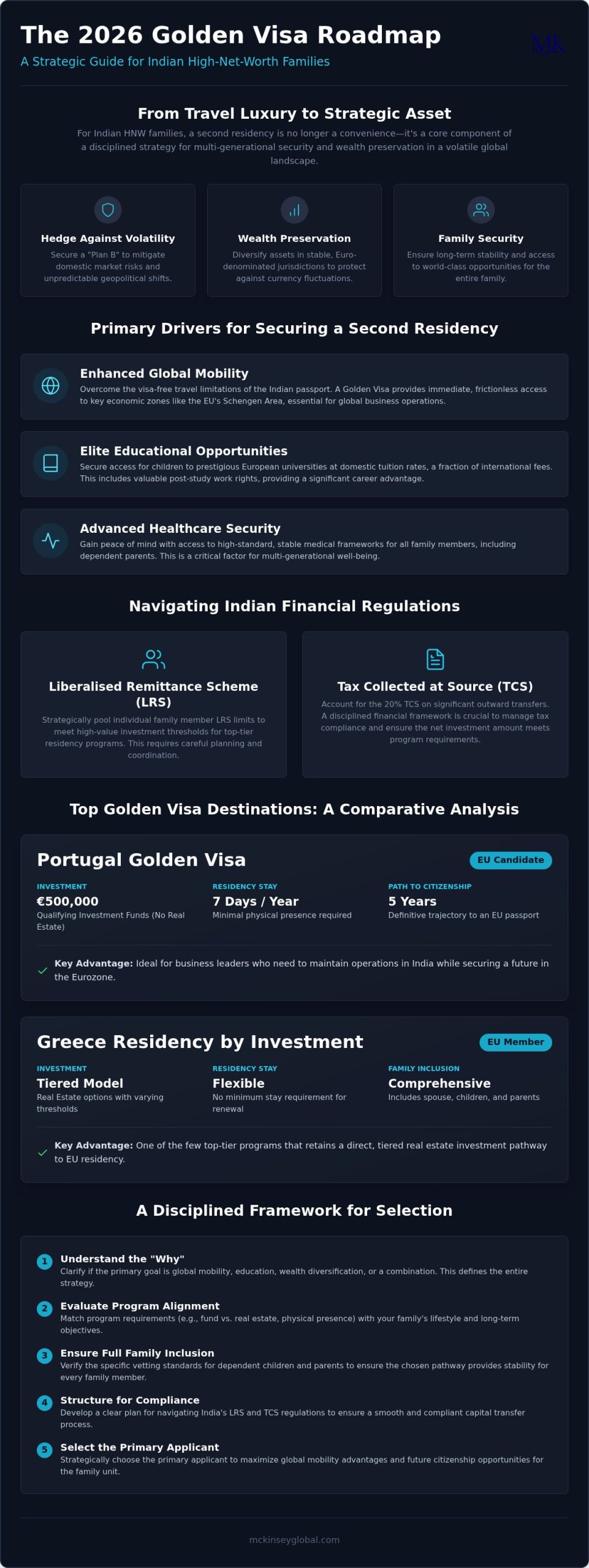
A secondary residency in 2026 is no longer a mere travel convenience; it’s a multi-generational hedge against regional volatility and global uncertainty. High-net-worth individuals recognize that a single passport often acts as a bottleneck for elite university placements and frictionless international commerce. The strategic landscape for a golden visa for indian families has evolved into a complex matrix of regulatory compliance and shifting investment thresholds. Success in this environment requires more than capital; it demands a disciplined framework that accounts for India’s Liberalised Remittance Scheme (LRS) and the 20% Tax Collected at Source (TCS) on significant outward transfers.
You’re seeking a path that prioritizes family safety and long-term security over short-term convenience. This guide provides a professional roadmap to evaluate the most robust residency and citizenship programs available today. We’ll analyze the transition from property-based investments to diversified fund options in Europe and the invitation-only schemes in the Middle East. By the end of this report, you’ll possess a clear understanding of how to align these global opportunities with your family’s specific requirements for quality of life and permanent residency.
Key Takeaways
- Understand why a golden visa for indian families has transitioned from a travel luxury to a critical strategic asset for wealth preservation and multi-generational security.
- Evaluate the latest 2026 investment thresholds for European residency, including the shift toward fund-based options in Portugal and the tiered real estate requirements in Greece.
- Learn how to navigate the Liberalised Remittance Scheme (LRS) by strategically pooling family limits to meet high-value investment requirements while managing tax compliance.
- Discover the specific vetting standards for dependent children and parents to ensure your chosen residency pathway provides long-term stability for the entire family.
- Identify a disciplined framework for selecting the primary applicant to maximize global mobility and future citizenship opportunities within a compliant regulatory environment.
The Strategic Shift: Why Indian Families are Prioritizing Golden Visas in 2026
For Indian high-net-worth families, the concept of a golden visa for indian families has transformed from a luxury travel perk into a sophisticated risk-management tool. It represents a strategic asset class that provides a hedge against domestic market volatility and unpredictable geopolitical shifts. This “Plan B” imperative is no longer a peripheral consideration; it’s a core component of a disciplined family office strategy designed to ensure long-term stability and wealth preservation across multiple jurisdictions.
The 2026 Global Mobility Landscape for Indians
Despite India’s economic growth, the Indian passport continues to face significant visa-free travel limitations according to the 2026 Henley Passport Index. This friction often hinders the operational agility required by business leaders in Mumbai and Delhi who manage global interests. A Golden Visa serves as a formal regulatory pathway for residency-via-capital. By participating in global immigrant investor programs, families can bypass the administrative burdens of traditional visa applications and secure immediate access to key economic zones like the Schengen Area. This transition toward “Global Citizen” status is now a standard benchmark for the Indian business elite.
Education and Healthcare: The Primary Family Drivers
Educational arbitrage remains a decisive factor for families with an eye on the next generation’s trajectory. Residency in European Union nations, such as Greece or Portugal, allows students to access prestigious universities while qualifying for domestic tuition rates. These rates are often a fraction of the fees paid by international applicants. This status also includes post-study work rights that are increasingly difficult to obtain through standard student visas. Parallel to these academic benefits is the critical need for healthcare security. Stable jurisdictions offer advanced medical frameworks that provide peace of mind for the safety of dependent parents. The strategic advantages include:
- Securing domestic tuition rates at elite European institutions.
- Facilitating post-study work rights in the Schengen Area for adult children.
- Accessing high-standard healthcare for multi-generational family members.
- Hedging against regional currency fluctuations through Euro-denominated assets.
These drivers create a compelling case for residency. It’s not just about where you can go; it’s about what your family can achieve. By securing a second residency, Indian families ensure that their children’s career trajectories aren’t limited by shifting immigration policies in any single nation. This foresight provides the security and precision required in an increasingly complex global environment.
Comparative Analysis: Top Golden Visa Destinations for Indian Investors
Selecting the optimal jurisdiction requires a meticulous evaluation of long-term objectives versus immediate capital outlay. For a golden visa for indian families, the choice often hinges on the balance between physical residency requirements and the eventual path to a secondary passport. The 2026 landscape presents distinct advantages across European and Caribbean corridors, each demanding a disciplined approach to capital allocation and regulatory adherence.
European Residency: Portugal and Greece
The Portugal Golden Visa remains a primary choice for families seeking a definitive five-year trajectory toward EU citizenship. Following the removal of the real estate investment option, the program now focuses on the €500,000 qualifying investment fund route. It is particularly attractive for those who cannot commit to permanent relocation, as it requires only seven days of physical presence per year. This minimal stay requirement allows Indian business leaders to maintain their domestic operations while securing a future in the Eurozone.
In contrast, the Greece Residency by Investment program offers immediate Schengen access with zero physical stay requirements. For 2026, Greece has implemented a tiered real estate framework: prime regions such as Athens, Thessaloniki, Mykonos, and Santorini require an €800,000 investment in a single property of at least 120 square meters. Other regions are accessible at a €400,000 threshold. This program is ideal for families prioritizing high-yield real estate assets alongside residency rights.
Caribbean Citizenship: Antigua and St. Kitts
For families requiring immediate mobility rather than a residency-to-citizenship timeline, Caribbean programs offer direct passport acquisition. The Antigua and Barbuda Investment Options are frequently cited for their efficiency in processing large family units, including dependent children and parents. This provides a robust “Plan B” that is not contingent on future legislative changes in Europe.
The St. Kitts and Nevis Citizenship program continues to be positioned as a premium mobility asset. It offers a streamlined application process for individuals who value speed and confidentiality. When structuring these investments, families must remain cognizant of the Liberalised Remittance Scheme (LRS) regulations. The $250,000 annual per-person limit necessitates a multi-year or multi-member remittance strategy to meet higher investment thresholds without violating Indian foreign exchange laws.
Each jurisdiction offers unique trade-offs regarding time, cost, and mobility. Families should consult with a strategic advisor to ensure their chosen pathway aligns with their specific multi-generational goals and compliance requirements.
Navigating Indian Regulatory Frameworks: LRS and Tax Compliance
Securing a golden visa for indian families requires more than selecting a destination; it necessitates a disciplined alignment with India’s stringent regulatory frameworks. The primary mechanism for capital outflow is the Liberalised Remittance Scheme (LRS), which currently permits resident individuals to remit up to USD 250,000 per financial year, running from April to March. While this limit may seem restrictive for high-value programs, families can strategically pool these limits to meet substantial investment thresholds.
Strategic Remittance Planning
A family of four can legally remit up to USD 1 million within a single fiscal year by combining their individual LRS quotas. For investments that exceed this combined capacity, such as the €800,000 requirement for prime Greek real estate, timing becomes a critical tactical advantage. By distributing remittances across two financial years, families can fund significant capital requirements without violating Foreign Exchange Management Act (FEMA) guidelines. Professional advisory plays a decisive role in this process, ensuring that every transaction is meticulously documented and remains compliant with Reserve Bank of India standards to avoid severe penalties or legal scrutiny.
Cash flow planning must also account for Tax Collected at Source (TCS). Under current regulations, a 20% TCS applies to LRS remittances exceeding ₹10 lakh. Although this amount is adjustable against final income tax liabilities, it represents a significant upfront capital outlay. Investors must factor this 20% liquidity requirement into their initial budget to ensure the total investment remains viable without straining family reserves.
Dual Residency and Tax Implications
Tax planning extends far beyond the initial capital transfer. The ‘Resident but Not Ordinarily Resident’ (RNOR) status provides a critical transitional window for Indian families. This status often allows individuals to remain exempt from paying Indian tax on their foreign-sourced income for up to three years after relocating. This period is essential for restructuring global assets and managing the shift in fiscal residency with precision.
Navigating the Double Taxation Avoidance Agreements (DTAA) between India and jurisdictions like Portugal or Greece is equally vital. These treaties are designed to prevent the same income from being taxed in two countries, but their application depends on specific residency triggers and income types. Strategic foresight regarding global income tax exposure ensures that families don’t inadvertently create multiple tax liabilities. By aligning their global mobility goals with a robust tax strategy, a golden visa for indian families becomes a sustainable instrument for long-term wealth preservation and compliance.
Family Inclusion Strategies: Securing Multi-Generational Residency
A golden visa for indian families is fundamentally a legacy project that extends security far beyond the primary investor. In 2026, regulatory bodies have tightened the definition of “dependency,” requiring robust evidence of financial or medical reliance for adult children and elderly parents. This shift demands a disciplined approach to documentation; proving that a child aged 25 to 28 remains a full-time student or that parents are financially supported by the applicant is now a mandatory standard for successful vetting.
Selecting the primary applicant is a tactical decision that influences the entire family’s trajectory. While the family patriarch often leads, appointing a younger family member as the main applicant can sometimes be more advantageous. This strategy can mitigate the risk of residency rights terminating or requiring complex re-applications upon the death of an older primary holder. It ensures a seamless transition of global mobility rights across generations without additional regulatory hurdles.
Inclusion Criteria for European Programs
Greece’s “Three Generation” rule remains a benchmark for inclusivity, as it allows the main applicant to include both their parents and parents-in-law within a single investment. This framework is particularly suited for the traditional Indian joint-family structure. In contrast, Portugal’s program requires careful management of the “aging out” risk. If children turn 18 or 26 during a protracted application process, they may lose their eligibility unless they maintain full-time enrollment in an educational institution. Precise timing of the initial submission is critical to lock in the dependent status of younger family members.
Caribbean CBI Family Dynamics
For larger households, the choice between Donation vs Real Estate involves a complex cost-benefit analysis. Antigua and Barbuda’s University of the West Indies (UWI) fund is a specialized route designed specifically for families of six or more; it offers a cost-effective alternative to standard donation tiers while providing a one-year scholarship for one family member. It is important to note that all family members over the age of 16 must undergo rigorous due diligence, including comprehensive background checks and source-of-wealth verification.
Securing the legacy also means planning for future descendants. Once permanent residency or citizenship is attained, these rights are typically inheritable, allowing future grandchildren to acquire status by descent. To ensure your specific family structure meets these rigorous international standards, contact our specialist team for a confidential evaluation of your multi-generational goals.
Partnering with McKinsey: Bespoke Residency Solutions for Indian HNWIs
Securing a golden visa for indian families requires a level of procedural integrity that exceeds standard administrative support. McKinsey Citizenship and Residency Solutions operates as a boutique advisory firm, focusing on the specific regulatory intersections of the Indian-Global investment corridor. Our firm prioritizes risk mitigation and long-term stability, ensuring that every application is treated with the precision of a high-level consultancy. We act as a meticulous gatekeeper, guiding families through the complexities of international law while maintaining the highest standards of confidentiality and compliance.
Our Strategic Advisory Process
The journey begins with a comprehensive initial assessment where family goals are meticulously aligned with the specific requirements of global programs. With over 5 years of specialist experience in investment migration, our team conducts exhaustive pre-vetting of all documentation to ensure adherence to international standards. This disciplined approach is designed to maintain a 100% success rate by identifying potential regulatory hurdles before they impact the application. We manage the entire end-to-end process:
- Procuring and verifying all necessary source-of-wealth documentation to satisfy international vetting standards.
- Liaising directly with government authorities in host countries to ensure procedural transparency.
- Coordinating with local legal counsel to ensure adherence to jurisdictional residency laws.
- Managing the intersection of Indian LRS regulations and international investment thresholds as detailed in previous sections.
Long-Term Compliance and Support
Our commitment to your family’s security doesn’t end with the initial approval. We provide ongoing support to manage residency renewals and eventual citizenship applications five years into the process. For those who have utilized investment-based residency, we offer strategic advice on asset management and exit strategies to ensure your capital remains secure and your residency status remains uninterrupted. This steady, predictable cadence of support reinforces our role as a dedicated partner in your family’s global future. It’s essential to understand that while we provide expert guidance on investment migration, we are an independent advisory firm and are not affiliated with McKinsey & Company management consultants.
Choosing the right partner is the most critical decision in your residency journey. A disciplined authority provides the clarity and certainty needed to navigate shifting global landscapes with confidence. Consult with our strategic advisors for your family’s global future.
Defining Your Multi-Generational Global Strategy
The acquisition of a golden visa for indian families has evolved into a critical component of sophisticated wealth management and multi-generational security. It’s a strategic move that requires more than just capital; it demands a disciplined approach to international regulations and a deep understanding of Indian outward remittance frameworks. By prioritizing compliance and long-term stability, you ensure that your family’s global mobility remains uninterrupted by shifting geopolitical landscapes.
McKinsey Citizenship and Residency Solutions offers the meticulous vetting and high-level guidance necessary for these complex transitions. We maintain a 100% application success rate for our pre-vetted clients, providing direct access to premium government-approved programs in the Caribbean and Europe. Our specialized expertise in FEMA compliance and LRS regulations ensures your investment is structured with absolute precision. Secure your family’s global legacy with a strategic consultation. Your family’s international trajectory is a journey that deserves the oversight of a seasoned authority.
Frequently Asked Questions
Can Indian citizens hold dual citizenship with a Golden Visa?
Indian law strictly prohibits dual citizenship, so a golden visa for indian families typically focuses on residency rights rather than a second passport. If a family pursues citizenship by investment, they must renounce their Indian passport and apply for Overseas Citizen of India (OCI) status. This allows for lifelong entry and residency in India while holding a foreign passport, ensuring a compliant transition between jurisdictions.
How does the Indian LRS limit affect a €500,000 Golden Visa investment?
The USD 250,000 annual LRS limit requires strategic pooling among family members to fund a €500,000 investment. Since a family of four can legally remit USD 1 million per fiscal year, the threshold is manageable within a single cycle. Alternatively, splitting the transfer across the March and April fiscal year boundary allows a single applicant to meet higher capital requirements while remaining compliant with Reserve Bank of India regulations.
Which Golden Visa program is the fastest for Indian families in 2026?
Caribbean citizenship by investment programs, specifically Antigua and Barbuda or St. Kitts and Nevis, remain the fastest pathways, often concluding in four to six months. For those seeking residency only, the UAE Golden Visa offers rapid processing for skilled professionals and investors. European programs like Greece or Portugal generally involve longer administrative timelines, often ranging from twelve to eighteen months due to increased regulatory scrutiny in 2026.
Can I include my parents-in-law in my Golden Visa application?
Yes, specific programs like the Greece Residency by Investment allow for the inclusion of parents-in-law under the “Three Generation” rule. This framework is highly beneficial for Indian families who wish to secure residency for the entire extended household within a single investment. While Caribbean programs also offer inclusive options for dependents, European programs like Portugal typically limit eligibility to the main applicant’s direct parents and children.
Is a real estate investment or a government donation better for Indian families?
Real estate investments in Greece provide a tangible asset with potential rental yields, whereas Caribbean donations involve a lower, non-recoverable capital outlay. For families prioritizing wealth preservation, the real estate route offers a long-term hedge against currency fluctuations. Conversely, the donation route is often more efficient for those seeking immediate global mobility without the complexities of property management or the maintenance of physical assets abroad.
Do I need to live in the host country to maintain my Golden Visa residency?
Most Golden Visa programs don’t require full-time relocation to maintain residency status. Greece and many Caribbean nations have zero physical stay requirements, making them ideal for families who wish to remain based in India. Portugal requires a minimal presence of seven days per year. These flexible arrangements allow Indian business leaders to manage their domestic interests while benefiting from the security of a secondary international residency.
What happens to my Golden Visa if India changes its remittance laws?
Changes to Indian remittance laws or LRS limits only affect future capital transfers, not existing investments. Once your capital is legally remitted and the investment is finalized, your residency status is secured under the host country’s laws. It’s essential to work with a disciplined advisor who ensures that all initial transfers are meticulously documented and FEMA-compliant to protect against retroactive scrutiny or regulatory shifts.
How does the Portugal Golden Visa lead to an EU passport for Indians?
The Portugal Golden Visa offers a definitive path to an EU passport after five years of holding residency. Applicants must maintain their investment, spend at least seven days per year in the country, and demonstrate a basic A2 level of Portuguese language proficiency. This program is unique because it provides a pathway to citizenship without requiring the family to move permanently, making it a highly strategic asset for Indian HNWIs.