The era of the “transactional” Golden Visa is officially over. As of late 2026, securing a residency permit by real estate acquisition requires more than just liquid capital; it demands a sophisticated alignment of asset performance and regulatory foresight. You likely recognize that the landscape has shifted: Spain has terminated its program, Portugal has pivoted toward regulated funds, and Greece has implemented a rigorous tiered investment structure. These changes reflect a global trend toward higher entry thresholds and stricter compliance standards.
This guide provides the strategic clarity necessary to master these complexities while ensuring your property portfolio remains a high-yield asset rather than a regulatory liability. We’ll examine the specific requirements for securing Schengen or Middle Eastern access: from the €800,000 thresholds in high-demand Greek regions to the AED 2 million equity requirements in the United Arab Emirates. By the end of this analysis, you’ll have a clear, disciplined pathway to permanent residency that prioritizes long-term stability and meticulous risk mitigation.
Key Takeaways
- Identify the shift from transactional visa programs to strategic asset diversification, ensuring your investment serves both residency and wealth preservation goals.
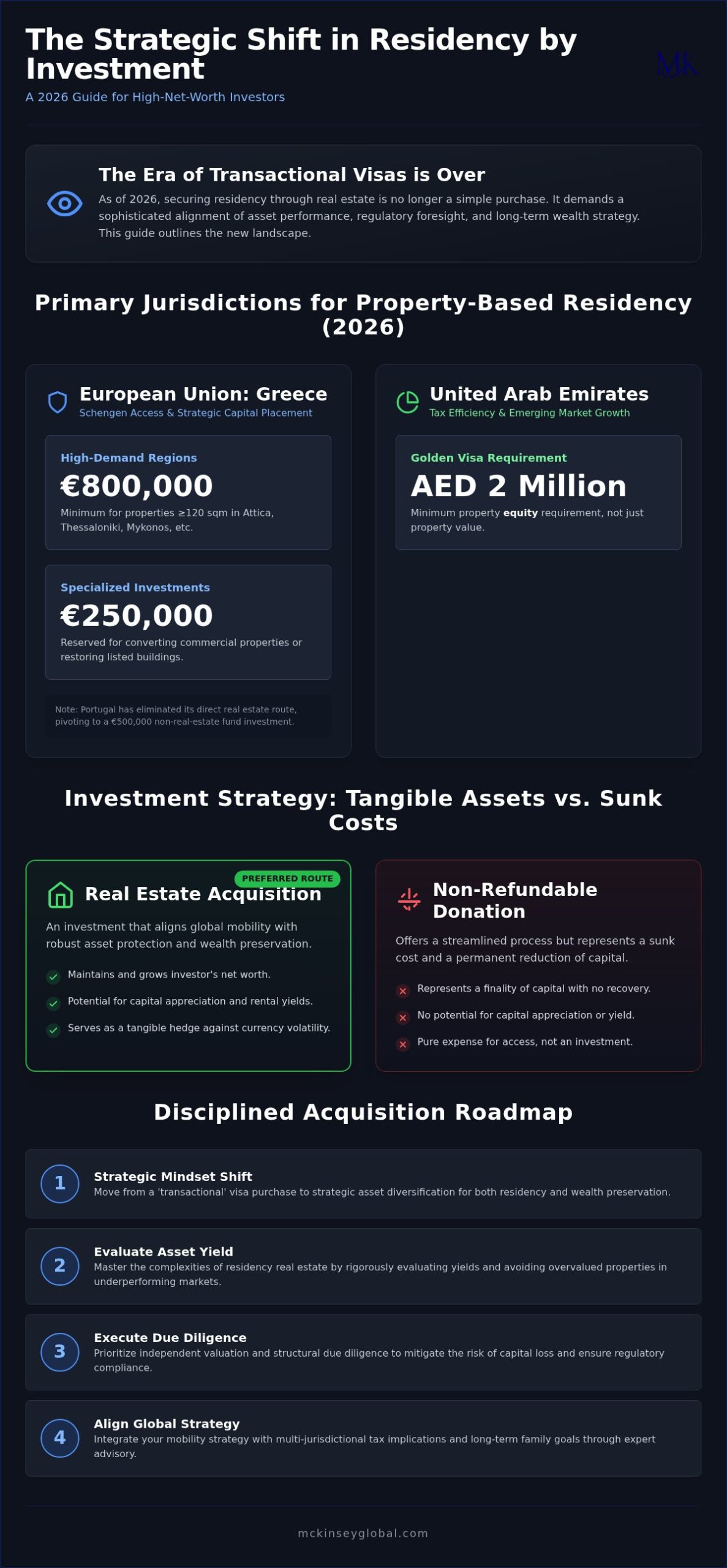
- Navigate the updated 2026 thresholds, including the €800,000 tier for high-demand Greek regions and the AED 2 million equity requirements for the UAE Golden Visa.
- Master the complexities of a residency permit by real estate acquisition by evaluating asset yields and avoiding overvalued properties in underperforming markets.
- Execute a disciplined acquisition roadmap that prioritizes independent valuation and structural due diligence to mitigate the risk of capital loss.
- Align your global mobility strategy with multi-jurisdictional tax implications and family goals through a boutique advisory model focused on meticulous compliance.
The Strategic Evolution of Residency Permit by Real Estate Acquisition
The concept of the residency permit by real estate acquisition has undergone a fundamental transformation, transitioning from a purely administrative process into a sophisticated pillar of global wealth management. For the modern investor, this pathway is no longer viewed as a transactional cost for entry; instead, it’s approached as a dual-purpose strategy that balances the necessity of global mobility with the requirement for robust asset protection. Historically, immigrant investor programs were often simplified as a means of purchasing access. In the prevailing regulatory environment, however, high-net-worth individuals prioritize strategic asset diversification, viewing property not just as a key to a new jurisdiction, but as a critical hedge against currency volatility and geopolitical instability. Securing a residency permit by real estate acquisition allows for the alignment of personal mobility with institutional-grade property holdings.
The 2026 Landscape for Global Investors
Current trends reveal a distinct divergence between European and Middle Eastern residency frameworks. While jurisdictions such as Spain have terminated their property-based routes, others like Greece have refined their requirements under Law 5100/2024, introducing tiered investment thresholds to manage local housing demand. In 2026, the strategic acquisition of high-value real estate serves as a sophisticated hedge that secures cross-border mobility while anchoring capital in a tangible, appreciating asset. Investors now gravitate toward markets that offer both residency security and long-term capital appreciation, such as the UAE with its AED 2 million threshold or the renovated property sectors in Southern Europe.
Tangible Assets vs. Non-Refundable Contributions
Upon evaluating the optimal route for international residency, the distinction between non-refundable donations and property acquisition is significant. While government donations offer a streamlined application process, they represent a finality of capital. Conversely, real estate remains the preferred route because it maintains the investor’s net worth through potential capital appreciation and rental yields. In emerging hubs like Türkiye and the UAE, the ROI potential often outweighs the initial administrative costs. For a deeper analysis of these competing models, investors should review our report on Citizenship by Investment: Donation vs Real Estate Strategy for 2026. This preference for tangible assets reflects a broader commitment to risk mitigation and the preservation of generational wealth within a disciplined regulatory environment.
Primary Jurisdictions for Property-Based Residency
Primary jurisdictions for a residency permit by real estate acquisition are categorized by their specific utility: Schengen access, tax efficiency, or fast-track citizenship. While some European programs have faced termination, others have evolved into tiered systems that reward strategic capital placement. Investors must distinguish between jurisdictions offering direct property ownership and those requiring indirect exposure through regulated funds or specific conversion projects. Success in 2026 depends on selecting a program that aligns with both your mobility needs and your broader financial objectives.
European Union: Greece and Portugal Strategies
Greece remains a cornerstone of European residency planning, though the entry requirements have become more nuanced. Under current regulations, the €250,000 threshold is strictly reserved for the conversion of commercial properties to residential use or the restoration of listed buildings. For standard residential acquisitions in high-demand areas like Attica, Thessaloniki, or Mykonos, the minimum has risen to €800,000 for properties of at least 120 square meters. Our detailed analysis of Greece residency by investment highlights how these tiers affect long-term ROI. Portugal, conversely, has eliminated direct real estate routes in favor of fund-based investments. Investors seeking Portuguese residency now utilize qualifying non-real-estate funds, often with a €500,000 entry point. Adhering to OECD guidance on investment schemes is vital here to ensure that these multi-jurisdictional structures remain compliant with international tax transparency standards.
Emerging Markets: Türkiye and the United Arab Emirates
The Middle East offers a compelling alternative focused on commercial agility and tax optimization. The UAE Golden Visa requires a minimum property investment of AED 2 million; this can be achieved through a single asset or a diversified portfolio. For mortgaged properties, the paid-up equity must meet this AED 2 million threshold to qualify for the 10-year residency. For those prioritizing a faster route to a second passport, Türkiye provides a pathway to citizenship through property acquisition, often utilized as a bridge between Eastern and Western markets. For a side-by-side evaluation of these hubs, refer to our Turkey vs. UAE Residency by Investment: A Strategic 2026 Comparison. In the Caribbean, programs in Antigua and Barbuda or St. Kitts and Nevis continue to leverage high-end resort developments to grant citizenship, providing a permanent solution for global mobility and wealth preservation.
Careful selection of a jurisdiction ensures your capital works as hard as your visa. If you’re ready to evaluate these options against your specific portfolio needs, we invite you to explore our specialist advisory services.
Evaluating Asset Yield and Portfolio Alignment
Securing a residency permit by real estate acquisition should be viewed as a disciplined capital allocation decision rather than an administrative expense. While the primary objective is often global mobility, the financial performance of the underlying asset determines the long-term viability of the strategy. Investors frequently overlook the “Net Effective Yield” by failing to account for local property taxes, maintenance costs, and currency fluctuations. A property that fails to appreciate or generate competitive rent becomes a sunk cost, undermining the strategic benefit of the residency itself.
The “Ghost Property” trap remains a significant risk for the unadvised investor. These developments are often marketed exclusively to visa applicants at prices significantly above local market valuations. Because these assets lack organic demand from the local population, they often suffer from poor liquidity and stagnant capital growth. Avoiding these overvalued developments requires a rigorous assessment of the property’s value independent of the residency benefits it provides.
Comparative Yield Analysis by Region
Yield profiles vary significantly between the established European markets and the high-growth hubs of the Middle East. Capital cities like Athens or Lisbon offer stability, but holiday resort areas often provide higher seasonal returns if managed correctly. Net returns are heavily influenced by local fiscal policies; for instance, the 3% property transfer tax in Greece must be amortized over the holding period to understand the true ROI. In 2026, gross residential rental yields in the Athens Riviera range between 5.1% and 5.8%, whereas prime commercial assets in Dubai often provide yields exceeding 7% for well-positioned portfolios.
Maintenance and Management of Foreign Assets
Effective management is the cornerstone of preserving asset value across international borders. For non-resident owners, professional property management is a necessity to ensure compliance with local tenant laws and maintenance standards. Strategic investors also prioritize the following variables:
- Currency Risk Mitigation: Implementing hedging strategies to protect rental income against fluctuations between the EUR, USD, and AED.
- Ownership Structures: Utilizing corporate entities or trusts where permitted to facilitate future liquidation and minimize inheritance tax complexities.
- Exit Strategy Alignment: Ensuring the property can be sold after the mandatory holding period without jeopardizing the residency status.
Tax residency implications are equally critical. While property ownership alone doesn’t always trigger global tax obligations, spending more than 183 days in certain jurisdictions can shift your tax domicile. Investors must coordinate with their advisors to ensure that their residency permit by real estate acquisition doesn’t inadvertently lead to multi-jurisdictional tax exposure on their global income.
The Acquisition Roadmap: Vetting and Compliance
Securing a residency permit by real estate acquisition requires a methodical approach that prioritizes procedural integrity over speed. The 2026 landscape demands a disciplined five-step roadmap to ensure both the permit’s approval and the underlying asset’s security. This process isn’t merely a sequence of administrative tasks; it’s a strategic operation designed to minimize uncertainty in a high-stakes regulatory environment.
- Step 1: Strategic Vetting. Match your jurisdictional choice with specific mobility and tax goals before committing capital.
- Step 2: Due Diligence. Conduct independent property valuation and structural audits. Never rely on a developer’s internal assessment, as third-party surveyors must verify that the asset’s value aligns with legal thresholds.
- Step 3: AML Compliance. Undergo rigorous Source of Funds (SoF) verification to satisfy modern transparency standards.
- Step 4: Transaction Execution. Utilize secure escrow or government-monitored accounts to facilitate the transfer of funds.
- Step 5: Official Filing. Submit the residency application with the relevant immigration authority through an authorized representative.
Source of Funds and AML Rigour
In 2026, vetting standards have reached unprecedented levels of scrutiny for global investors. Regulators in the EU and Caribbean now require a comprehensive “Wealth Narrative” that documents the accumulation of capital over several decades. It’s no longer sufficient to show a liquid bank balance. You must provide an exhaustive audit trail of historical tax filings, inheritance records, or corporate dividends. Professional compliance departments act as essential gatekeepers here, identifying potential red flags before the application reaches government reviewers. This level of meticulousness is what separates successful applications from those caught in lengthy administrative delays.
Legal Safeguards in Foreign Real Estate
Protecting your capital requires independent legal counsel unaffiliated with any property developer. Ensuring a clear title and the absence of hidden encumbrances is a non-negotiable requirement in foreign jurisdictions. For those considering Caribbean options, our St. Kitts and Nevis Citizenship by Investment: The 2026 Strategic Guide provides a template for managing these legal complexities. Your legal representative must prioritize your interests over the developer’s commission to effectively future-proof your investment against future regulatory shifts. To secure your global future with a disciplined, compliant strategy, contact our strategic advisors today.
Professional Advisory: The McKinsey Strategic Approach
Securing a global foothold requires more than liquid capital; it demands a partnership with an authority that operates with the discretion and insight of a seasoned strategist. At McKinsey Citizenship and Residency Solutions, we’ve moved beyond the transactional model used by traditional agents. Our boutique consultancy model focuses on high-stakes precision, ensuring that every residency permit by real estate acquisition is treated as a core component of a broader wealth preservation strategy. We don’t act as direct real estate brokers. Instead, we serve as independent gatekeepers who vet every variable to minimize uncertainty for our clients.
Selecting the optimal jurisdiction is a nuanced process that must account for the specific long-term goals of the family office. Whether the priority is securing immediate Schengen access through Greece or establishing a tax-efficient commercial hub in the UAE, our role is to align these requirements with the most stable regulatory frameworks available in 2026. We provide a disciplined environment where multi-jurisdictional tax implications and asset yields are analyzed long before an application is filed. This strategic foresight ensures that your residency remains a viable asset rather than a complex liability.
End-to-End Application Management
We manage the complex intersection of international law and private finance to reduce the administrative burden on high-net-worth families. By providing a single point of contact for portfolios that may span from the Caribbean to Europe, we ensure that documentation remains consistent across different authorities. Our team handles the meticulous details of application filing, from initial vetting to final approval. This comprehensive approach allows families to focus on their global interests while we maintain the procedural integrity of their residency status.
Future-Proofing Your Global Mobility
Securing a permit is merely the first milestone in a long-term journey. We conduct periodic “Plan B” audits to review your residency status against shifting global policies in the Schengen zone and the Caribbean. As regulations evolve, we manage the transition from temporary residency to permanent status or citizenship, ensuring all physical presence requirements and compliance standards are met. This proactive monitoring is essential for maintaining global mobility in an era of rapid legislative change. To begin your journey with a disciplined and compliant authority, Consult with a McKinsey Strategic Advisor on your 2026 Residency Strategy.
Securing Your Global Legacy in a Dynamic Regulatory Environment
Navigating the international landscape in 2026 requires a transition from transactional thinking to a disciplined strategy of capital allocation. As we’ve explored, the successful attainment of a residency permit by real estate acquisition depends on your ability to align high-yield property assets with the evolving regulatory frameworks of jurisdictions like Greece, the UAE, or the Caribbean. By prioritizing independent due diligence and procedural integrity, you ensure that your investment serves as both a gateway to global mobility and a robust pillar of wealth preservation.
McKinsey Citizenship and Residency Solutions operates as a meticulous gatekeeper, offering five years of specialist expertise in investment migration. We provide the strategic foresight necessary to manage complex multi-jurisdictional portfolios while ensuring conflict-free property vetting. It’s time to move beyond uncertainty and anchor your future in stability. Secure your global future with a strategic residency consultation and take the first step toward a resilient international legacy.
Frequently Asked Questions
Can I include my family in a residency permit by real estate acquisition?
Most programs allow the main applicant to include a spouse and dependent children under the age of 21 within a single application. Specific jurisdictions like Greece often extend this benefit to include the dependent parents of both the main applicant and their spouse. Each additional dependent typically requires the payment of specific government fees and the provision of comprehensive health insurance coverage to ensure full compliance with local immigration standards.
What are the minimum physical stay requirements for a property-based residency permit?
Minimum stay requirements vary significantly by jurisdiction. Greece and the United Arab Emirates currently impose no physical residence requirements to maintain a residency permit by real estate acquisition, making them ideal for non-resident investors. Conversely, the Cyprus permanent residency program requires a visit at least once every two years. In Portugal, the current fund-based Golden Visa route necessitates a stay of seven days during the first year and fourteen days in subsequent periods.
Does owning property for residency automatically make me a tax resident?
Property ownership for residency purposes doesn’t automatically trigger tax residency in the host country. Tax residency is generally determined by the “183-day rule,” where an individual becomes a tax resident only after spending more than half the year within the jurisdiction. However, investors should consult with a specialist to understand how specific double taxation treaties and local property taxes might impact their global fiscal obligations and the net yield of their assets.
Can I sell the property and still maintain my residency status?
Maintaining your residency status is typically contingent upon the continuous ownership of the qualifying asset. If you sell the property before obtaining permanent residency or citizenship, your permit will likely be revoked unless you immediately reinvest in a qualifying asset of equal or greater value. In jurisdictions like Greece, the permit is tied directly to the property deed and must be renewed every five years based on proof of continued ownership.
How long does the processing take for a property-based residency in 2026?
Current processing timelines for 2026 range from two to eight months depending on the jurisdiction’s administrative efficiency and current application volume. The United Arab Emirates offers one of the most streamlined processes, often concluding within 30 to 60 days. European programs, such as Greece, generally require four to six months for initial approval, provided that all Source of Funds documentation meets the rigorous 2026 compliance standards and anti-money laundering protocols.
What happens if the government changes the residency rules after I invest?
Most jurisdictions apply a “grandfathering” principle, meaning that new legislative changes don’t retroactively invalidate existing permits. However, operational rules can shift. For instance, the 2024 Greek regulations banned short-term rentals for Golden Visa properties acquired under specific tiers. Meticulous planning and regular “Plan B” audits are essential to ensure your residency permit by real estate acquisition remains compliant with shifting policy environments and protects your long-term mobility goals.
Is it possible to finance the real estate purchase through a local mortgage?
Financing options are restricted in many residency-by-investment programs. In Greece, the full investment amount must be paid via a Greek bank account before the application is filed, effectively precluding local mortgages for the qualifying threshold. In the United Arab Emirates, however, investors may utilize local financing provided that their paid-up equity in the property meets the AED 2 million minimum requirement established by the Dubai Land Department for Golden Visa eligibility.
Which country currently offers the fastest path to residency via property?
The United Arab Emirates currently provides the most efficient pathway for investors, with Golden Visa approvals often granted in under eight weeks. For those seeking a direct route to a second passport rather than just residency, Türkiye remains a primary choice, offering a fast-track citizenship process that can be completed within six to nine months. These timelines are subject to the applicant’s ability to provide an exhaustive and compliant wealth narrative during the initial vetting phase.