In an era of shifting borders, a second passport is no longer a luxury travel document; it’s a core strategic hedge within a resilient global wealth architecture. You likely recognize that geopolitical volatility and increasingly complex tax compliance have transformed global mobility into a matter of risk management rather than mere convenience. Effective second passport strategic planning requires a shift from reactive acquisition to a disciplined, long-term methodology. It’s a realization that your current citizenship may not provide the necessary security for your family’s future or your capital’s preservation in an unpredictable decade.
This guide provides a sophisticated framework for 2026, designed to help you master the integration of investment migration into your broader wealth and mobility strategy. We’ll explore how to construct a diversified portfolio of citizenships and residencies, moving beyond opaque vetting processes to achieve seamless global access. By the end of this analysis, you’ll understand the precise steps needed to align jurisdictions like Portugal, Greece, or the Caribbean nations with your succession planning goals. We’ll examine the structural requirements for enhancing your legacy while ensuring your assets remain protected against shifting international regulations.
Key Takeaways
- Recognize why the current global environment demands a transition from reactive document acquisition to comprehensive second passport strategic planning as a core pillar of wealth resilience.
- Learn to apply modern portfolio theory to your global footprint by balancing high-mobility Caribbean citizenships with high-security European residency permits.
- Evaluate the 2026 regulatory framework, including the impact of unified Caribbean pricing and the evolving residency-to-citizenship timelines within the Schengen Zone.
- Identify precise strategies to mitigate fiscal risks and potential tax complications through strict alignment with OECD and EU compliance standards.
- Master a meticulous, multi-phase methodology for integrating investment migration into your long-term legacy and succession planning.
Defining Second Passport Strategic Planning in 2026
The global environment has fundamentally altered the utility of investment migration. What was once viewed as an elective luxury perk for frequent travelers has evolved into a mandatory risk-mitigation necessity for high-net-worth individuals. As we enter 2026, the industry faces unprecedented levels of international transparency and rigorous vetting. This shift marks a transition from simple document acquisition to sophisticated second passport strategic planning.
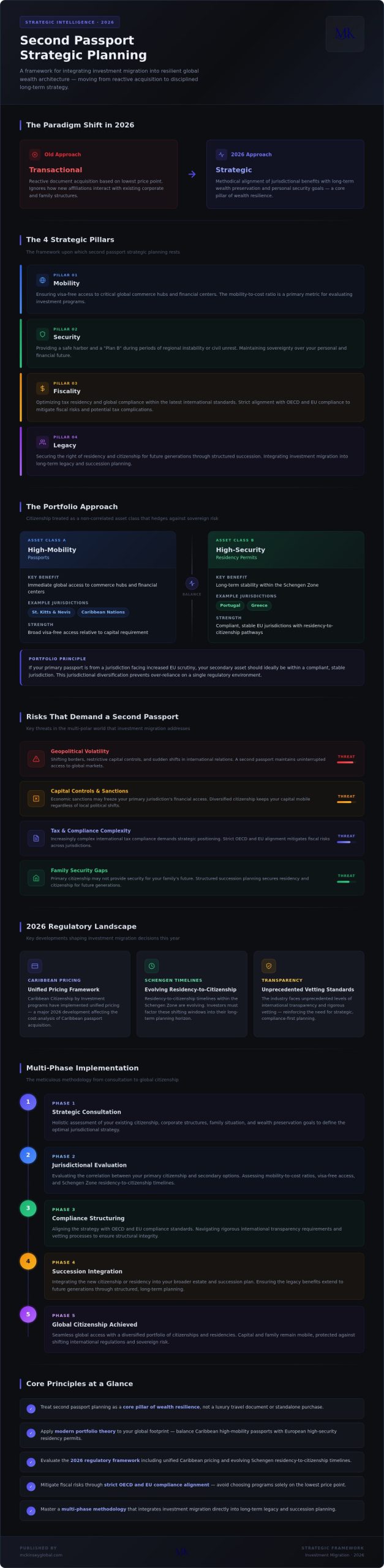
In this context, strategic planning isn’t merely the act of applying for a visa; it’s the methodical alignment of jurisdictional benefits with your long-term wealth preservation and personal security goals. The framework rests upon four distinct pillars:
- Mobility: Ensuring visa-free access to critical global commerce hubs and financial centers.
- Security: Providing a safe harbor and a “Plan B” during periods of regional instability or civil unrest.
- Fiscality: Optimizing tax residency and global compliance within the latest international standards.
- Legacy: Securing the right of residency and citizenship for future generations through structured succession.
The Shift from Transactional to Strategic
Choosing a program based solely on the lowest price point is a flawed methodology in 2026. A transactional approach ignores the complexities of multiple citizenship and how new affiliations interact with existing corporate and family structures. Strategic planning is the alignment of jurisdictional benefits with long-term wealth preservation. Within this framework, second passport strategic planning serves as the essential bridge between legal status and financial stability. It requires a meticulous evaluation of how a second nationality fits into a broader estate plan rather than viewing it as a standalone purchase.
Geopolitical Hedging in a Multi-Polar World
The rise of a multi-polar world has introduced new variables, from restrictive capital controls to sudden shifts in international relations. A second passport functions as a vital hedge against these jurisdictional risks. It’s not just about travel; it’s about maintaining uninterrupted access to global markets and financial institutions when your primary jurisdiction faces constraints. By diversifying your citizenship portfolio, you create a robust insurance policy. This ensures that your capital and your family remain mobile, regardless of local political shifts or economic sanctions. It’s a disciplined approach to maintaining sovereignty over your personal and financial future.
The Portfolio Approach: Treating Citizenship as a Strategic Asset
In the discipline of high-level wealth management, modern portfolio theory is typically applied to equities and fixed-income assets. However, in 2026, the most resilient investors are applying these same principles to their global footprint. A robust second passport strategic planning framework treats citizenship as a non-correlated asset class that hedges against sovereign risk. By diversifying your legal affiliations, you ensure that no single economic bloc or political shift can compromise your mobility or capital.
It’s essential to balance “High-Mobility” passports with “High-Security” residency permits. While a Caribbean passport provides immediate global access, a European residency permit offers long-term stability within the Schengen Zone. Evaluating the correlation between your primary citizenship and your secondary options is critical; for instance, if your primary passport is from a jurisdiction facing increased scrutiny from the EU, your secondary asset should ideally be within a compliant, stable jurisdiction like Portugal or Greece. This jurisdictional diversification prevents over-reliance on a single regulatory environment.
Asset Allocation for Global Mobility
The mobility-to-cost ratio is a primary metric for evaluating investment programs. You should identify jurisdictions that offer the broadest visa-free access relative to the capital requirement and processing time. For many elite investors, St. Kitts and Nevis citizenship by investment remains a benchmark for mobility due to its long-standing reputation and established vetting protocols. This program allows for rapid deployment of a mobility hedge while you simultaneously pursue longer-term European solutions. Integrating the speed of Caribbean programs with the permanence of a Portugal Golden Visa or Greece residency creates a balanced global portfolio. If you’re ready to evaluate your current jurisdictional exposure, a confidential briefing can help align these assets with your specific risk profile.
Legacy Planning and Multi-Generational Access
A strategic asset is only as valuable as its longevity. When evaluating programs, you must scrutinize “Citizenship by Descent” rules to ensure the safety net extends to future generations. Some jurisdictions offer citizenship that is easily passed to children born abroad, while others have restrictive residency requirements for succession. For family offices managing multiple nationalities, the goal is to create a permanent, multi-generational framework. This involves analyzing the legal durability of the chosen programs and ensuring they provide a stable foundation for succession planning and global inheritance. It’s about building a legacy that isn’t tethered to the fate of a single nation-state.
Evaluating Jurisdictions: Caribbean Mobility vs. European Residency
The selection of a jurisdiction requires a clinical assessment of your timeline and mobility requirements. While direct citizenship offers immediate utility, residency-to-citizenship programs provide a slower but often more prestigious path into the European Union. In 2026, the Caribbean landscape has been redefined by a unified Memorandum of Agreement (MoA); this has harmonized pricing and vetting standards across the region. This evolution ensures that second passport strategic planning remains grounded in international compliance and long-term stability.
Comparing Antigua and Barbuda investment options with Mediterranean residency programs reveals a clear trade-off between speed and geopolitical integration. If your priority is immediate visa-free travel to over 140 countries, the Caribbean is the logical choice. However, if you seek a permanent foothold in the Schengen Zone, European residency remains the gold standard for business-centric investors who value the ability to live and work within a stable economic bloc. Each path serves a distinct purpose within a diversified global portfolio.
The Caribbean Quintet: Speed and Efficiency
The nations of Antigua, Dominica, Grenada, St. Kitts, and St. Lucia offer the most streamlined path to a second nationality. Under the 2026 MoA, these programs have adopted rigorous due diligence protocols that protect the integrity of the passport. When selecting a route, you must decide between a citizenship by investment donation vs real estate strategy. Donations provide a clean, one-time exit from the capital commitment; conversely, real estate allows for potential asset appreciation and a physical link to the jurisdiction. High vetting standards shouldn’t be seen as a hurdle; they serve as a reputational shield, ensuring your second citizenship is respected by global financial institutions.
European Residency: The Strategic Gateway
For those prioritizing a future in the EU, Greece residency by investment is a critical asset for Schengen mobility. It provides immediate access to 29 European countries without the need for additional visas. Executing the path to EU citizenship requires a long-term view, as programs in Portugal or Latvia involve physical presence requirements and language tests over several years. While Latvia offers a strategic entry point into Northern Europe, Mediterranean programs continue to dominate due to their established residency-to-citizenship frameworks. Your choice depends on whether you require a rapid travel document or a permanent shift in your family’s global center of gravity.
Mitigating Geopolitical and Fiscal Risk through Compliance
Successful second passport strategic planning hinges on more than just legal approval; it requires a proactive approach to international regulatory standards. Compliance isn’t a hurdle to be cleared, but a mechanism that preserves the long-term utility of your global assets. By aligning with OECD and EU standards, you ensure your second nationality remains a recognized and respected document in the global financial system. Rigorous due diligence acts as a shield, protecting the integrity of your status and ensuring your reputation remains beyond reproach among international banking institutions.
It is essential to address the distinction between “buying” a passport and “investing” in citizenship. The latter involves a structured contribution to a nation’s sovereign development or a regulated real estate asset. This formal investment framework is what provides the legal durability of the citizenship. Treating the process as a mere transaction is a flawed methodology that can lead to future regulatory complications. A disciplined approach ensures that your new status is established on a foundation of total transparency and legal certainty.
Fiscal Planning and Tax Residency
Distinguishing between legal citizenship, physical residency, and tax domicile is a fundamental requirement for the modern investor. Holding a second passport doesn’t automatically alter your tax obligations, but it can create a “dual residency” trap if not managed with precision. The Common Reporting Standard (CRS) ensures that financial data is shared across borders, making transparency the only viable path for wealth preservation. Jurisdictions like the UAE and Türkiye offer efficient structures for global fiscal management, provided they are integrated correctly into your existing tax profile. You must ensure that your global mobility strategy doesn’t inadvertently trigger unintended tax liabilities in multiple jurisdictions.
Regulatory Compliance in 2026
The 2026 regulatory environment is defined by the “Six Principles” of Caribbean vetting, which were established to harmonize due diligence across the region. These principles include mandatory interviews, standardized background checks, and enhanced financial scrutiny. This rigorous process protects the integrity of your second passport by ensuring only high-integrity individuals enter the program. Professional advisory is essential for managing this complex application process and ensuring all renewals and ongoing compliance requirements are met. Maintaining your second citizenship requires an ongoing commitment to jurisdictional rules and procedural integrity. To ensure your global footprint meets these rigorous standards, you can schedule a strategic compliance briefing with our advisors.
Implementation Strategy: From Consultation to Global Citizenship
Converting theoretical analysis into the practical execution of a global mobility framework demands a disciplined, multi-phase methodology. At McKinsey Citizenship and Residency Solutions, we utilize a structured approach to ensure every variable of your second passport strategic planning is aligned with your family’s long-term security. This process is designed to minimize uncertainty and ensure adherence to the highest international standards of compliance and procedural integrity.
Our methodology is divided into four distinct phases of engagement:
- Phase 1: The Strategic Briefing. This initial stage focuses on aligning your global goals with the jurisdictional realities of 2026. We evaluate your wealth architecture and mobility requirements to determine the optimal mix of Caribbean and European programs.
- Phase 2: Document Verification and Pre-Vetting. Operating as a meticulous gatekeeper, we perform exhaustive due diligence before any government filing. This proactive step identifies potential hurdles and protects your global reputation.
- Phase 3: Portfolio Execution. Our team manages the complex application management process across multiple jurisdictions simultaneously. We ensure that every document, from medical certificates to financial statements, meets the exact specifications of the target nation.
- Phase 4: Post-Grant Stewardship. Citizenship is a lifelong commitment. We provide ongoing support for compliance, document renewals, and the seamless addition of new family members to your existing portfolio.
The Value of Boutique Advisory
High-net-worth families require more than a service provider; they need a confidential, expert-led partnership that understands the stakes of international migration. McKinsey Citizenship and Residency Solutions bridges the gap between rigid government programs and the nuanced goals of private wealth. Our disciplined authority ensures that every application is treated with the gravity it deserves. This focus on procedural integrity distinguishes a boutique advisory from high-volume transactional firms, providing you with the clarity needed to navigate complex international landscapes. It’s a commitment to accuracy and discretion that safeguards your family’s future.
Next Steps for the Strategic Investor
Preparing your family office for the investment migration journey involves gathering extensive documentation and aligning stakeholders on the chosen jurisdictions. In 2026, timeline expectations from initial filing to passport issuance typically range from four to twelve months, depending on the specific program and the depth of vetting required. To begin this transition, you should ensure your records are consolidated and ready for a preliminary review. If you’re ready to secure your global footprint, you can schedule a confidential strategic planning session with our advisors to begin the briefing process.
Architecting Your Jurisdictional Sovereignty for the Future
The global landscape of 2026 requires a transition from reactive document acquisition to a disciplined, long-term methodology. By treating citizenship as a strategic asset class, you ensure that your family’s freedom of movement and capital preservation remain insulated from geopolitical volatility. Success in this environment depends on a precise balance between high-mobility Caribbean programs and the long-term stability of European residency; it’s a realization that your jurisdictional footprint must be both resilient and compliant.
Implementing a robust second passport strategic planning framework is the only viable path to maintaining sovereignty in an increasingly regulated world. As a boutique firm specializing in Caribbean and European investment migration, we provide high-stakes advisory with a strict adherence to international compliance standards. Your global resilience isn’t a matter of chance; it’s the result of meticulous evaluation and strategic foresight. We invite you to begin your journey toward a more secure global architecture through a confidential briefing.
Secure Your Global Future: Contact McKinsey Citizenship and Residency Solutions
Frequently Asked Questions
Is second passport strategic planning legal for high-net-worth individuals?
Yes, second passport strategic planning is an entirely legal process sanctioned by sovereign governments through established investment migration laws. These programs are designed to attract foreign direct investment in exchange for legal residency or citizenship. All applications must undergo rigorous due diligence to ensure compliance with both local and international regulations. It’s essential to work with a disciplined advisory that prioritizes procedural integrity and transparency throughout the engagement.
How much does a second citizenship cost in 2026 under the new Caribbean rules?
Under the 2026 Memorandum of Agreement, Caribbean nations have harmonized their pricing structures to ensure regional stability and program integrity. While specific investment thresholds vary based on the chosen jurisdiction and the number of dependents, the unified framework has established a new baseline for both donation and real estate routes. You should consult a strategic advisor to receive a precise briefing on the capital requirements for programs in Antigua, St. Kitts, or St. Lucia.
What is the fastest citizenship by investment program available in 2026?
Caribbean jurisdictions currently offer the most efficient processing timelines for global investors seeking immediate mobility. Nations such as St. Kitts and Nevis or Antigua and Barbuda typically provide approval within a matter of months, provided all due diligence requirements are met. These programs are designed for speed without compromising the rigorous vetting standards mandated by international regulators. European residency pathways, by contrast, often require a multi-year commitment before citizenship becomes a viable option.
Does a second passport automatically change my tax residency status?
No, acquiring a second passport doesn’t automatically alter your tax residency status or your global fiscal obligations. Tax residency is generally determined by physical presence, center of life, or specific statutory rules within a jurisdiction rather than legal citizenship alone. Effective second passport strategic planning must incorporate a clear distinction between your nationality and your tax domicile. You’ll need to coordinate with fiscal experts to ensure your global wealth architecture remains compliant under the Common Reporting Standard.
Can I include my extended family in my citizenship by investment application?
Most investment migration programs allow for the inclusion of a spouse and dependent children within a single application. Depending on the specific jurisdiction, you may also be permitted to include elderly parents or grandparents who are financially dependent on the main applicant. Some programs have expanded these definitions to include unmarried siblings under certain conditions. It is vital to verify the specific dependency requirements for each nation to ensure your family’s future security is fully integrated.
What happens if a citizenship program is suspended after I have invested?
If a program is suspended or undergoes significant regulatory changes after your investment is finalized, your citizenship is typically protected under grandfathering principles. Sovereign states generally respect the legal status granted to existing citizens, even if the pathway for new applicants is closed. However, this highlights the importance of selecting jurisdictions with a history of long-term stability and international compliance. Working with a meticulous gatekeeper ensures that you choose programs with the highest levels of legal durability.
Which second passport offers the best visa-free access to the EU and USA?
Passports from European Union member states, such as Greece or Portugal, provide the most comprehensive access to the Schengen Zone and other global commerce hubs. While most Caribbean passports offer extensive visa-free travel to the EU and UK, access to the United States typically requires a separate visa process unless the jurisdiction holds a specific waiver agreement. You should evaluate your mobility needs against the specific travel privileges of each nation to ensure your portfolio meets your global business requirements.
How does the vetting process for second passports work in 2026?
The vetting process in 2026 is a multi-layered system involving mandatory interviews, exhaustive background checks, and financial scrutiny. International regulators have mandated the Six Principles of Caribbean vetting to ensure that only individuals of high integrity are granted citizenship. This process includes verification of the source of funds and a review of global criminal databases. These rigorous standards are designed to protect the reputation of the passport and the security of the granting nation’s borders.