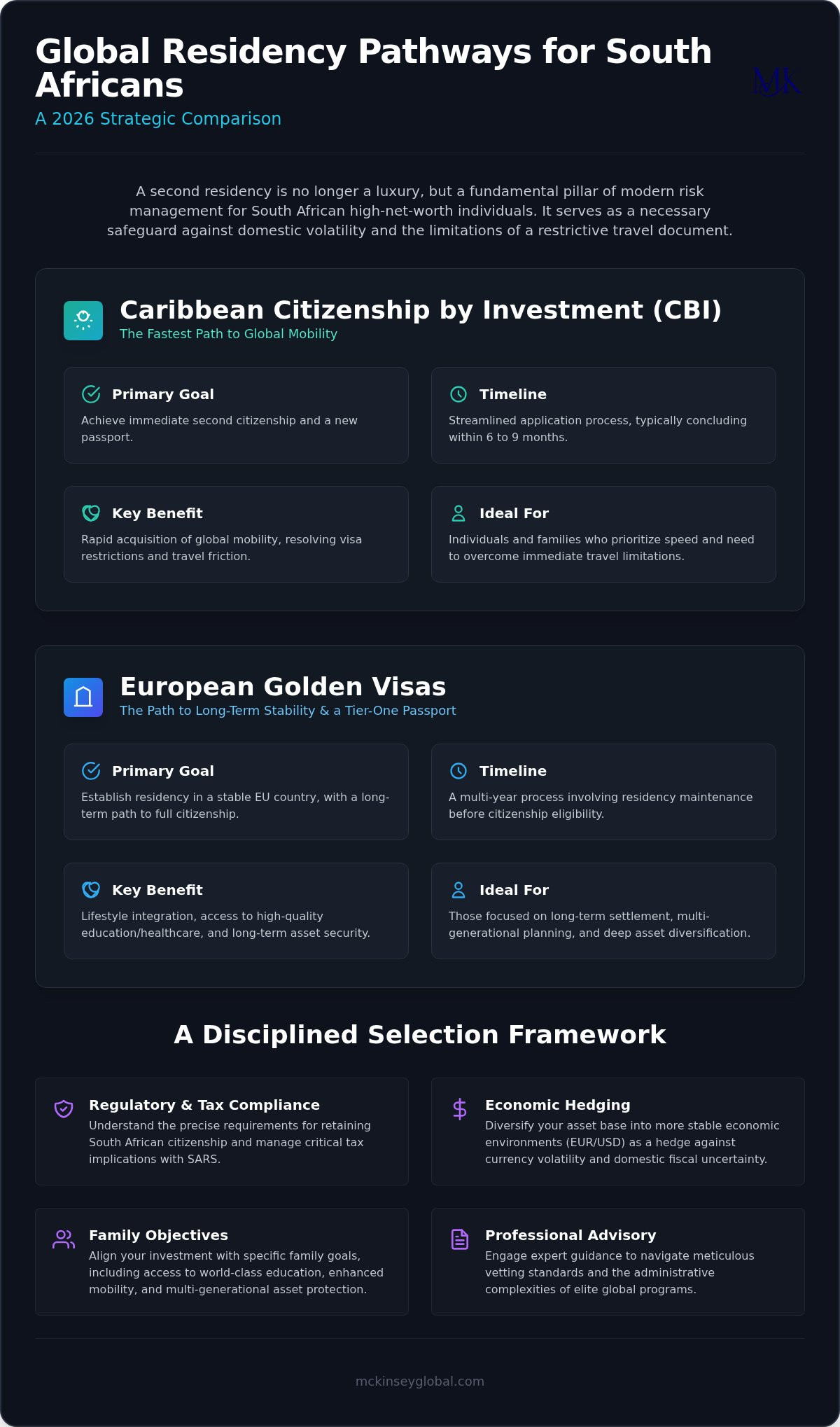
For the South African high-net-worth individual, a second residency is no longer a luxury of the elite; it is a fundamental pillar of modern risk management. The strategic acquisition of a tier-one passport or European Union residency serves as a necessary safeguard against domestic volatility and the limitations of a restrictive travel document.
You likely recognize the increasing friction of global mobility and the persistent concerns regarding long-term capital security. These variables necessitate a disciplined approach to wealth protection and international access. This guide provides a comprehensive analysis of the most secure pathways for residency by investment for south african citizens, specifically tailored for the 2026 regulatory environment. We will evaluate the shift toward fund-based investments in Europe, the newly harmonized pricing structures across the Caribbean, and the precise legal requirements for maintaining South African dual citizenship. By examining these elite programs through a lens of compliance and strategic foresight, you can establish a secure global footprint for your family and your assets.
Key Takeaways
- Analyze the widening mobility gap and understand why global residency has become a fundamental requirement for the strategic protection of South African wealth.
- Evaluate the most efficient pathways for residency by investment for south african citizens, contrasting the immediate citizenship of the Caribbean with the residency-to-citizenship routes in Europe.
- Learn the precise regulatory requirements for the retention of South African citizenship and the critical tax implications managed by SARS.
- Apply a disciplined selection framework to align your investment with specific family objectives, including education, mobility, and asset diversification.
- Understand the importance of professional advisory in navigating the meticulous vetting standards and administrative complexities of elite global programs.
The Strategic Necessity of Global Residency for South Africans in 2026
The current geopolitical and economic climate of 2026 has fundamentally shifted the perspective of South African high-net-worth individuals from passive observation to active diversification. While traditional investment portfolios remain essential, the strategic acquisition of a second residency has become a critical component of a comprehensive risk mitigation strategy. For these individuals, exploring Immigrant investor programs is no longer merely an option for lifestyle enhancement; it is a calculated move to secure family legacy and capital against localized instability.
The mobility gap between the South African passport and tier-one alternatives continues to widen. South African citizens often face cumbersome visa applications and restrictive travel protocols that impede spontaneous business engagements and leisure travel. By contrast, European and Caribbean programs offer seamless access to the Schengen Area and major global financial hubs. This disparity highlights why residency by investment for south african citizens is viewed as a vital tool for maintaining international competitiveness and personal freedom.
Passport Strength and Global Access
Current visa restrictions for South African citizens entering the Schengen Area or the United Kingdom often involve significant administrative delays and rigorous documentation requirements. These hurdles don’t just affect personal travel; they stifle international business expansion by delaying critical face-to-face negotiations and market entry. A second citizenship or residency provides the agility required to navigate global markets without the friction of border bureaucracies. Within the framework of South African wealth management, Global Mobility is defined as the unrestricted ability to deploy capital and physical presence across international borders to maximize strategic opportunities and personal security.
Economic Hedging and Capital Security
Securing a ‘Plan B’ involves more than just a physical safe haven; it requires a robust hedge against currency volatility. By participating in residency programs denominated in Euro or USD, South Africans can effectively diversify their asset base into more stable economic environments. This strategic shift addresses several core concerns:
- Long-term stability: European residency programs provide a predictable regulatory environment that contrasts with domestic fiscal uncertainty.
- Asset protection: These pathways allow for the legal externalization of wealth into jurisdictions with strong property rights and transparent legal frameworks.
- Multi-generational planning: Residency solutions ensure that future generations possess the right to live, work, and study in stable, high-growth regions.
This methodical approach to global residency ensures that capital remains protected while providing a disciplined framework for family security in an unpredictable global landscape. It is about creating a permanent hedge that transcends market cycles.
Comparing Elite Pathways: Caribbean CBI vs. European Golden Visas
Choosing between Caribbean citizenship and European residency requires a disciplined evaluation of your family’s immediate needs versus long-term settlement goals. For those evaluating residency by investment for south african citizens, the choice between these two regions often depends on the urgency of the mobility requirement. While Caribbean programs prioritize speed and global mobility, European options focus on lifestyle integration and an eventual path to a tier-one passport. It’s essential to understand that each jurisdiction carries specific risks associated with investment migration, necessitating a meticulous due diligence process to ensure long-term compliance.
Caribbean CBI: The Fastest Path to Mobility
The Caribbean remains the most efficient route for those seeking an immediate second passport. Programs like the Antigua and Barbuda investment options provide a streamlined application process, typically concluding within six to nine months. The St. Kitts and Nevis citizenship by investment program is particularly distinguished by its Sustainable Island State Contribution, which requires a $250,000 donation. These programs are highly favorable for families, as they allow for the inclusion of dependent children and elderly parents. This efficiency makes them a premier choice for residency by investment for south african citizens who require rapid visa-free access to the UK and other major global hubs without the need for physical relocation.
European Golden Visas: The Lifestyle and Settlement Play
European programs offer a more gradual but deeply integrated approach to global residency. The Greece residency by investment program continues to attract significant interest due to its tiered real estate entry points, ranging from €250,000 for commercial-to-residential conversions to €800,000 in prime areas like Athens. Conversely, Portugal has moved exclusively toward non-real-estate fund investments, requiring a €500,000 commitment. These pathways don’t grant immediate citizenship but offer permanent residency and the freedom of movement within the Schengen Zone. For business travelers, this access is invaluable for maintaining a consistent presence in European markets. If you’re uncertain which jurisdiction best serves your wealth protection strategy, you might consult with a specialist advisor to evaluate your specific risk profile and family objectives.
Ultimately, the decision rests on whether you prioritize the speed of a passport or the security of a European settlement. Caribbean CBI provides a functional travel document almost immediately, whereas European RBI builds a foundation for a future second home in a stable regulatory environment. Both pathways require a significant capital commitment and a clear understanding of the evolving international regulatory landscape.
Navigating South African Regulatory and Tax Compliance
Success in securing global residency requires more than just capital; it demands strict adherence to South African regulatory frameworks. For many, the question of how valuable is your passport often depends on the legal certainty surrounding its use. When pursuing residency by investment for south african citizens, the primary hurdle isn’t the foreign jurisdiction, but rather the failure to manage domestic obligations with the South African Revenue Service (SARS) and the Department of Home Affairs. This is a disciplined process where oversight can lead to the involuntary loss of citizenship or significant fiscal penalties.
Misconceptions regarding ‘financial emigration’ still persist in 2026, despite the process having been phased out in 2021 in favor of a tax-residency-based system. An ‘exit tax’ or capital gains tax on deemed disposals of worldwide assets may apply if you formally cease to be a South African tax resident. However, acquiring a second residency doesn’t automatically trigger this event. You must distinguish between legal residency and tax residency to avoid unintended fiscal consequences. Failure to correctly report your status to SARS can result in double taxation on your global income under Section 10(1)(o)(ii), unless you meet specific physical presence tests abroad.
Preserving Your South African Status
The South African Citizenship Act is explicit: if you acquire a second citizenship without first applying for the ‘Retention of South African Citizenship,’ you may lose your original status by operation of law. This process involves obtaining a ‘Letter of Retention’ from the Department of Home Affairs before your second naturalization is finalized. Losing your citizenship can complicate your ability to return to South Africa or manage domestic assets. As of 2026, South African law mandates that citizens must obtain formal prior consent from the Department of Home Affairs to retain their original nationality before voluntarily acquiring a second citizenship through an investment program.
Tax Residency and Capital Transfers
Funding your offshore residency requires careful navigation of the South African Reserve Bank (SARB) regulations. Currently, individuals can utilize their R1 million discretionary allowance or the R10 million foreign investment allowance, the latter requiring a SARS tax-clearance certificate. Couples can combine these to remit approximately R22 million per year, providing a substantial foundation for elite programs. The choice between a donation vs real estate strategy can significantly impact your capital deployment and tax efficiency. Proper planning ensures that your residency by investment for south african citizens remains a secure hedge rather than a regulatory liability. Maintaining meticulous records of these transfers is essential for long-term wealth preservation and compliance.
Selecting the Right Jurisdiction: A Framework for Families
Selecting a jurisdiction requires a methodical evaluation of family-specific variables. For those considering residency by investment for south african citizens, the process begins by isolating the primary objective: are you seeking global mobility, educational access for children, or tax optimization? Once the objective is clear, you must assess your risk tolerance and capital liquidity. A disciplined selection framework ensures that the chosen program aligns with your long-term wealth protection strategy.
The decision-making process should follow a structured sequence of evaluations:
- Step 1: Define Objectives. Mobility-focused families often favor Caribbean citizenship for immediate travel freedom. Those seeking relocation or elite education usually prioritize European residency.
- Step 2: Asset Class Assessment. Decide between a non-refundable donation, which often involves a lower initial capital outlay, and real estate or fund investments that offer potential for capital appreciation.
- Step 3: Physical Stay Requirements. Programs like the Greece Golden Visa or Caribbean options require minimal physical presence, whereas other pathways demand a significant commitment to residency as a prerequisite for naturalization.
- Step 4: Dependency Inclusion. It’s vital to ensure the program accommodates the specific ages and legal statuses of your children and elderly parents to maintain family unity.
The Middle Eastern Alternative: UAE and Türkiye
The Middle East offers distinct strategic advantages for South African entrepreneurs and families. The Turkey vs UAE residency by investment comparison reveals two divergent paths: Türkiye remains a unique route to immediate citizenship through real estate acquisition, while the Dubai Golden Visa serves as a premier hub for business expansion and tax-efficient lifestyle management. These jurisdictions provide a bridge between Western and Eastern markets, making them ideal for high-net-worth individuals with global commercial interests.
Educational and Lifestyle Benefits
For many South African families, the primary driver is the long-term security and development of their children. European residency provides access to EU-standard healthcare and the opportunity for children to attend elite universities at domestic or subsidized tuition rates. This shift provides a significant advantage over international student protocols. Beyond education, the transition to a jurisdiction with higher safety standards and a stable quality of life acts as a profound emotional and financial hedge. To begin your evaluation of these programs, you can contact McKinsey Citizenship and Residency Solutions for a confidential briefing.
The McKinsey Advantage: Meticulous Advisory for South Africans
McKinsey Citizenship and Residency Solutions operates as an independent boutique advisory firm, focusing on the strategic alignment of global programs with the specific requirements of the South African market. In a regulatory environment that has become increasingly complex, professional guidance is essential to ensure that your application meets the high-stakes precision required by international authorities. We don’t merely facilitate transactions; we act as a disciplined gatekeeper to minimize uncertainty and protect your family’s interests. By managing the end-to-end process, we reduce the administrative burden on our clients, allowing you to focus on your commercial and personal priorities while we handle the meticulous details of residency by investment for south african citizens.
Expert Vetting and Compliance
The success of an application rests on a rigorous pre-screening process that identifies potential obstacles before they become formal rejections. Our firm implements a comprehensive vetting protocol that mirrors the strict due diligence standards of Caribbean and European authorities, including the mandatory biometric collection and interview requirements implemented in 2026. Within the South African context, we manage the complex logistics of document authentication and apostilles through the Department of International Relations and Cooperation (DIRCO). This thoroughness ensures that every submission is compliant and positioned for a high success rate, maintaining the confidentiality and discretion that our boutique service provides.
Commencing Your Global Journey
Your engagement begins with a bespoke roadmap designed during an initial strategic consultation. This session evaluates your financial goals and family objectives against government-approved programs in jurisdictions such as Portugal, Greece, and the Caribbean. Our commitment extends beyond the initial acquisition; we provide ongoing post-acquisition support to manage renewals and monitor your long-term path to citizenship. This steady, predictable cadence of advisory ensures you remain secure at every step of the process. If you’re prepared to secure your family’s future, you should Schedule a confidential consultation with our South African specialists to explore the most efficient pathways for residency by investment for south african citizens today.
Securing Your Global Legacy in a Changing World
Establishing a second residency or citizenship is a complex undertaking that requires a disciplined approach to both international opportunities and domestic obligations. This guide has detailed the definitive pathways for residency by investment for south african citizens, emphasizing the critical balance between global mobility and strict regulatory compliance with SARS and Home Affairs. By selecting a jurisdiction that aligns with your specific family objectives, you create a permanent hedge against domestic volatility while securing access to elite educational and financial ecosystems.
Navigating these high-stakes transitions demands the precision of a seasoned strategist. McKinsey Citizenship and Residency Solutions has operated as an independent boutique advisory since 2019, providing meticulous end-to-end management of Caribbean and European applications. Our firm specializes in the unique requirements of high-net-worth South African clients, ensuring that every detail is managed with the highest level of confidentiality and procedural integrity. You’re invited to secure your family’s future with a bespoke global residency strategy that prioritizes long-term stability. Your journey toward enhanced mobility and wealth protection begins with a single, strategic decision.
Frequently Asked Questions
Do I lose my South African citizenship if I get residency by investment elsewhere?
No, you don’t lose your citizenship if you follow the prescribed legal protocols. Residency itself doesn’t affect your status, but if you acquire a second citizenship, you must apply for a “Letter of Retention” from the Department of Home Affairs before naturalizing. Failure to obtain this prior consent results in the automatic loss of your South African status. It’s a critical step in residency by investment for south african citizens.
What is the fastest residency by investment program for South Africans in 2026?
Caribbean Citizenship by Investment programs currently offer the most expedited processing times. Jurisdictions like Antigua and Barbuda or St. Lucia typically conclude the application cycle within several months. St. Kitts and Nevis also maintains a streamlined pathway, though the 2026 implementation of mandatory interviews and biometric collection has standardized timelines across the region. These programs provide a direct route to citizenship much faster than European residency-to-citizenship options.
Can I use my South African business funds to pay for an international residency?
You can utilize business funds, provided the capital is correctly externalized under South African Reserve Bank regulations. This usually involves declaring the funds as a dividend or director’s loan to move them into your personal capacity. You’ll need a tax clearance certificate from SARS for amounts exceeding the annual discretionary allowance. Meticulous documentation of the source of funds is essential for the destination country’s due diligence process.
Which European country has the lowest physical stay requirement for South Africans?
Greece and Portugal offer the most accommodating physical stay requirements in Europe. The Greece Residency by Investment program requires no physical presence to maintain the permit, while the Portugal Golden Visa mandates only a brief stay of a few days annually. This flexibility is ideal for South African citizens who wish to maintain their primary home and business interests in South Africa while securing the long-term benefits of European residency.
What are the tax implications of having a second residency while living in South Africa?
Obtaining a second residency doesn’t automatically alter your tax obligations to the South African Revenue Service (SARS). If you remain “ordinarily resident” in South Africa, you’re still liable for tax on your worldwide income. You only cease to be a South African tax resident if you meet specific criteria to “break” residency. This involves a formal declaration and potentially an exit tax on deemed disposals of assets.
Is the Caribbean citizenship by investment safe for South African families?
Caribbean citizenship programs are exceptionally safe and operate under a highly regulated government framework. All member states of the Organisation of Eastern Caribbean States have harmonized their vetting processes and price floors to ensure the integrity of their programs. The rigorous due diligence, which includes mandatory interviews and biometric checks, protects the reputation of the passport. For South African families, these programs offer a reliable and legally sound hedge.
How much does a Golden Visa cost for a family of four in 2026?
The total capital requirement for a family of four depends on the chosen jurisdiction and the specific investment route. Caribbean programs typically require a government donation or a real estate investment, with additional fees for due diligence and processing. European Golden Visas involve higher investment thresholds, often centered on property acquisition or investment funds. It’s essential to evaluate the full cost structure, including government levies, to plan your residency by investment for south african citizens.
What happens to my South African passport if I acquire a second one?
Your South African passport remains valid and functional alongside your second travel document, provided you’ve followed the retention process. South African law allows for dual nationality, but it mandates that you must enter and depart South Africa using your South African passport. Your second passport is then utilized for international travel and entry into other jurisdictions, providing the enhanced global mobility that the South African document currently lacks.