
The era of frictionless, transactional economic passports has officially closed; lawful naturalization now demands sovereign regulatory integrity rather than procedural shortcuts. For high-net-worth applicants evaluating legitimate countries offering citizenship by investment 2026 marks a pivotal turning point defined by centralized regional intelligence, tightened statutory frameworks, and intensified international compliance across every established corridor.
You’ve likely found that distinguishing authentic sovereign programs from speculative residency pathways has become increasingly complex, particularly when aggressive intermediary marketing creates unvetted legal and reputational exposure. That uncertainty shouldn’t dictate your family’s global asset and mobility strategy. This analysis provides a structured, objective framework covering the sovereign jurisdictions that grant lawful citizenship through vetted capital allocation, prioritizing long-term security over commercial expediency.
Ahead, we outline the verified sovereign inventory, dissect modern institutional due diligence standards, and clarify procedural realities so you can evaluate jurisdictional options with total statutory clarity.
Key Takeaways
- Understand the precise constitutional and statutory distinctions separating direct economic citizenship from long-term residency bridges.
- Evaluate the verified inventory of sovereign countries offering citizenship by investment 2026 establishes under harmonized regulatory frameworks and heightened vetting protocols.
- Analyze the strategic positioning of transcontinental programs alongside the shifting naturalization parameters governing European residency routes.
- Assess the financial and legal trade-offs between unrecoverable statutory government donations and recoverable capital asset allocations.
- Discover how institutional pre-screening protocols safeguard your procedural standing and insulate your family portfolio from unvetted intermediary risks.
Defining Citizenship by Investment: Legal Frameworks and Sovereign Standards
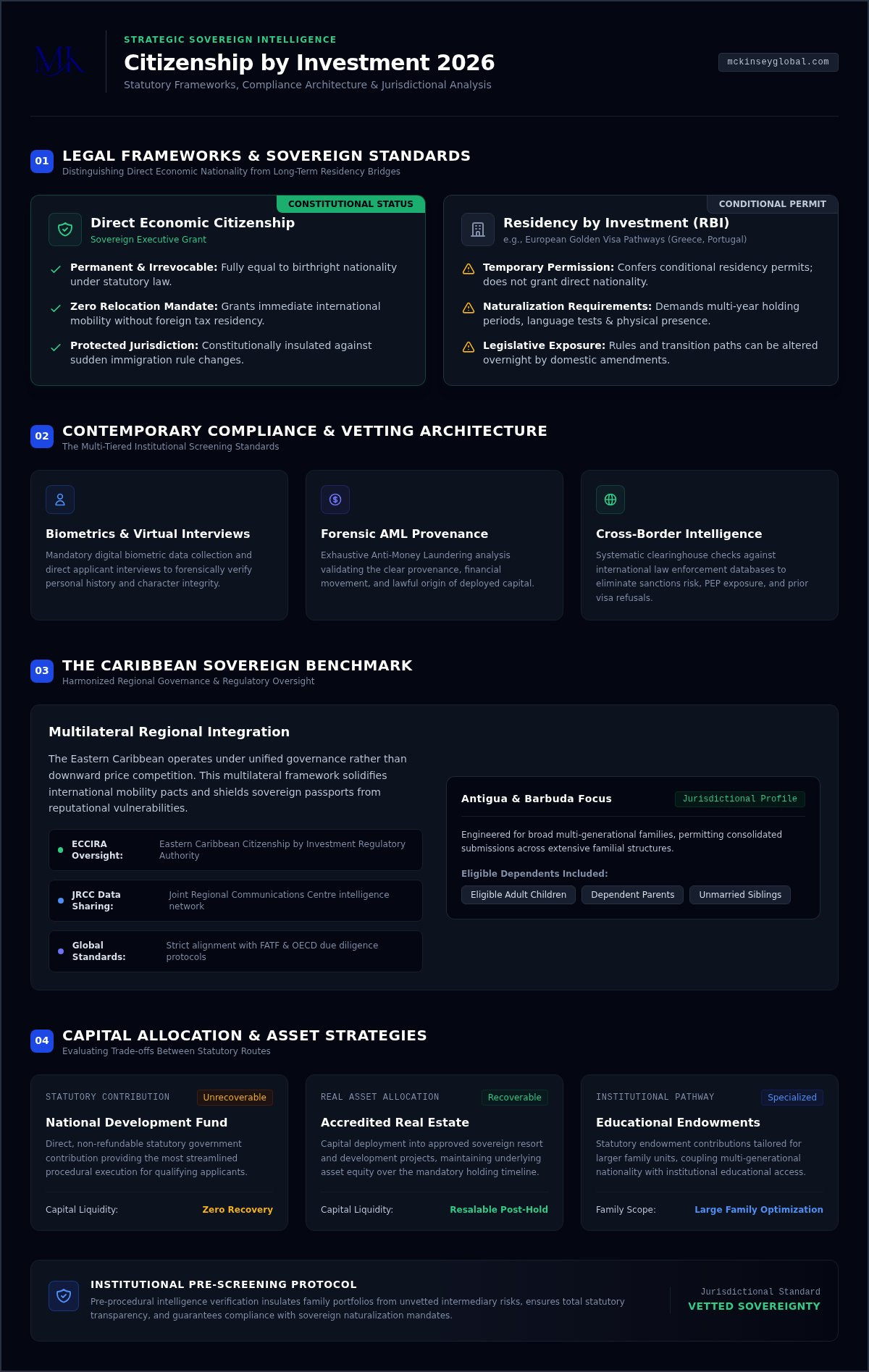
Sovereign citizenship rests on an indelible legal status granted under supreme constitutional or statutory authority. When assessing legitimate countries offering citizenship by investment 2026 standards require looking past commercial marketing to examine the underlying legislative architecture. Lawful economic naturalization occurs when an executive government exercises explicit statutory authority, granting full constitutional nationality to an individual in exchange for qualifying capital under vetted citizenship by investment frameworks. This statutory foundation ensures that the status awarded remains permanent, irrevocable, and equal to that of birthright citizens, providing vital jurisdictional redundancy for international families.
Direct Economic Citizenship vs. Residency by Investment (RBI)
A frequent failure in wealth advisory is the conflation of direct economic citizenship with residency by investment (RBI). European golden visa pathways, such as those established in Greece or Portugal, confer conditional residency permits; they do not grant direct nationality. Transitioning from temporary residency to naturalized citizenship requires satisfying multi-year holding periods, language proficiencies, and domestic physical presence mandates. Direct citizenship pathways, by contrast, yield immediate sovereign nationality and international mobility without requiring foreign tax residency or relocation. Understanding this boundary is essential, as legislative amendments to domestic immigration laws can alter residency rules overnight, whereas granted citizenship remains constitutionally protected.
The Contemporary Compliance and Enhanced Vetting Architecture
Sovereign programs across vetted jurisdictions now operate under an exhaustive, multi-tiered compliance matrix designed to safeguard international mobility pacts and state security. Applicants undergo forensic evaluations managed through regional intelligence clearinghouses, international law enforcement databases, and independent private intelligence firms. Modern procedural standards universally require:
- Mandatory biometric data collection and direct applicant virtual interviews to verify personal history and character integrity;
- Forensic anti-money laundering screening confirming the clear provenance, movement, and legal origin of deployed capital;
- Systematic cross-border intelligence verification to eliminate sanctions risk, political exposure, and prior visa refusals.
This institutional architecture protects the long-term diplomatic strength of the sovereign passport, shielding compliant investors from reputational and procedural exposure.
Caribbean Jurisdictions: The Benchmark Sovereign Citizenship Programs
The Eastern Caribbean remains the global benchmark for statutory economic citizenship, shaped by unprecedented multilateral governance. Rather than competing through downward price pressure, regional states operate under unified governance frameworks, establishing collective compliance oversight via the Eastern Caribbean Citizenship by Investment Regulatory Authority (ECCIRA). For private clients evaluating countries offering citizenship by investment 2026 demands a focus on statutory robustness rather than speed alone. Caribbean citizenship units now enforce standardized biometric screening, digital intelligence sharing through the Joint Regional Communications Centre (JRCC), and mandatory applicant interviews aligned directly with established FATF and OECD due diligence standards. This institutionalization protects visa-waiver treaties and solidifies the international standing of each passport.
Antigua and Barbuda: Family Structuring and Institutional Standing
Antigua and Barbuda offers exceptional flexibility for multi-generational families. The statutory framework accommodates broad dependent inclusion, permitting eligible adult children, dependent parents, and unmarried siblings within a consolidated submission. Applicants select between national fund donations, accredited real estate, or qualifying educational endowment contributions, as outlined in our detailed analysis of Antigua and Barbuda investment options. Maintaining lawful status requires fulfilling a modest post-approval physical presence mandate during the initial renewal cycle, reinforcing the sovereign connection between the citizen and the state.
St. Kitts and Nevis: The Historic Pioneer of Economic Citizenship
Operating continuously since 1984, St. Kitts and Nevis represents the oldest economic citizenship framework globally. The Federation maintains an elite position in the market by enforcing rigorous security vetting and direct oversight. Capital deployment models prioritize national infrastructure resilience, public benefit projects, and vetted private developments. For families requiring pristine sovereign standing, reviewing the strategic architecture in our St. Kitts and Nevis citizenship by investment guide reveals why this jurisdiction continues to anchor institutional family office strategies.
Dominica and St. Lucia: Sovereign Agility and Infrastructure Alignment
Dominica and St. Lucia balance administrative efficiency with rigorous security vetting. Dominica emphasizes direct national diversification contributions alongside government-approved eco-resort equity shares, driving sustainable economic transformation. St. Lucia provides a uniquely diversified portfolio of capital routes, featuring enterprise investments, government bonds, and specialized infrastructure funds alongside its core economic fund.
Selecting the optimal jurisdiction requires evaluating nuanced dependency rules, processing backlogs, and long-term sovereign stability. Prospective applicants can review their profile through McKinsey Solutions to identify the most suitable statutory pathway before initiating formal application documentation.
Transcontinental and European Programs: Citizenship and Strategic Residency Bridges
Global mobility planning extends well beyond the Western Hemisphere. A strategic analysis of countries offering citizenship by investment 2026 highlights a distinct division: direct sovereign naturalization routes outside the European Union versus conditional residency bridges within it. Direct programs provide immediate statutory nationality, full passport issuance, and constitutional protections without mandatory domestic relocation. Conversely, European mechanisms grant initial residency privileges, requiring investors to navigate complex local integration requirements before citizenship becomes legally attainable. Understanding these geopolitical variations allows families to deploy capital effectively while avoiding unverified intermediary claims.
Türkiye: Strategic Eurasian Commercial Gateway
Türkiye serves as a primary example of an authentic transcontinental citizenship-by-investment jurisdiction. Under Turkish Citizenship Law, foreign nationals acquire direct nationality through qualifying real estate acquisitions, capital fund participations, or institutional bank deposits held for a statutory holding period. The framework imposes zero physical presence or language mandates throughout the application process. Nationality is granted directly to the main investor, spouse, and minor children. Strategically, Turkish citizenship bridges Western commerce and Middle Eastern capital markets, offering profound commercial access. Those assessing cross-border relocation and regional positioning should review our detailed Turkey vs UAE residency by investment assessment to evaluate dual-jurisdiction exposure.
European Strategic Pathways: The Residency-to-Citizenship Continuum
Structured European pathways operate under a residency model rather than direct statutory naturalization. Following European judicial rulings and domestic statutory reforms, direct capital-for-passport routes within the European Union have ceased. Instead, frameworks such as the Greece residency by investment program provide lawful permanent residency and borderless Schengen Area access through targeted real estate or business allocations.
Achieving eventual European citizenship through residency requires adherence to rigorous naturalization metrics:
- Fulfilling sustained domestic physical residency requirements over multi-year statutory periods;
- Demonstrating verified local language competency, civic integration, and fiscal tax compliance;
- Maintaining qualifying underlying investment holdings throughout the entirety of the residency term.
These residency programs serve as effective wealth-preservation and lifestyle foundations. However, they must not be conflated with the expedited, unconditional nationality granted by direct sovereign citizenship programs.
Evaluating Citizenship Pathways: Strategic Asset Allocation and Due Diligence
Capital structuring lies at the center of any sovereign citizenship acquisition. When assessing countries offering citizenship by investment 2026 framework protocols compel applicants to choose between unrecoverable state contributions and capital-retaining assets. Each vehicle introduces distinct financial trade-offs; direct sovereign contributions represent a sunk capital outlay with zero ongoing liabilities, whereas tangible property equity demands careful scrutiny of market liquidity, holding obligations, and long-term asset security.
Non-Refundable Contributions vs. Tangible Asset Investments
Unrecoverable government donations provide administrative finality. You absorb the capital transfer as a direct sovereign fee, eliminating secondary asset management and post-naturalization liquidity concerns. In contrast, approved real estate or infrastructure equity preserves underlying capital, yet exposes the family office to developer counterparty risk, ongoing maintenance levies, and localized conveyance duties. For an exhaustive risk analysis of these capital structures, consult our citizenship by investment donation vs real estate assessment. Sovereign frameworks strictly regulate mandatory hold periods, typically spanning several years; exiting requires an institutional resale audit to verify secondary buyer qualification and ensure that sovereign standing remains uncompromised.
Fiduciary Due Diligence and Source-of-Wealth Preparation
Sovereign citizenship processing hinges on forensic financial verification. Compliance units don’t simply accept audited accounts; they trace capital across banking jurisdictions, scrutinize corporate dividend trails, and review historic tax filings. Any discrepancy can cause protracted processing suspensions or formal refusals.
To safeguard your procedural standing, meticulous pre-submission validation is paramount:
- Forensic reconciliation of historic cross-border wealth origins and institutional wire structures;
- Legal verification of corporate dividend distributions, asset liquidations, and beneficial ownership filings;
- Pre-emptive cross-referencing against global sanctions lists, PEP registries, and regional law enforcement databases.
Before committing capital to international jurisdictions, schedule an institutional portfolio review with McKinsey Solutions to pre-clear your documentation through multi-tiered compliance screening.
Executing a Sovereign Migration Strategy with McKinsey Solutions
Securing economic citizenship demands disciplined, institutional execution. As an independent boutique advisory firm specializing in vetted investment migration pathways across the Caribbean, Europe, and the Middle East, McKinsey Solutions provides structured counsel tailored to complex family estates. Navigating the vetted countries offering citizenship by investment 2026 establishes requires moving beyond transactional broker relationships. Our practice aligns sovereign legal mandates directly with family governance requirements, asset protection strategies, and global mobility goals, ensuring every application maintains impeccable regulatory standing from inception through completion.
Multi-Tiered Pre-Screening and Risk Mitigation Protocols
Procedural security begins before any official state submission occurs. McKinsey Solutions enforces rigorous multi-tiered pre-screening compliance protocols designed to safeguard client confidentiality and procedural standing. We conduct internal audits matching the forensic standards utilized by sovereign citizenship units and international intelligence clearinghouses. This process validates corporate structures, reconciles source-of-wealth documentation, and identifies potential compliance questions in private, eliminating reputational exposure and preventing adverse government findings.
Seamless Procedural Management and Sovereign Filing
Our advisory delivers hands-on administrative execution at every procedural junction. We manage the application lifecycle across authorized sovereign citizenship units, diplomatic consulates, certified legal translators, and apostille authorities. Our direct coordination covers:
- Comprehensive assembly and legal harmonization of primary corporate, banking, and civil vital records;
- Scheduling and preparation for mandatory state biometric appointments and virtual compliance interviews;
- Direct administrative engagement with Caribbean citizenship units, Turkish authorities, and European migration departments;
- Secure diplomatic courier transit and physical custody transfer of approved naturalization certificates and passports.
Our engagement extends well past initial citizenship acquisition. Through ongoing post-naturalization advisory, we oversee periodic passport renewals, coordinate the statutory inclusion of new spouses or newborn dependents, and provide compliance oversight when legislative updates affect sovereign frameworks. This enduring stewardship ensures your alternative nationality remains an unassailable asset across generations.
Securing Your Sovereign Jurisdictional Footprint
Strategic citizenship acquisition has transitioned from an informal wealth convenience into an exact legal science. Identifying legitimate countries offering citizenship by investment 2026 demands absolute fidelity to sovereign statutes, clear differentiation between direct nationality and European residency bridges, and rigorous fiduciary asset allocation. As multilateral vetting architectures and intelligence protocols tighten globally, partnering with an institutional advisor protects your family’s procedural standing and long-term capital.
McKinsey Citizenship and Residency Solutions operates as a specialized boutique advisory, delivering focused procedural expertise across tier-one sovereign migration frameworks. Our multi-tiered pre-screening compliance protocols evaluate your family’s documentation against international forensic standards before submission, insulating your wealth and safeguarding your global reputation. To structure your international mobility with absolute statutory confidence, schedule a confidential advisory consultation with McKinsey Citizenship and Residency Solutions today.
Frequently Asked Questions
Which countries offer direct citizenship by investment in 2026 without prior residency?
Direct statutory citizenship without preceding residency periods is primarily granted by sovereign Eastern Caribbean states, including Antigua and Barbuda, St. Kitts and Nevis, Dominica, and St. Lucia, alongside transcontinental nations such as Türkiye. Among legitimate countries offering citizenship by investment 2026 frameworks ensure these jurisdictions grant full constitutional nationality upon capital completion and background approval, distinguishing them from European mechanisms that provide temporary or permanent residency permits.
How do recent international compliance accords affect Caribbean citizenship programs?
Regional compliance agreements have unified regulatory standards under centralized statutory bodies such as the Eastern Caribbean Citizenship by Investment Regulatory Authority. These accords establish mandatory digital applicant interviews, direct intelligence sharing through regional security agencies, and harmonized background checks. While these protocols extend administrative processing timeframes slightly, they safeguard bilateral visa-waiver treaties with international partners and reinforce the enduring reputational integrity of Caribbean economic nationality.
Can family members and multi-generational dependents be included in a single application?
Yes, established sovereign frameworks permit the primary investor to incorporate eligible family members within a unified submission. Permissible dependents generally encompass spouses, dependent biological or legally adopted children within statutory age limits, elderly parents, and, in jurisdictions like Antigua and Barbuda, unmarried siblings. Each sovereign unit maintains distinct dependency criteria, requiring tailored legal structuring to confirm financial reliance before filing.
What is the legal distinction between residency by investment and economic citizenship?
Residency by investment confers a conditional legal right to reside, conduct business, or travel within a host country, remaining subject to periodic renewals, investment maintenance, and sovereign immigration amendments. Direct citizenship confers permanent constitutional status, an irreversible legal bond, and sovereign passport issuance. Transforming residency into citizenship requires meeting multi-year domestic physical presence mandates and civic naturalization tests that direct citizenship programs waive.
Is physical presence required in the host country to maintain economic citizenship?
Most sovereign direct citizenship pathways impose zero ongoing physical presence requirements before or after naturalization. Passports are renewed via diplomatic missions or specialized authorized attorneys. Certain jurisdictions apply modest procedural exceptions; for instance, Antigua and Barbuda requires five days of physical presence during the initial five-year passport renewal cycle, confirming the citizen’s active sovereign connection with the state.
What happens if an applicant fails the sovereign due diligence or background check?
A formal rejection by a sovereign citizenship unit results in an official refusal record shared across regional intelligence bodies and international databases. Capital held in escrow is released back to the investor under statutory refund rules, though government due diligence and application fees remain non-refundable. Failing a formal check critically impairs future international visa applications, highlighting why pre-screening audits remain vital prior to submission.
Can economic citizenship be revoked by sovereign governments after issuance?
Constitutional economic citizenship remains irrevocable under normal circumstances, carrying identical rights to birthright status. However, sovereign legislation reserves executive authority to revoke citizenship if naturalization was secured through material fraud, misrepresentation of source of funds, or non-disclosure of criminal convictions. For lawful investors evaluating countries offering citizenship by investment 2026 adherence to institutional due diligence ensures that acquired nationality remains permanently insulated against revocation.