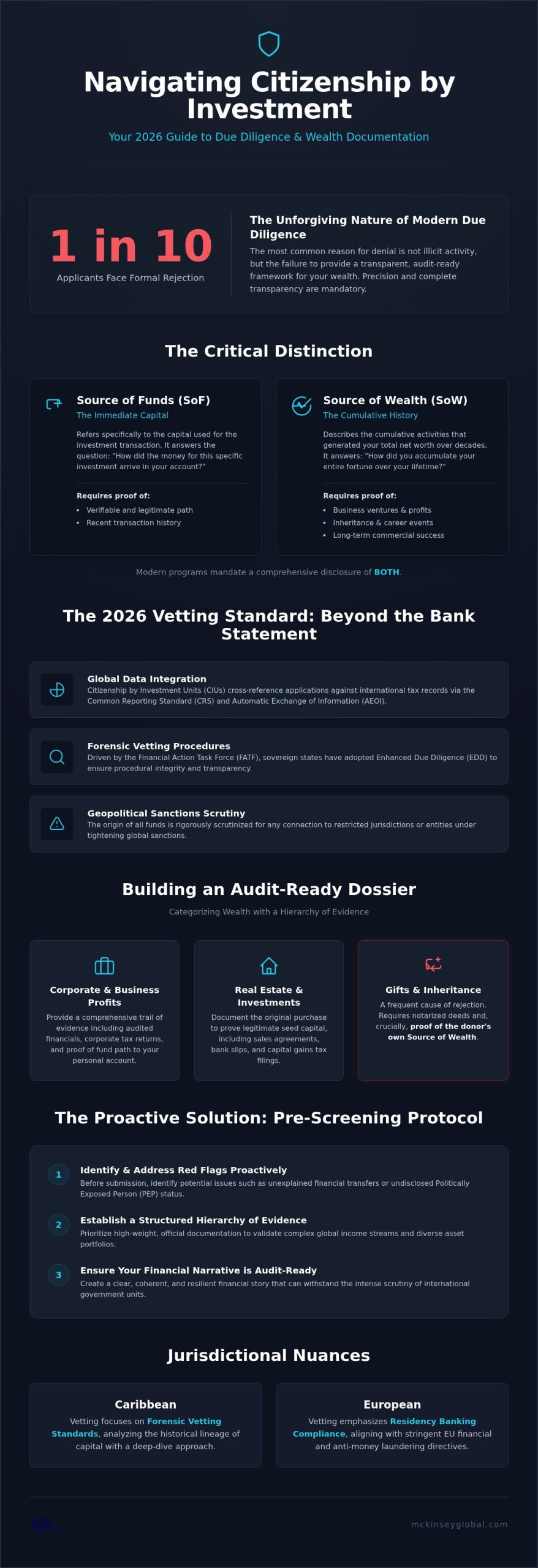
Approximately one in ten citizenship by investment applicants faces a formal rejection, a figure that underscores the unforgiving nature of modern due diligence. Understanding the common reasons for citizenship by investment denial is no longer optional; it’s a prerequisite for high-net-worth individuals seeking global mobility in an era of heightened transparency. You likely recognize that the transition from a private financial history to a public regulatory filing is fraught with technicalities. The anxiety surrounding the disclosure of sensitive wealth origins is a natural response to a process that demands absolute precision and total transparency.
This briefing provides the strategic clarity required to master the complexities of wealth documentation, ensuring your application meets the rigorous 2026 global vetting standards. By aligning your financial history with the expectations of international regulators, you can secure a successful, fast-tracked outcome. We’ll clarify the critical distinctions between Source of Wealth and Source of Funds; additionally, we’ll outline the exact documentation required to ensure your narrative is audit-ready and resilient against the scrutiny of global authorities.
Key Takeaways
- Distinguish between Source of Funds and Source of Wealth to satisfy the holistic transparency requirements of the 2026 regulatory landscape.
- Identify and proactively address common reasons for citizenship by investment denial, such as unexplained financial transfers or undisclosed PEP status, before formal submission.
- Establish a structured hierarchy of evidence that prioritizes high-weight documentation to validate complex global income streams and diverse asset portfolios.
- Navigate the specific jurisdictional nuances between Caribbean forensic vetting standards and European residency banking compliance with strategic precision.
- Implement a rigorous pre-screening protocol to ensure your financial narrative is audit-ready and resilient against the scrutiny of international government units.
Defining Source of Funds in the 2026 Regulatory Landscape
The regulatory environment governing Immigrant investor programs has undergone a fundamental transformation as we enter 2026. This shift is largely driven by the Financial Action Task Force (FATF), which has pressured sovereign states to adopt more forensic vetting procedures. In this high-stakes environment, one of the most common reasons for citizenship by investment denial is not necessarily the presence of illicit activity, but rather the failure of an applicant to provide a transparent, audit-ready architectural framework for their wealth. Even when funds are entirely legitimate, a lack of documentation precision can lead to a summary rejection by government authorities who prioritize procedural integrity above all else.
Source of Funds (SoF) vs. Source of Wealth (SoW)
Understanding the technical distinction between these two concepts is the first step in a compliant application. Source of Funds refers specifically to the immediate capital used for the investment transaction; it requires proof that the money sitting in your bank account today arrived there through a verifiable and legitimate path. Conversely, Source of Wealth describes the cumulative activities, business ventures, and inheritance events that generated your total net worth over several decades. Modern programs, including the St. Kitts and Nevis citizenship by investment, now mandate a comprehensive disclosure of both. This dual requirement ensures that the investment is not only liquid but also rooted in a history of long-term commercial success and stability.
The 2026 Vetting Standard: Beyond the Bank Statement
In previous cycles, a simple bank reference letter might have sufficed for many jurisdictions. Today, the standard has evolved into Enhanced Due Diligence (EDD), a process that integrates global data from the Common Reporting Standard (CRS) and the Automatic Exchange of Information (AEOI). These frameworks allow Citizenship by Investment Units (CIUs) to cross-reference an applicant’s declarations against international tax records with unprecedented speed. Additionally, the tightening of geopolitical sanctions in 2026 means that the origin of funds is scrutinized for any connection to restricted jurisdictions or entities. To avoid common reasons for citizenship by investment denial, applicants must move beyond the basic bank statement, providing a holistic wealth narrative that accounts for every significant financial milestone in their professional career.
Categorizing Legitimate Wealth: A Documentation Framework
Success in the 2026 regulatory landscape depends on your ability to categorize assets into a structured evidence hierarchy. Government vetting units don’t simply evaluate the total value of your holdings; they analyze the historical lineage of the capital. Incomplete or fragmented dossiers, particularly regarding gifts and inheritances which now require notarized deeds and proof of the donor’s wealth, are frequently cited as reasons for CBI application rejection. Maintaining a forensic approach to documentation is essential to avoid the common reasons for citizenship by investment denial during the preliminary review phase.
Corporate Dividends and Business Profits
If your investment capital originates from business operations, you must provide a comprehensive trail of evidence. This includes audited financial statements, corporate tax returns, and certificates of incumbency that confirm your ownership stake. It’s not enough to present a dividend voucher. You must demonstrate the precise path of funds from the corporate treasury to your personal bank account. The Business Nexus requirement mandates that the entity must have a verifiable commercial purpose and a history of tax compliance in its home jurisdiction.
Real Estate and Investment Portfolio Liquidations
Liquidation of property or securities requires you to document the original purchase to prove that the initial seed capital was legitimate. Vetting officers expect to see sales agreements, bank credit slips, and capital gains tax filings. This level of detail is particularly vital when evaluating your citizenship by investment donation vs real estate strategy, as the origin of the purchase price is often the first point of scrutiny. Cross-border transfers must be supported by evidence that the funds moved through regulated banking channels to ensure long-term stability.
Modern Wealth: Digital Assets and Venture Capital
Digital assets represent a significant challenge for traditional vetting officers due to perceived anonymity. To pass a 2026 review, you must provide exchange statements and wallet histories that track the asset from its acquisition to its fiat exit. Similarly, venture capital wealth requires subscription agreements and exit notices to validate the capital gains. These modern income streams are frequently cited among the common reasons for citizenship by investment denial when the documentation architecture is poor. Engaging in a professional pre-screening of your portfolio ensures that your financial narrative is audit-ready before formal submission.
Jurisdictional Nuances: Caribbean vs. European Standards
The regulatory philosophy governing investment migration varies significantly between the Caribbean basin and the European Union. While both regions demand high levels of transparency, their methods of verification reflect different geopolitical priorities. Caribbean nations have recently tightened their Source of Funds (SoF) protocols to maintain critical Schengen Zone visa-free access; consequently, their vetting units now operate with the forensic intensity of a private intelligence agency. In contrast, European programs often delegate the primary burden of financial verification to the highly regulated banking sector. Understanding these regional discrepancies is vital, as a failure to adapt your documentation to local expectations is among the common reasons for citizenship by investment denial.
The Caribbean Vetting Model: St. Kitts, Antigua, and Beyond
The five Eastern Caribbean programs now operate under a harmonized regulatory framework, overseen by a regional authority that enforces a standardized price floor of US$200,000. These programs, including the various Antigua and Barbuda investment options, prioritize a strict chain of custody for the specific investment amount. A frequent pitfall in this region involves third-party payments; specifically, funds originating from a company or associate rather than the applicant’s personal account often trigger immediate red flags. The Citizenship by Investment Units (CIUs) in these jurisdictions conduct a forensic financial review that tracks capital from its historical origin to the final transaction, leaving no room for unexplained wealth gaps.
The European Union Standard: Portugal, Greece, and Latvia
European “Golden Visa” programs rely heavily on the European Union’s internal banking Know Your Customer (KYC) protocols. When applying for Greece residency by investment, for example, the primary requirement is that funds must originate from a bank account held in the applicant’s name within a regulated jurisdiction. While the initial residency stage focuses on banking compliance, the subsequent path to citizenship, which typically requires five years or more of integration, demands a consistent and transparent Source of Wealth narrative. European authorities act as banking supervisors rather than forensic auditors, yet they remain uncompromising regarding the legality of the capital entering the Eurozone.
In contrast to the structured Caribbean and European models, jurisdictions like Türkiye and the United Arab Emirates offer slightly more flexibility regarding fund origins. However, this flexibility doesn’t imply a lack of scrutiny. It’s significant that Türkiye’s program maintains a rejection rate of approximately 9%, often due to inconsistencies in financial declarations. Regardless of the chosen jurisdiction, providing a fragmented or poorly structured narrative remains one of the most common reasons for citizenship by investment denial across all active global programs.
The Pre-Screening Protocol: Preparing an Audit-Ready Narrative
A meticulous self-audit is the mandatory first step for any high-net-worth individual aiming for a successful application in 2026. One of the common reasons for citizenship by investment denial is the failure to identify internal inconsistencies before they reach a government unit. By conducting a rigorous internal review, you can address potential discrepancies in bank statements or business filings that might otherwise trigger a request for additional information. This proactive approach allows for the correction of technical errors and the preparation of clarifying statements that provide context for your financial history. It’s essential that your documentation doesn’t just exist; it must tell a coherent story of legitimate wealth accumulation.
Identifying and Mitigating Financial Red Flags
Vetting officers are trained to identify specific red flags, such as large cash deposits or unexplained transfers from third parties. If your financial history includes gaps in tax filings or funds originating from high-risk jurisdictions, you must provide a notarized explanation that justifies these anomalies. A Politically Exposed Person (PEP) is an individual who holds, or has held, a prominent public function, a status that triggers maximum Source of Funds scrutiny due to the heightened risk of regulatory and reputational exposure. To mitigate these risks, all non-English documents must be handled by professional translators and properly notarized to ensure they meet international compliance standards. Professional oversight at this stage is the most effective way to address the common reasons for citizenship by investment denial.
The Architecture of the Wealth Narrative
The wealth narrative is a chronological timeline that bridges the gap between your professional CV and your current bank balance. Every significant increase in your net worth must be matched with a corresponding event, such as a business exit, a dividend payout, or a successful investment liquidation. Consistency across all forms and supporting documents is the primary factor in passing due diligence; any contradiction between your reported income and your lifestyle can lead to an immediate rejection. This narrative summary serves as a guide for the vetting officer, providing a clear map of your financial journey. To ensure your application is resilient against the scrutiny of global authorities, we recommend initiating a pre-screening consultation to verify your documentation architecture before formal submission.
Strategic Wealth Advisory: How McKinsey Citizenship Secures Approval
McKinsey Citizenship and Residency Solutions operates as a meticulous gatekeeper, ensuring that every application submitted under our guidance adheres to the highest levels of procedural integrity. We recognize that the common reasons for citizenship by investment denial often stem from a lack of attention to detail during the initial drafting phase. Our internal compliance team functions as a dedicated pre-vetting unit, replicating the forensic scrutiny of government Citizenship by Investment Units (CIUs) to identify and resolve potential issues before they become formal obstacles. This boutique approach prioritizes risk mitigation and long-term stability, ensuring that our clients are never treated as mere data points in a mass-market pipeline.
Boutique Advisory vs. Mass-Market Agencies
Unlike mass-market agencies that focus on volume, we specialize in the architectural planning of complex global portfolios. This high-stakes environment requires a consultant who can navigate the nuanced Turkey vs UAE regulatory differences with strategic foresight. We understand that a wealth structure suitable for a Caribbean forensic review may require significant adaptation for a European residency path. By maintaining a high register of confidentiality and precision, we act as a steady guide through the increasingly complex international regulatory landscape, providing the clarity needed to minimize uncertainty at every stage of the process.
Next Steps: Your Strategic Consultation
The journey toward a successful outcome begins with a comprehensive financial evaluation. During this initial phase, our advisors work closely with you to map out your financial history and identify any documentation gaps that could lead to common reasons for citizenship by investment denial. We then build an irrefutable wealth narrative that aligns your professional achievements with your capital origins, ensuring that your file is resilient against the scrutiny of global auditors. This methodical process provides the assurance that your application is not only compliant but strategically positioned for approval. We invite you to contact McKinsey Citizenship for a confidential assessment to secure your global future with absolute precision.
Securing Your Global Legacy Through Procedural Excellence
The 2026 regulatory landscape requires more than just capital; it demands a flawlessly constructed financial narrative that withstands the forensic scrutiny of international authorities. By mastering the distinction between Source of Funds and Source of Wealth, you can proactively mitigate the common reasons for citizenship by investment denial that often stall high-net-worth applications. Success depends on the alignment of complex variables through a rigorous pre-screening protocol and the architectural planning of your documentation.
As an independent boutique advisory with over five years of strategic experience, McKinsey Citizenship specializes in the high-stakes compliance and wealth narratives essential for both Caribbean and European programs. We operate as your dedicated gatekeeper, providing the meticulous oversight required to navigate these intricate international requirements with total confidence. Our focus remains on your long-term stability and the preservation of your global mobility through every stage of the vetting process.
Secure your global future with a strategic citizenship consultation at McKinsey Citizenship. Your transition to a new jurisdiction is a significant strategic milestone; we’re here to ensure it’s executed with the precision and discretion it deserves.
Frequently Asked Questions
What is the difference between Source of Funds and Source of Wealth?
Source of Funds refers specifically to the immediate capital utilized for the investment transaction; it requires proof that the specific amount was acquired legitimately and moved through regulated channels. Source of Wealth is a broader concept that describes the lifetime activities, business ventures, and inheritance events that generated your total net worth. Vetting units mandate a comprehensive disclosure of both to ensure that your current liquidity is rooted in a history of long-term commercial success.
Can I use cryptocurrency to pay for citizenship by investment in 2026?
Direct payment in cryptocurrency is generally not accepted by government Citizenship by Investment Units in 2026. Applicants must typically liquidate digital assets into a regulated fiat currency through an established financial exchange. You’ll be required to provide a comprehensive audit trail, including exchange statements and wallet histories, to prove the original acquisition of the crypto assets and the subsequent path of funds into your personal bank account.
What happens if I cannot document the original source of my wealth from 20 years ago?
If primary documentation from several decades ago is unavailable, you must provide a credible and notarized wealth narrative supported by secondary evidence. This might include historical bank letters, news articles, or affidavits from professional advisors who oversaw the transactions. Vetting officers prioritize the logical consistency of your financial timeline; therefore, we help you reconstruct an audit-ready history that justifies your current net worth despite missing legacy records.
Do I need to provide tax returns for my citizenship application?
Yes, personal and corporate tax returns are standard requirements for most investment migration programs. These documents serve as primary evidence to validate that your income has been declared and processed through regulated fiscal channels. Providing certified tax filings for the last three to five years is a critical step in ensuring your application is audit-ready and resilient against the scrutiny of international vetting officers who prioritize tax transparency.
Can a third party, such as a parent or business partner, provide the funds for my investment?
Third-party funding is permissible in many jurisdictions, provided the donor undergoes the same rigorous due diligence as the main applicant. You must provide a formal deed of gift or a loan agreement, alongside comprehensive Source of Wealth documentation for the individual or entity providing the capital. Failure to prove the legitimacy of the donor’s wealth is another of the common reasons for citizenship by investment denial in 2026.
How far back does the due diligence process look into my financial history?
Due diligence typically focuses on the last ten years of your financial activity regarding bank statements and tax filings. However, the investigation into your Source of Wealth is holistic and can extend to the very beginning of your professional career. Vetting units analyze the entire arc of your wealth accumulation to ensure that the initial seed capital for your business ventures was acquired through legitimate and verifiable professional means.
What are the most common reasons for an application being rejected based on Source of Funds?
The most frequent causes for rejection include unexplained large cash deposits, fragmented documentation that fails to show a clear path of funds, and the use of third-party donors without sufficient background checks. Inconsistencies between your professional CV and your reported income also trigger red flags. Applications are often denied when the financial narrative feels disjointed, representing one of the most common reasons for citizenship by investment denial across global programs.
Is my financial information kept confidential during the vetting process?
Your financial information is handled with the highest register of discretion by McKinsey Citizenship and Residency Solutions and the respective government units. While your data is shared with authorized third-party due diligence firms and international law enforcement agencies for vetting purposes, it remains protected under strict confidentiality protocols. These entities are legally bound to maintain the security of your sensitive history, ensuring that your privacy is preserved throughout the process.