For the modern British investor, a single passport is no longer a mark of global freedom; it is a point of strategic vulnerability. You likely recognize that the post-Brexit landscape has introduced significant friction into once-seamless European travel and complicated your long-term fiscal planning. Securing a second citizenship for UK nationals has evolved from a luxury pursuit into a fundamental requirement for risk mitigation and global mobility. This necessity is driven by a desire for stability in an increasingly volatile geopolitical climate.
We understand that your objectives extend beyond simple travel convenience. You’re seeking a disciplined approach to portfolio diversification and legally compliant tax mitigation that secures your family’s legacy for generations. This strategic guide provides a definitive analysis of the most secure and tax-efficient investment pathways available in 2026. We’ll examine the rigorous vetting processes of Caribbean programs, the shifting residency requirements in Europe, and the precise regulatory hurdles you must clear to ensure your global standing remains unimpeachable.
Key Takeaways
- Analyze the 2026 global mobility landscape and the implementation of ETIAS to understand why a second citizenship for UK nationals is now a critical tool for maintaining unrestricted access to the Schengen Area.
- Compare the expedited processing timelines of Caribbean programs with the more gradual residency-to-citizenship pathways offered by European jurisdictions such as Greece and Portugal.
- Evaluate the financial implications of citizenship by investment donation versus real estate strategies to ensure your capital is deployed in a manner that balances immediate costs with long-term portfolio growth.
- Navigate the complexities of international due diligence by mastering the documentation standards for Source of Wealth and Source of Funds required by modern regulatory frameworks.
- Discover how a bespoke migration strategy aligns your investment choice with specific fiscal goals, lifestyle preferences, and generational security requirements.
The Strategic Necessity of Second Citizenship for UK Nationals in 2026
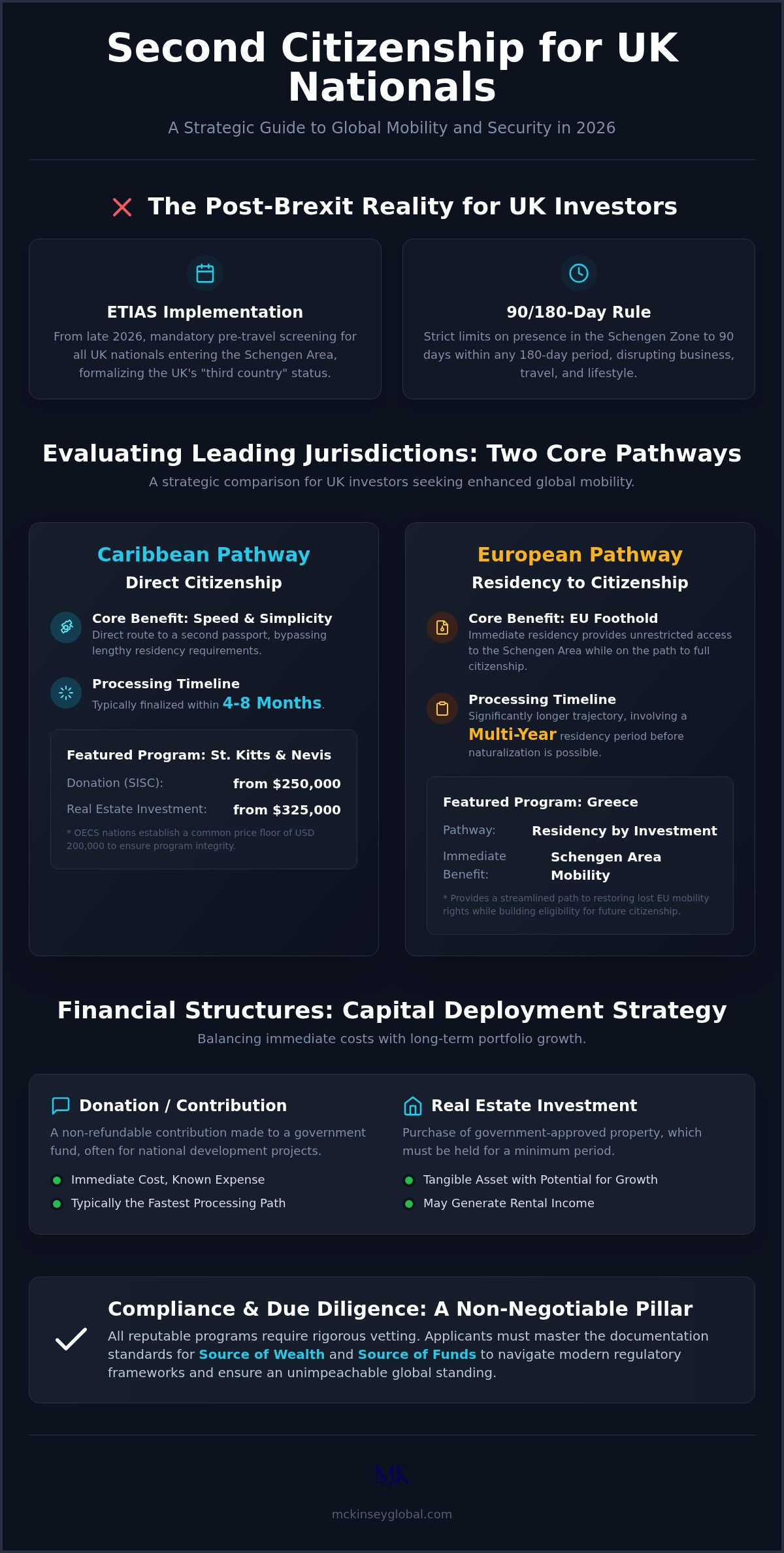
The geopolitical environment of 2026 requires a more sophisticated approach to personal sovereignty than was necessary a decade ago. For British passport holders, the post-Brexit transition has moved beyond mere political rhetoric into a daily reality of restricted movement and increased oversight. The implementation of the ETIAS travel authorization system in late 2026 has formalized the UK’s status as a third country, introducing mandatory pre-travel screening for all Schengen Area visits. In this context, obtaining a second citizenship for UK nationals is no longer an optional luxury. It’s a calculated response to a more rigid global mobility landscape.
Beyond travel, jurisdictional diversification acts as a vital hedge against domestic fiscal volatility. Relying on a single jurisdiction for your legal identity and tax residency exposes your wealth to the shifting priorities of a single government. By diversifying your citizenship, you create a buffer against unpredictable changes in tax law or capital controls. The concept of Multiple citizenship provides the legal framework for this diversification, allowing you to maintain your British identity while securing the rights and protections of a second sovereign state.
Restoring EU Mobility Post-Brexit
The 90/180-day rule continues to be the primary friction point for UK investors with interests in Europe. This regulation strictly limits your presence in the Schengen Area to 90 days within any 180-day window, a constraint that disrupts both business operations and personal lifestyle. Utilizing Greece Residency by Investment offers a streamlined path to restoring these lost mobility rights. While residency provides the immediate benefit of unrestricted travel within the Schengen zone, it’s essential to distinguish it from full citizenship. Residency grants you the right of stay, but citizenship offers the permanent right of settlement and the security of an EU-compatible passport.
The “Plan B” Philosophy: Security and Stability
A second home in a neutral jurisdiction provides a necessary sanctuary during periods of regional or global instability. This “Plan B” philosophy isn’t about immediate relocation. It’s about having a verified, legal exit strategy that can be activated instantly. Security is also a generational consideration. Most investment-based programs allow for the inclusion of dependents, ensuring that your children and grandchildren inherit the same global access and security you’ve secured. This creates a legacy of mobility that is immune to the political shifts of any single nation. In an era of high-stakes precision, having a secure, alternative base is the ultimate mark of a disciplined wealth strategy.
Evaluating Leading Jurisdictions: Caribbean vs. European Pathways
Selecting the optimal jurisdiction for second citizenship for UK nationals requires a meticulous evaluation of your timeline, budget, and mobility objectives. Caribbean programs offer a direct route to a second passport, often finalized within four to eight months. In contrast, European pathways focus on residency by investment, providing a legal foothold in the Schengen Area with a significantly longer trajectory toward full naturalization. It’s vital to confirm that your chosen path aligns with the UK government’s rules on dual citizenship, which remains permitted for British citizens in 2026.
Caribbean Excellence: Antigua, St. Kitts, and St. Lucia
The Caribbean region remains the primary choice for investors prioritizing speed and immediate global access. Following the OECS Memorandum of Agreement, a common price floor of USD 200,000 is established across these jurisdictions to ensure program integrity. The St. Kitts and Nevis citizenship by investment program is frequently cited as the industry benchmark, requiring a USD 250,000 contribution to the Sustainable Island State Contribution or a USD 325,000 real estate investment. For larger families, the Antigua and Barbuda investment options present a highly efficient structure, with the National Development Fund starting at USD 230,000 for a family of up to four. These programs require no physical residency, though applicants must now navigate mandatory biometric collection and formal interviews implemented as of early 2026.
European Residency: Portugal and Greece
European programs serve a distinct strategic purpose, focusing on long-term settlement and eventual EU citizenship. In Portugal, the removal of the real estate option in late 2023 has redirected capital into qualifying funds, requiring a €500,000 investment. While the processing backlog is currently estimated at 39.6 months, the seven-day annual stay requirement remains the lowest in Europe. Greece offers a tiered threshold system: €800,000 for prime areas including Athens and Mykonos, or €400,000 in most other regions, provided the property exceeds 120 square meters. These pathways are ideal if your goal is a permanent base within the European Union rather than immediate passport issuance. To determine which jurisdiction best serves your specific fiscal profile, you may wish to consult with a specialist advisor to review your options.
Financial Structures: Donation, Real Estate, and Capital Investment
Decisions regarding second citizenship for UK nationals hinge on the alignment of capital allocation with long-term liquidity requirements. Most jurisdictions offer two primary pathways: a non-refundable contribution to a national fund or a recoverable investment in government-approved assets. Before committing capital, it’s essential to consult the UK Government Guidance on Dual Citizenship to ensure your strategy remains compliant with domestic regulations. Each structure carries distinct risk-return profiles that must be meticulously weighed against your broader financial objectives.
A thorough evaluation of citizenship by investment donation vs real estate strategies reveals that the choice often depends on the size of the applicant’s family and their appetite for asset management. While donations offer simplicity, real estate provides a tangible asset that may appreciate over time. Both routes require a clear understanding of the total cost of acquisition, including government fees and due diligence costs.
The Donation Route: Speed and Simplicity
The donation model is characterized by its procedural efficiency and lower initial capital outlay. For a main applicant and up to three dependents, the National Development Fund in Antigua and Barbuda requires a contribution of USD 230,000. St. Kitts and Nevis has established its threshold at USD 250,000 for a similar family structure. These funds are utilized for national infrastructure and social projects. They are non-refundable. For many UK investors, the lack of ongoing management makes this the most disciplined choice for rapid acquisition. It eliminates the complexities of property maintenance and local tax obligations.
The Real Estate Route: Asset-Backed Citizenship
Investors seeking capital preservation often opt for government-approved real estate. In St. Kitts and Nevis, the minimum investment for such projects is USD 325,000. These developments are typically luxury resorts or high-end condominiums that have undergone rigorous government vetting. Most Caribbean jurisdictions mandate a holding period, often five to seven years, before the asset can be resold to another citizenship applicant. During this period, the property can generate rental yields. However, these returns are subject to local management fees and tourism market fluctuations. It’s a strategy that favors those who view citizenship as a component of a broader international property portfolio.
Alternative capital investment routes also exist, particularly within European frameworks. Portugal’s primary route now involves a €500,000 investment in qualifying funds, such as private equity or venture capital. This route avoids the physical overhead of real estate while offering exposure to diversified European markets. Regardless of the chosen structure, the focus must remain on the security of the investment and the procedural integrity of the host nation.
Compliance and Due Diligence: Navigating the Vetting Landscape
In 2026, the procedural rigor required to secure a second citizenship for UK nationals has reached an unprecedented level of scrutiny. This intensification is a response to global regulatory pressures and the need for host nations to protect the integrity of their sovereign borders. The vetting process typically follows a four-tier structure: initial internal screening by the advisory, background checks by specialized international firms, verification against global databases such as Interpol and Europol, and a final review by the host government’s intelligence unit. Failure to provide granular detail during these stages often results in immediate application rejection.
Source of Wealth (SoW) and Source of Funds (SoF) documentation remains the most challenging hurdle for sophisticated investors. You must provide a clear, chronological narrative of how your capital was accumulated, supported by tax returns, audited accounts, and dividend vouchers. For UK nationals with interests in multiple jurisdictions or complex trust structures, this requirement demands meticulous preparation to avoid any perception of ambiguity. A disciplined advisory ensures that every financial trail is fully transparent before the application is formally submitted.
Documentation and Procedural Integrity
The success of your application depends on the absolute accuracy of your supporting documentation. Standard requirements include certified birth certificates, marriage licenses, and professional references from recognized legal practitioners. If your wealth is held within complex corporate frameworks, you must disclose the ultimate beneficial ownership of every entity involved. All documents must undergo a formal legalization process, typically involving an Apostille, to be recognized internationally. Neglecting these procedural details is a common pitfall that can delay processing by several months.
Maintaining Compliance Post-Acquisition
Your obligations do not end upon the issuance of a second passport. As a dual national, you must follow the UK’s specific entry requirements, such as the February 2026 mandate for British citizens to use their UK passport when entering the country. You must also adhere to global transparency standards like the Common Reporting Standard (CRS). To ensure your global strategy remains fully compliant, you should engage with a professional consultant for ongoing oversight.
Bespoke Migration Strategy with McKinsey Citizenship Solutions
High-net-worth individuals require a level of precision that transcends standard application processing. For those evaluating second citizenship for UK nationals, the complexity of 2026 regulations demands a bespoke framework. Our methodology focuses on the meticulous alignment of your capital with your specific lifestyle and fiscal objectives. We operate as a strategic partner rather than a simple brokerage. This ensures your migration path is fully integrated into your broader wealth management and generational security strategy.
Our end-to-end management covers every phase of the acquisition process. We leverage a global network of legal and financial experts to navigate the four-tier vetting process with absolute accuracy. Whether you’re pursuing St. Kitts and Nevis citizenship or a Portugal Golden Visa, we provide the steady guidance needed to maintain procedural integrity. By maintaining these rigorous standards, we minimize the uncertainty often associated with international regulatory hurdles. This disciplined approach provides the clarity necessary for high-stakes international planning.
Jurisdictional Comparison Tool
Selecting the correct jurisdiction involves balancing immediate mobility needs with long-term regional stability. For many UK investors, the choice involves comparing Turkey vs UAE residency by investment models. While Türkiye offers a direct path to citizenship through strategic capital investment, the United Arab Emirates provides sophisticated residency solutions within a premier global financial hub. We help you evaluate these options based on family requirements, tax residency goals, and future exit strategies. Our partnership extends beyond the initial acquisition, providing ongoing support as global standards evolve.
Contact Our Strategic Advisors
Securing your global future requires an advisor who understands the gravity of your decision. We offer confidential consultations to review your eligibility for elite programs across the Caribbean, Europe, and the Middle East. Our advisors provide the insight needed to navigate complex international landscapes with confidence and discretion. You’ll receive a thorough evaluation of your options, ensuring that your chosen pathway aligns with your long-term risk mitigation goals. Take the next step in your global strategy by initiating a formal review of your eligibility for second citizenship for UK nationals.
Securing Your Global Standing in an Evolving Landscape
The transition into the 2026 regulatory environment has solidified the status of a second passport as a vital component of a resilient wealth strategy. By navigating the complexities of Caribbean investment thresholds or European residency requirements, you effectively restore the mobility and security that a single jurisdiction can no longer guarantee. This process requires a disciplined adherence to meticulous compliance and vetting standards to ensure your application remains unimpeachable. It’s a high-stakes undertaking that demands professional oversight and precise execution.
McKinsey Citizenship and Residency Solutions brings over five years of strategic investment migration experience to every engagement, with a specialized focus on the unique requirements of HNW UK nationals. We provide the steady guidance necessary to align your global ambitions with precise jurisdictional requirements. We invite you to Consult with our Strategic Advisors on your Second Citizenship Strategy to initiate a confidential review of your eligibility. Establishing a second citizenship for UK nationals is a definitive step toward long-term stability and generational peace of mind. Your future global access starts with a disciplined and compliant plan.
Frequently Asked Questions
Is it legal for a UK national to hold a second citizenship?
Yes, the United Kingdom continues to permit dual nationality as of March 2026. This allows you to hold a second citizenship for UK nationals without forfeiting your British status or legal protections. You should note the regulation implemented on February 25, 2026, which requires dual British citizens to use their British passport or a certificate of entitlement when entering the UK. This legal framework ensures your global diversification strategy remains fully compliant with domestic law.
Which second citizenship program is the fastest for UK citizens in 2026?
Caribbean programs currently offer the most efficient processing timelines for investors seeking rapid results. Jurisdictions such as Antigua and Barbuda or St. Kitts and Nevis typically finalize applications within four to eight months. This is significantly faster than European residency programs, which often require five to ten years of legal residency before you can apply for naturalization. These fast-track options for second citizenship for UK nationals are ideal if you require immediate global mobility.
Will I lose my UK passport if I acquire a second citizenship by investment?
Acquiring a second citizenship through a government-approved investment program doesn’t result in the loss of your UK passport. The British government recognizes multiple nationality, allowing you to maintain all rights and privileges associated with your original citizenship. Your new passport serves as a secondary travel document and a point of jurisdictional redundancy. It’s a strategic addition to your identity rather than a replacement for your British nationality and its associated legal protections.
What are the tax implications of second citizenship for UK residents?
Holding a second citizenship doesn’t automatically alter your UK tax obligations. The UK tax system is primarily based on your residency and domicile status rather than your nationality. While a second passport provides the legal right to relocate to a tax-efficient jurisdiction, you must still adhere to UK statutory residence tests. We recommend consulting with a qualified fiscal advisor to ensure your global strategy aligns with current international tax reporting standards and requirements.
Can my family be included in a citizenship by investment application?
Most investment-based programs allow you to include immediate family members within a single application. This typically encompasses your spouse and dependent children under the age of 30. Some jurisdictions also permit the inclusion of dependent parents or grandparents over the age of 55. Including your family ensures the benefits of global mobility and generational security are extended to your heirs, creating a permanent legacy of freedom that is transferable through future generations.
Which program offers the best visa-free access for British nationals?
For British nationals, a St. Kitts and Nevis passport currently offers the most comprehensive visa-free access among Caribbean programs, covering over 155 destinations. Grenada also remains a strong contender with access to 144 destinations. While your UK passport is already powerful, these secondary documents provide essential redundancy and unrestricted access to regions that may face diplomatic shifts. They ensure your ability to travel remains unimpeded regardless of regional geopolitical changes or new entry requirements.
What is the minimum investment required for a second citizenship in 2026?
The minimum investment for a reputable citizenship program is currently established at USD 200,000. This common price floor was formalized by the OECS Memorandum of Agreement to ensure the long-term integrity of Caribbean programs. For example, the Dominica Economic Diversification Fund requires this amount for a single applicant. You should also account for additional government processing fees, mandatory biometric collection costs, and professional due diligence fees, which vary depending on your family size.
How does the vetting process work for UK high-net-worth individuals?
The vetting process for high-net-worth individuals is a rigorous, four-tier procedure designed to ensure absolute compliance. It begins with an initial internal screening followed by exhaustive checks conducted by independent international due diligence firms. Applications are then cross-referenced against global law enforcement databases, including Interpol. Finally, the host nation’s intelligence unit performs a definitive review. This meticulous scrutiny, which includes mandatory biometric collection as of April 2026, protects the program’s reputation and ensures procedural integrity.